
Testing Times Ahead for India Inc
India was recently seen to be in a “Goldilocks” phase, with strong growth and relatively manageable macroeconomic pressures. That balance looks more fragile now.
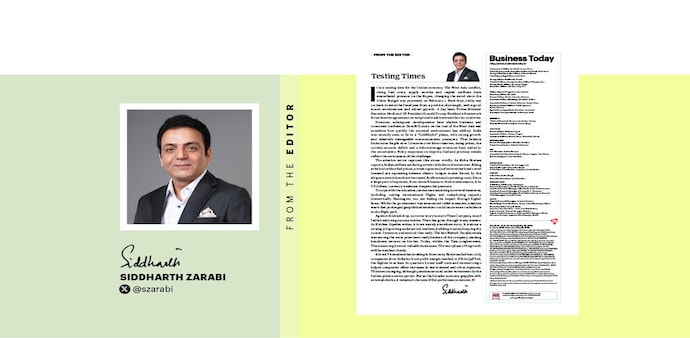
- May 24, 2026,
- Updated May 24, 2026 1:16 PM IST
It is a testing time for the Indian economy. The West Asia conflict, rising fuel costs, supply worries and capital outflows have exacerbated pressure on the Rupee, changing the mood since the Union Budget was presented on February 1. Back then, India was on track to enter the fiscal year from a position of strength, with a good macro environment and robust growth. A day later, Prime Minister Narendra Modi and US President Donald Trump finalised a framework for an interim agreement on reciprocal trade between the two countries.
However, subsequent developments have shaken business and consumer confidence. Surabhi’s story on the cost of the West Asia war examines how quickly the external environment has shifted. India was recently seen to be in a “Goldilocks” phase, with strong growth and relatively manageable macroeconomic pressures. That balance looks more fragile now. Concerns over forex reserves, rising prices, the current account deficit and a below-average monsoon have added to the uncertainty. Policy responses on imports, fuel and precious metals reflect the seriousness of the challenge.
The aviation sector captures this stress vividly. As Richa Sharma reports, Indian airlines are facing severe turbulence this summer. Rising aviation turbine fuel prices, a weak rupee and softer international travel demand are squeezing balance sheets. Longer routes forced by the airspace restrictions have increased fuel burn and operating costs. Since a large part of expenses, from aircraft leases to their maintenance, is in US dollars, currency weakness deepens the pressure.
To cope with the situation, carriers are resorting to several measures, including cutting international flights and redeploying capacity domestically. Passengers, too, are feeling the impact through higher fares. While the government has announced relief measures, analysts warn that prolonged geopolitical tensions could cause more turbulence in the flight path.
Against this backdrop, our cover story turns to Titan Company, one of India’s enduring success stories. Titan has gone through many avatars. As Krishna Gopalan writes, it is not merely a numbers story. It is about a strategy of spotting underserved markets, building trust and staying the course. Investors understood that early. The late Rakesh Jhunjhunwala was among the most prominent early backers of the company, earning handsome returns on his bet. Today, within the Tata conglomerate, Titan is among its most valuable businesses. The next phase of its growth will be watched closely.
It is not Titan alone that is raking in the money. Early results from 1,665 companies show India Inc’s net profit margin reached 12.8% in Q4FY26, the highest in at least 60 quarters. Lower staff costs and interest outgo helped companies offset increases in raw material and other expenses. This is encouraging, although questions around under-investment by the Indian private sector persist. But as the broader economy grapples with external shocks, it remains to be seen if this performance ensures. @szarabi
It is a testing time for the Indian economy. The West Asia conflict, rising fuel costs, supply worries and capital outflows have exacerbated pressure on the Rupee, changing the mood since the Union Budget was presented on February 1. Back then, India was on track to enter the fiscal year from a position of strength, with a good macro environment and robust growth. A day later, Prime Minister Narendra Modi and US President Donald Trump finalised a framework for an interim agreement on reciprocal trade between the two countries.
However, subsequent developments have shaken business and consumer confidence. Surabhi’s story on the cost of the West Asia war examines how quickly the external environment has shifted. India was recently seen to be in a “Goldilocks” phase, with strong growth and relatively manageable macroeconomic pressures. That balance looks more fragile now. Concerns over forex reserves, rising prices, the current account deficit and a below-average monsoon have added to the uncertainty. Policy responses on imports, fuel and precious metals reflect the seriousness of the challenge.
The aviation sector captures this stress vividly. As Richa Sharma reports, Indian airlines are facing severe turbulence this summer. Rising aviation turbine fuel prices, a weak rupee and softer international travel demand are squeezing balance sheets. Longer routes forced by the airspace restrictions have increased fuel burn and operating costs. Since a large part of expenses, from aircraft leases to their maintenance, is in US dollars, currency weakness deepens the pressure.
To cope with the situation, carriers are resorting to several measures, including cutting international flights and redeploying capacity domestically. Passengers, too, are feeling the impact through higher fares. While the government has announced relief measures, analysts warn that prolonged geopolitical tensions could cause more turbulence in the flight path.
Against this backdrop, our cover story turns to Titan Company, one of India’s enduring success stories. Titan has gone through many avatars. As Krishna Gopalan writes, it is not merely a numbers story. It is about a strategy of spotting underserved markets, building trust and staying the course. Investors understood that early. The late Rakesh Jhunjhunwala was among the most prominent early backers of the company, earning handsome returns on his bet. Today, within the Tata conglomerate, Titan is among its most valuable businesses. The next phase of its growth will be watched closely.
It is not Titan alone that is raking in the money. Early results from 1,665 companies show India Inc’s net profit margin reached 12.8% in Q4FY26, the highest in at least 60 quarters. Lower staff costs and interest outgo helped companies offset increases in raw material and other expenses. This is encouraging, although questions around under-investment by the Indian private sector persist. But as the broader economy grapples with external shocks, it remains to be seen if this performance ensures. @szarabi