
India will not bow, kneel before anyone: Commerce Minister Piyush Goyal
India will not bow, kneel before anyone: Commerce Minister Piyush Goyal
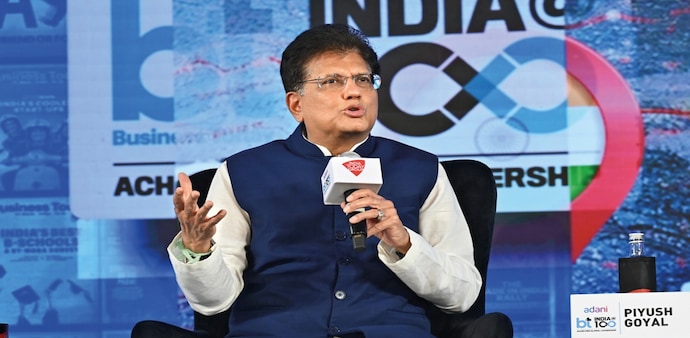
Piyush Goyal, Union Minister of Commerce and Industry, on India's new trade playbook, high-stakes negotiations and the road ahead.
Siddharth Zarabi
- Aug 21, 2025,
- Updated Aug 21, 2025 3:43 PM IST
It is a charged moment in the world economy, and India stands right at the heart of it. As the global trade order rewires and nations rethink their economic alliances, India’s commerce and trade policy has never been more consequential. At this high-stakes moment, Commerce and Industry Minister Piyush Goyal joined BT at the India@100 event to help decode the new trade order and India’s strategic playbook for navigating it. Edited excerpts from an exclusive conversation with Siddharth Zarabi and Gaurav Sawant:
Advertisement
SZ: At a time when global investors are very keenly looking at India, how are we shaping our engagement with the world?
A: The world keeps evolving, international trade keeps finding new pathways. What we are seeing today is possibly just a churn that happens every few years. Every few years, new countries come up, some countries go down. This is part of the history of nations. I think this is India’s time (Yeh Bharat ka samay hai). What I can see right before my eyes is how Prime Minister Narendra Modi inspired the whole nation, how he raised the nation’s morale, how he called upon the nation—this country will not bow; it will not kneel before anyone. Now, whether it’s our farmers, our livestock breeders, our retail traders, our small industries, entrepreneurs linked to micro or small units—the government takes care of their interests; we handle the nation’s affairs with public interest and national interest as the priority. India will have a place in this new world order.
Advertisement
The world recognises India’s strengths, recognises our demographic advantages, and what 1.4 billion aspirational Indians bring to the table in terms of demand
-Piyush Goyal, Commerce Minister
GS: PM Modi often says he turns every stone thrown at him into a stepping stone. What are the stones being thrown at India right now and where do you see the opportunity in adversity?
A: I don’t see stones being thrown at us. India’s morale and capabilities are strong. Take Y2K in 1999: the world feared a crash, but (then PM) Atal Bihari Vajpayee’s government saw opportunity. By supporting the information technology sector through software technology parks, a new telecommunications policy, and minimal interference, India built a $300 billion industry that employs millions.
During Covid-19, many predicted starvation and vaccine failure. Rich nations hoarded vaccines, but India developed and produced its own, administering 2.5 billion doses and giving free vaccines to over 100 countries. Not one person died of starvation—800 million people received rations; farmers, railways, power, and coal kept running under strict protocols.
Advertisement
In both crises, India turned adversity into strength, emerging, as I say, like Sita Maiya from agni pariksha (a trial by fire), and came out a winner.
SZ: How can India navigate de-globalisation and the way the trade order is being dismantled? What do you think the playbook will be?
A: I don’t see any de-globalisation. I see countries restructuring their trade routes and partners. I’m quite confident that India’s exports in the current year will be more than what they were last year.
SZ: How would you describe the state of India’s economy, particularly because someone recently called it a ‘dead economy’?
A: I think that was very sad. The whole world is looking up to India. The world recognises us as the fastest-growing large economy. We are contributing 16% of global growth. Our inflation is among the lowest in the world compared with other emerging market economies. Our currency, our foreign exchange reserves, our stock markets, our macroeconomic fundamentals are the best. The world recognises this. The world wants to come and work in India. The world wants to work with India’s 1.4 billion strong young, dynamic, enterprising, aspirational citizens. They recognise the talent and skill of young India. India has a very bright future. It is a matter of shame that the Leader of the Opposition in the Lok Sabha is parroting a negative narrative. I condemn him for that. And frankly, the nation will never forgive Rahul Gandhi for the demeaning comments about the great story that Bharat is demonstrating to the world.
Advertisement
SZ: India is currently engaged in trade negotiations with several countries. How many free trade agreements will we have by 2047?
A: India is much stronger today, much more self-confident, much more respected. We have a decisive leader in PM Modi, who is among the tallest and most respected leaders in the world. Today, we are a country that produces the highest number of STEM (science, technology, engineering and mathematics) graduates every year. We are a country already growing at 6.5% a year, and this will only get better in the years to come. We will, of course, have trading arrangements with other nations with whom we have complementarity, rather than concluding agreements like those done under the previous United Progressive Alliance regime, which did not help Indian business as much as they should have. On the contrary, if you look at our trade agreements, even business in India cannot find fault with them. We have agreements or dialogues with the UAE, Mauritius, Australia, the four-nation EFTA bloc (Switzerland, Norway, Liechtenstein, and Iceland), the UK; we are in dialogue with many other countries—Oman, the EU, the US, Chile, Peru and many others; New Zealand and many others want to start engaging with us. The world recognises India’s strengths, recognises our demographic advantages, and what 1.4 billion aspirational Indians bring to the table in terms of demand. The aggregate demand India has is huge. Why else do you think everybody wants trade or better market access in India?
Advertisement
Whether it’s our farmers, livestock breeders, retail traders, small industries, entrepreneurs—the government takes care of their interests
-Piyush Goyal, Commerce Minister
SZ: There is a view in some quarters that we have given the UK too much access, opened government procurement and certain sectors like alcohol. How would you address such concerns?
A: On government procurement, we have opened larger opportunities in the UK for Indian entrepreneurs, it is two-way traffic. Anyone expecting other nations to open markets to India without reciprocity is being unrealistic. The privileges accorded to the micro, small, and medium enterprises (MSME) sector remain intact; firms from the UK will only be class-two suppliers here. In return, restrictions in the UK won’t apply to Indian companies, unlocking more access to public procurement there.
The UK trade deal took more than 20 years—two decades of lost opportunities—largely because of the opposition over importing alcoholic beverages, mainly Scotch whisky. In exchange for limited access to Scotch, India gains 99% preferential, often zero-duty, access to a high-income UK market ($50,000 per capita). Delays have cost lakhs of crores in exports, thousands of companies, and countless jobs.
We’ve also secured a social security breakthrough: 100,000 Indians on short-term UK visas previously lost 25% of their salaries to the social security system in the UK without benefits. Now, these funds will go into their Indian Provident Fund accounts, earning 8% tax-free interest, saving Rs 8,000–10,000 crore for our youth.
Advertisement
Is protecting the Rs 2,000-crore Scotch market worth sacrificing massive export and employment opportunities for?
SZ: A unique feature of the recent EFTA trade deal is the massive amount of committed investment into India. Please elaborate on this.
A: Earlier, India used to sign free trade agreements and assumed duty concession was the only element that was part of such deals: our goods would be sold duty-free in their country and vice versa. When we were negotiating with the EFTA countries, I told them that India is the fastest-growing large economy in the world with 1.4 billion people, while your economy is growing slowly, and the population is ageing. Maybe your economy will double by 2047; my economy could grow eight times with a projected gross domestic product of $32 trillion. So, what will you give in return to make this a win-win situation?
This had never happened before. There is no free-trade agreement in history in which investment is committed. Here is an investment commitment without a bilateral investment treaty, cast in stone, that says if they do not invest, or do not create jobs in India, the country can claw back their duty concessions.
These four countries committed that they will invest $100 billion in India—that is, Rs 8.5 lakh crore—as foreign direct investment (FDI) in manufacturing, innovation, research, financial services, IT—these are tangible sectors. This does not include foreign institutional investment (FII). The FDI commitment will create 1 million direct jobs. And when Rs 8.5 lakh crore of FDI comes in, there will be Indian partners investing with them, loans will be taken, ecosystems will develop, infrastructure will be built. My estimate is that Rs 50 lakh crore of investment will flow into India over the coming years because of this FDI. One million jobs will be created directly; if you count direct plus indirect, 5 million new jobs will be created in India. The EFTA agreement will come into effect from October 1, and you will start seeing its benefits.
@szarabi
It is a charged moment in the world economy, and India stands right at the heart of it. As the global trade order rewires and nations rethink their economic alliances, India’s commerce and trade policy has never been more consequential. At this high-stakes moment, Commerce and Industry Minister Piyush Goyal joined BT at the India@100 event to help decode the new trade order and India’s strategic playbook for navigating it. Edited excerpts from an exclusive conversation with Siddharth Zarabi and Gaurav Sawant:
Advertisement
SZ: At a time when global investors are very keenly looking at India, how are we shaping our engagement with the world?
A: The world keeps evolving, international trade keeps finding new pathways. What we are seeing today is possibly just a churn that happens every few years. Every few years, new countries come up, some countries go down. This is part of the history of nations. I think this is India’s time (Yeh Bharat ka samay hai). What I can see right before my eyes is how Prime Minister Narendra Modi inspired the whole nation, how he raised the nation’s morale, how he called upon the nation—this country will not bow; it will not kneel before anyone. Now, whether it’s our farmers, our livestock breeders, our retail traders, our small industries, entrepreneurs linked to micro or small units—the government takes care of their interests; we handle the nation’s affairs with public interest and national interest as the priority. India will have a place in this new world order.
Advertisement
The world recognises India’s strengths, recognises our demographic advantages, and what 1.4 billion aspirational Indians bring to the table in terms of demand
-Piyush Goyal, Commerce Minister
GS: PM Modi often says he turns every stone thrown at him into a stepping stone. What are the stones being thrown at India right now and where do you see the opportunity in adversity?
A: I don’t see stones being thrown at us. India’s morale and capabilities are strong. Take Y2K in 1999: the world feared a crash, but (then PM) Atal Bihari Vajpayee’s government saw opportunity. By supporting the information technology sector through software technology parks, a new telecommunications policy, and minimal interference, India built a $300 billion industry that employs millions.
During Covid-19, many predicted starvation and vaccine failure. Rich nations hoarded vaccines, but India developed and produced its own, administering 2.5 billion doses and giving free vaccines to over 100 countries. Not one person died of starvation—800 million people received rations; farmers, railways, power, and coal kept running under strict protocols.
Advertisement
In both crises, India turned adversity into strength, emerging, as I say, like Sita Maiya from agni pariksha (a trial by fire), and came out a winner.
SZ: How can India navigate de-globalisation and the way the trade order is being dismantled? What do you think the playbook will be?
A: I don’t see any de-globalisation. I see countries restructuring their trade routes and partners. I’m quite confident that India’s exports in the current year will be more than what they were last year.
SZ: How would you describe the state of India’s economy, particularly because someone recently called it a ‘dead economy’?
A: I think that was very sad. The whole world is looking up to India. The world recognises us as the fastest-growing large economy. We are contributing 16% of global growth. Our inflation is among the lowest in the world compared with other emerging market economies. Our currency, our foreign exchange reserves, our stock markets, our macroeconomic fundamentals are the best. The world recognises this. The world wants to come and work in India. The world wants to work with India’s 1.4 billion strong young, dynamic, enterprising, aspirational citizens. They recognise the talent and skill of young India. India has a very bright future. It is a matter of shame that the Leader of the Opposition in the Lok Sabha is parroting a negative narrative. I condemn him for that. And frankly, the nation will never forgive Rahul Gandhi for the demeaning comments about the great story that Bharat is demonstrating to the world.
Advertisement
SZ: India is currently engaged in trade negotiations with several countries. How many free trade agreements will we have by 2047?
A: India is much stronger today, much more self-confident, much more respected. We have a decisive leader in PM Modi, who is among the tallest and most respected leaders in the world. Today, we are a country that produces the highest number of STEM (science, technology, engineering and mathematics) graduates every year. We are a country already growing at 6.5% a year, and this will only get better in the years to come. We will, of course, have trading arrangements with other nations with whom we have complementarity, rather than concluding agreements like those done under the previous United Progressive Alliance regime, which did not help Indian business as much as they should have. On the contrary, if you look at our trade agreements, even business in India cannot find fault with them. We have agreements or dialogues with the UAE, Mauritius, Australia, the four-nation EFTA bloc (Switzerland, Norway, Liechtenstein, and Iceland), the UK; we are in dialogue with many other countries—Oman, the EU, the US, Chile, Peru and many others; New Zealand and many others want to start engaging with us. The world recognises India’s strengths, recognises our demographic advantages, and what 1.4 billion aspirational Indians bring to the table in terms of demand. The aggregate demand India has is huge. Why else do you think everybody wants trade or better market access in India?
Advertisement
Whether it’s our farmers, livestock breeders, retail traders, small industries, entrepreneurs—the government takes care of their interests
-Piyush Goyal, Commerce Minister
SZ: There is a view in some quarters that we have given the UK too much access, opened government procurement and certain sectors like alcohol. How would you address such concerns?
A: On government procurement, we have opened larger opportunities in the UK for Indian entrepreneurs, it is two-way traffic. Anyone expecting other nations to open markets to India without reciprocity is being unrealistic. The privileges accorded to the micro, small, and medium enterprises (MSME) sector remain intact; firms from the UK will only be class-two suppliers here. In return, restrictions in the UK won’t apply to Indian companies, unlocking more access to public procurement there.
The UK trade deal took more than 20 years—two decades of lost opportunities—largely because of the opposition over importing alcoholic beverages, mainly Scotch whisky. In exchange for limited access to Scotch, India gains 99% preferential, often zero-duty, access to a high-income UK market ($50,000 per capita). Delays have cost lakhs of crores in exports, thousands of companies, and countless jobs.
We’ve also secured a social security breakthrough: 100,000 Indians on short-term UK visas previously lost 25% of their salaries to the social security system in the UK without benefits. Now, these funds will go into their Indian Provident Fund accounts, earning 8% tax-free interest, saving Rs 8,000–10,000 crore for our youth.
Advertisement
Is protecting the Rs 2,000-crore Scotch market worth sacrificing massive export and employment opportunities for?
SZ: A unique feature of the recent EFTA trade deal is the massive amount of committed investment into India. Please elaborate on this.
A: Earlier, India used to sign free trade agreements and assumed duty concession was the only element that was part of such deals: our goods would be sold duty-free in their country and vice versa. When we were negotiating with the EFTA countries, I told them that India is the fastest-growing large economy in the world with 1.4 billion people, while your economy is growing slowly, and the population is ageing. Maybe your economy will double by 2047; my economy could grow eight times with a projected gross domestic product of $32 trillion. So, what will you give in return to make this a win-win situation?
This had never happened before. There is no free-trade agreement in history in which investment is committed. Here is an investment commitment without a bilateral investment treaty, cast in stone, that says if they do not invest, or do not create jobs in India, the country can claw back their duty concessions.
These four countries committed that they will invest $100 billion in India—that is, Rs 8.5 lakh crore—as foreign direct investment (FDI) in manufacturing, innovation, research, financial services, IT—these are tangible sectors. This does not include foreign institutional investment (FII). The FDI commitment will create 1 million direct jobs. And when Rs 8.5 lakh crore of FDI comes in, there will be Indian partners investing with them, loans will be taken, ecosystems will develop, infrastructure will be built. My estimate is that Rs 50 lakh crore of investment will flow into India over the coming years because of this FDI. One million jobs will be created directly; if you count direct plus indirect, 5 million new jobs will be created in India. The EFTA agreement will come into effect from October 1, and you will start seeing its benefits.
@szarabi
Read more!