
IT stocks have been hit more than they deserve: Happiest Minds Co-Chairman and CEO Joseph Anantharaju
Joseph Anantharaju, Co-Chairman and CEO of Happiest Minds, on automation, IT sell-off and innovation.
- Mar 17, 2026,
- Updated Mar 17, 2026 4:03 PM IST
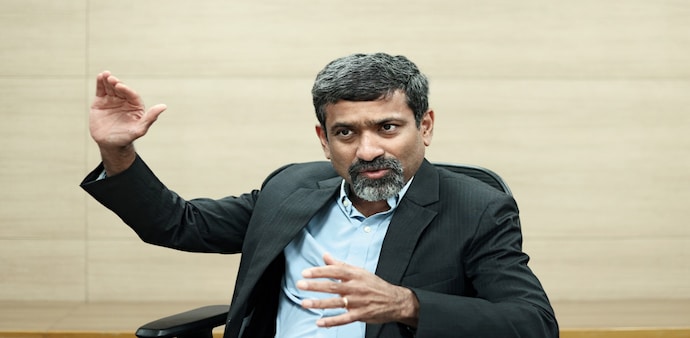
On a quiet afternoon at IT services company Happiest Minds’ headquarters in Bengaluru, Joseph Anantharaju, 55, appears strikingly unruffled. Dressed in a crisp dim grey suit, the company’s Co-Chairman and CEO speaks with an easy smile, radiating a calm that contrasts sharply with the anxiety gripping India’s IT sector where investors have been rattled by rapid advances in artificial intelligence (AI) and emergence of coding agents. For an industry valued at over $300 billion and long hailed as India’s global technology backbone, the narrative has turned unusually pessimistic. Clients are reassessing spending, hiring has slowed, and questions around the future of entry-level roles and traditional services delivery are growing louder. If AI agents can write code, manage workflows, and automate support, will the Indian IT model face a structural disruption?
Anantharaju disagrees. Tools branded as “AI co-workers”, he argues, remain just that—tools. “There will always be a human in the loop,” he says, describing the future as hybrid, where AI accelerates execution but cannot replace the tacit knowledge that enterprises require. In his view, enterprise adoption remains steady and pragmatic, shaped as much by concerns around data privacy, security, and risk as by the promise of productivity gains. The real shift, he says, is evolutionary—of skills, pricing, and a workforce redesigned around deeper technical expertise. Anantharaju believes the AI moment is a recalibration, with the industry learning to treat it as an ally. Edited excerpts:
Q: There is a lot of buzz around AI tools and concerns they could threaten the Indian IT industry. How do you see this?
A: In my view, even if they are being called “co-workers,” the AI agents are still agents. You need somebody to work with that agent. There will always be a human in the loop. I believe we will see a hybrid set-up, whether on the workflow side or the engineering lifecycle side.
From an IT perspective, even if you deploy AI agents, you must first understand how a company’s business workflow functions and map that accurately. That cannot be automated end-to-end—much of the logic and context resides in people’s tacit knowledge. While AI may accelerate application development once this is translated, critical elements such as data collection, system interaction, governance, and integration still need deliberate design and oversight.
The threat narrative is being overplayed. The pace of AI adoption in enterprises is measured. While there is significant discussion globally about potential risks and opportunities, enterprise behaviour reflects an approach focused on efficiency and productivity gains, and addressing customer data protection and security concerns, rather than panic.
Q: Are enterprises hesitant about adopting such tools due to data privacy concerns? Is that an advantage for IT services companies?
A: Yes, that is an advantage. It won’t be easy for enterprises to jump in blindly. For example, if you use one enterprise solution and want to build something using an AI agent, where will all the customer interaction data go? While AI can interpret data and even automate outreach, the data must still reside somewhere, with proper data models and workflows.
Some claim software-as-a-service will disappear. I don’t believe that. Some front-end layers may get replaced, but systems of record and core workflows will still be required. And once those exist, you need IT firms to implement and manage them.
There are serious concerns. Even private versions of these tools are used to train models. Customers worry about data privacy. Many are embedding clauses in Master Service Agreements stating that AI tools cannot be used without explicit approval.
Q: Indian IT has spent decades delivering services to global enterprises. Why hasn’t that experience translated into globally scaled product companies or innovation-led giants?
A: We are 25 years into this century, so, many people don’t remember the environment in which Indian IT began in the 1980s. In the ’80s and early ’90s, regulatory constraints such as foreign exchange controls and import restrictions limited the ability to build globally scaled product businesses. Establishing credibility with international clients was a challenge, and Y2K became the turning point that led to rapid growth.
Once services demand accelerated, companies prioritised scaling delivery and execution, which offered steady profits and resilience through disruptions like the dot-com bust and the global financial crisis in 2008. Innovation did occur, and firms like Happiest Minds have created AI-driven recommendation engines. However, these often remained embedded within services rather than evolving into standalone products.
Q: What kind of job losses are we realistically looking at in the Indian IT sector? What replaces those roles?
A: One reason firms haven’t hired freshers is not automation—it’s uncertainty. Companies don’t want to commit to large numbers. At Happiest Minds, we were prepared to hire, but decisions have to be made months in advance. With elections, geopolitical uncertainty, and tariffs, we decided to hold back. Customers are also hesitant. If a supply-chain decision goes wrong due to policy changes, senior executives could lose jobs. So, people are cautious.
There is some impact of automation—I don’t deny that. But uncertainty is the bigger factor right now.
That said, productivity improvements are possible, particularly in infrastructure services. We saw that with remote process automation [which can efficiently automate repetitive manual computing tasks]. It delivered 30–40% productivity gains, forcing people to reskill. It happened earlier with testing. Something similar will happen in coding.
The middle layer will be squeezed. People with strong technical depth—code, architecture, design—will remain in demand. Agents and junior developers using AI tools can build faster, but you still need experts to validate and troubleshoot.
The industry that concerns me most is IT-enabled services and customer service. In limited contexts, agents are already smarter than humans. They’re trained on company-specific data and customer history. Basic conversations can be replaced unless emotional or complex judgement is required.
Q: As AI improves productivity and reduces employee costs or bench strength, won’t clients push for lower pricing?
A: You have to look at this through the lens of the three revenue models—time & material (T&M), fixed price, and outcome-based pricing.
In fixed-price projects, AI-driven productivity is now widely expected. Customers expect efficiency gains, but firms also need to retain a part of those gains to offset investments in AI tools and training. Overall, customers benefit from reduced timelines and costs.
In the T&M model, productivity gains often accrue to customers, who expect more output from the same team. The industry is exploring ways to price AI-skilled engineers at a premium to capture that value.
Outcome-based pricing remains relatively rare, but represents an area where the industry can mature.
Ultimately, pricing negotiations will reflect the balance of risk and reward. When risk is high, customers are more willing to share it; when risk is low and the upside is clear, they push harder to capture gains.
Q: Happiest Minds’ revenue us growing, but the stock performance hasn’t kept pace. Why?
A: Stock prices are sentiment-driven. If you compare Happiest Minds with the IT index since our listing, we track it closely. The industry has been hit more than it deserves, despite decent growth and profitability.
Once geopolitical uncertainty reduces and investors understand automation better, valuations should improve. Current valuations aren’t justified.
We’ve also transformed our business, moving towards product solutions. Growth acceleration requires doing things differently, and we’re doing that.
@PalakAgarwal64
On a quiet afternoon at IT services company Happiest Minds’ headquarters in Bengaluru, Joseph Anantharaju, 55, appears strikingly unruffled. Dressed in a crisp dim grey suit, the company’s Co-Chairman and CEO speaks with an easy smile, radiating a calm that contrasts sharply with the anxiety gripping India’s IT sector where investors have been rattled by rapid advances in artificial intelligence (AI) and emergence of coding agents. For an industry valued at over $300 billion and long hailed as India’s global technology backbone, the narrative has turned unusually pessimistic. Clients are reassessing spending, hiring has slowed, and questions around the future of entry-level roles and traditional services delivery are growing louder. If AI agents can write code, manage workflows, and automate support, will the Indian IT model face a structural disruption?
Anantharaju disagrees. Tools branded as “AI co-workers”, he argues, remain just that—tools. “There will always be a human in the loop,” he says, describing the future as hybrid, where AI accelerates execution but cannot replace the tacit knowledge that enterprises require. In his view, enterprise adoption remains steady and pragmatic, shaped as much by concerns around data privacy, security, and risk as by the promise of productivity gains. The real shift, he says, is evolutionary—of skills, pricing, and a workforce redesigned around deeper technical expertise. Anantharaju believes the AI moment is a recalibration, with the industry learning to treat it as an ally. Edited excerpts:
Q: There is a lot of buzz around AI tools and concerns they could threaten the Indian IT industry. How do you see this?
A: In my view, even if they are being called “co-workers,” the AI agents are still agents. You need somebody to work with that agent. There will always be a human in the loop. I believe we will see a hybrid set-up, whether on the workflow side or the engineering lifecycle side.
From an IT perspective, even if you deploy AI agents, you must first understand how a company’s business workflow functions and map that accurately. That cannot be automated end-to-end—much of the logic and context resides in people’s tacit knowledge. While AI may accelerate application development once this is translated, critical elements such as data collection, system interaction, governance, and integration still need deliberate design and oversight.
The threat narrative is being overplayed. The pace of AI adoption in enterprises is measured. While there is significant discussion globally about potential risks and opportunities, enterprise behaviour reflects an approach focused on efficiency and productivity gains, and addressing customer data protection and security concerns, rather than panic.
Q: Are enterprises hesitant about adopting such tools due to data privacy concerns? Is that an advantage for IT services companies?
A: Yes, that is an advantage. It won’t be easy for enterprises to jump in blindly. For example, if you use one enterprise solution and want to build something using an AI agent, where will all the customer interaction data go? While AI can interpret data and even automate outreach, the data must still reside somewhere, with proper data models and workflows.
Some claim software-as-a-service will disappear. I don’t believe that. Some front-end layers may get replaced, but systems of record and core workflows will still be required. And once those exist, you need IT firms to implement and manage them.
There are serious concerns. Even private versions of these tools are used to train models. Customers worry about data privacy. Many are embedding clauses in Master Service Agreements stating that AI tools cannot be used without explicit approval.
Q: Indian IT has spent decades delivering services to global enterprises. Why hasn’t that experience translated into globally scaled product companies or innovation-led giants?
A: We are 25 years into this century, so, many people don’t remember the environment in which Indian IT began in the 1980s. In the ’80s and early ’90s, regulatory constraints such as foreign exchange controls and import restrictions limited the ability to build globally scaled product businesses. Establishing credibility with international clients was a challenge, and Y2K became the turning point that led to rapid growth.
Once services demand accelerated, companies prioritised scaling delivery and execution, which offered steady profits and resilience through disruptions like the dot-com bust and the global financial crisis in 2008. Innovation did occur, and firms like Happiest Minds have created AI-driven recommendation engines. However, these often remained embedded within services rather than evolving into standalone products.
Q: What kind of job losses are we realistically looking at in the Indian IT sector? What replaces those roles?
A: One reason firms haven’t hired freshers is not automation—it’s uncertainty. Companies don’t want to commit to large numbers. At Happiest Minds, we were prepared to hire, but decisions have to be made months in advance. With elections, geopolitical uncertainty, and tariffs, we decided to hold back. Customers are also hesitant. If a supply-chain decision goes wrong due to policy changes, senior executives could lose jobs. So, people are cautious.
There is some impact of automation—I don’t deny that. But uncertainty is the bigger factor right now.
That said, productivity improvements are possible, particularly in infrastructure services. We saw that with remote process automation [which can efficiently automate repetitive manual computing tasks]. It delivered 30–40% productivity gains, forcing people to reskill. It happened earlier with testing. Something similar will happen in coding.
The middle layer will be squeezed. People with strong technical depth—code, architecture, design—will remain in demand. Agents and junior developers using AI tools can build faster, but you still need experts to validate and troubleshoot.
The industry that concerns me most is IT-enabled services and customer service. In limited contexts, agents are already smarter than humans. They’re trained on company-specific data and customer history. Basic conversations can be replaced unless emotional or complex judgement is required.
Q: As AI improves productivity and reduces employee costs or bench strength, won’t clients push for lower pricing?
A: You have to look at this through the lens of the three revenue models—time & material (T&M), fixed price, and outcome-based pricing.
In fixed-price projects, AI-driven productivity is now widely expected. Customers expect efficiency gains, but firms also need to retain a part of those gains to offset investments in AI tools and training. Overall, customers benefit from reduced timelines and costs.
In the T&M model, productivity gains often accrue to customers, who expect more output from the same team. The industry is exploring ways to price AI-skilled engineers at a premium to capture that value.
Outcome-based pricing remains relatively rare, but represents an area where the industry can mature.
Ultimately, pricing negotiations will reflect the balance of risk and reward. When risk is high, customers are more willing to share it; when risk is low and the upside is clear, they push harder to capture gains.
Q: Happiest Minds’ revenue us growing, but the stock performance hasn’t kept pace. Why?
A: Stock prices are sentiment-driven. If you compare Happiest Minds with the IT index since our listing, we track it closely. The industry has been hit more than it deserves, despite decent growth and profitability.
Once geopolitical uncertainty reduces and investors understand automation better, valuations should improve. Current valuations aren’t justified.
We’ve also transformed our business, moving towards product solutions. Growth acceleration requires doing things differently, and we’re doing that.
@PalakAgarwal64