
Petrol, diesel and electric vehicles will be priced equally soon: Nitin Gadkari
Petrol, diesel and electric vehicles will be priced equally soon: Nitin Gadkari
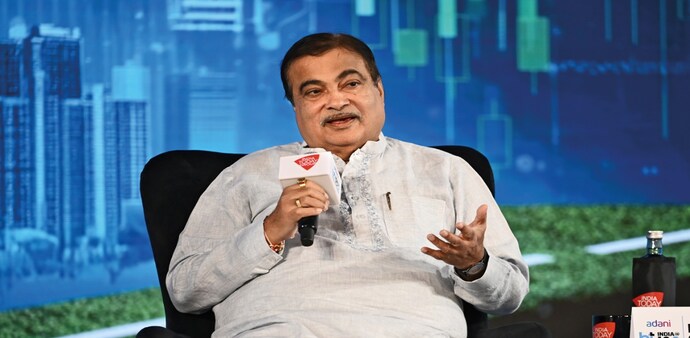
Nitin Gadkari, Minister for Road Transport and Highways, on reducing the dependence on petroleum imports, the next phase of growth and more
Siddharth Zarabi
- Aug 22, 2025,
- Updated Aug 22, 2025 7:16 PM IST
When India turns 100 as a republic in 2047, the story of its progress will also be that of its roads. And few have built more of them than Nitin Gadkari. For over a decade as Minister for Road Transport and Highways, he has been the architect of a national transformation measured in expressways, bridges, tunnels, and the sheer audacity of connecting a nation of 1.4 billion people. Launching Business Today’s special India@100 edition, a blueprint of 100 bold reforms for the next quarter-century, Gadkari spoke about what is next on the road map, and how fast India can get there. Edited excerpts:
Advertisement
SZ: What will India’s roads and highways look like in 2047?
NG: When I became minister, I had a quote by American President John F. Kennedy written and placed in my office in front of my table—American roads are not good because America is rich, but America is rich because American roads are good. We started work with this in mind. I will not list old work because you know that already. But just in Delhi NCR, we are working on projects worth Rs 1 lakh crore. In the next four months, we will award new projects worth Rs 40,000 crore again.
This year, we have two targets. These are targets, not declarations. The first is that from building 38 km of road per day we aim to increase to build 100 km per day—this will happen next year. I’m not just saying that; we are working toward this target. To achieve this, the most important thing is our contract awards—we have awarded projects worth about Rs 2.5 lakh crore so far this year, and by March end, we will have awarded contracts worth Rs 10 lakh crore for road construction. If we do projects worth Rs 10 lakh crore, I believe that for every rupee spent on infrastructure, Rs 3.80 is generated economically. This is what our economists say.
Advertisement
The most important achievement is that IIM Bangalore, IIT Chennai and IIT Kanpur conducted studies, and all three said that India’s road logistics costs have reduced by 6%. Earlier, our logistics cost was 16%; it is 12% in the US and Europe, and 8% in China. I believe that by this December, our logistics cost will come down to 9%. Thanks to better roads, speed has increased and time saved, so the logistics cost will definitely come below 7%. This will increase our exports by 1.5 times or will possibly double.
I challenge anyone to provide evidence of problems with ethanol use. Opposition may arise due to vested interests.
-Nitin Gadkari, Minister for Road Transport and Highways
We are also working on alternative fuels and biofuels. For mass rapid transport on electricity—we have awarded a contract to the Tata group for flash-charging buses. For the first time in the country, a 135-seater bus running on flash charging is starting as a pilot in Nagpur. Soon, these buses will start plying on routes like Delhi-Jaipur, Delhi-Dehradun, Chennai-Bengaluru, and many others. These buses have metro rail’s capacity, but metro costs Rs 450 crore per km, while these buses cost Rs 2 crore each. The ticket price will be 30% less than diesel buses. They will be air-conditioned with executive seats, and passengers will get amenities like tea, snacks, like in airplanes. Each seat will have a TV in front.
Advertisement
We are also building 360 ropeway cable cars. Earlier, this was only considered for tourism, but now we are slowly working on it to transport containers from ports via ropeways. Overall, we have started 10 pilot projects on hydrogen in India involving firms like Tata, Leyland, Volvo, Indian Oil, HPCL, Reliance, and others. The Tata group has made three trucks—one on hydrogen fuel cells and two with internal combustion engines running on hydrogen. We are working on hydrogen filling stations, transportation of hydrogen, and green hydrogen production. The work has started, and there will be a big transformation in the transport sector soon.
SZ: Do you think trade tensions will adversely affect our economy and exports?
NG: When I became minister, India’s automobile sector ranked seventh in the world. Six-and-a-half months ago, we overtook Japan and reached the third rank. America is first at Rs 78 lakh crore, China second at Rs 49 lakh crore, and India is Rs 22 lakh crore. Interestingly, our automobile sector employs about 45 million youth, and it is the biggest GST revenue generator for the state and Centre. Our biggest export is from this sector. Our two-wheeler industry exports 50% of its production. Mercedes-Benz’s chairman met me about one-and-a-half months ago and said they are shifting completely to electric and will make India their manufacturing centre. Maruti Suzuki, Toyota, Hyundai have big exports. There is a big change: alternative fuels and biofuels are progressing fast. Now electric vehicles are so popular that there is a waiting list. Electric buses: 500 made yearly, but demand is for 100,000. Electric tractors and trucks are arriving. Battery chemistry has improved greatly—the lithium-ion battery cost was $150 per kWh when we started, now it is $55 per kWh in India. A bus battery costing Rs 40 lakh then will now cost a third of that.
Advertisement
The day is near when petrol, diesel and electric vehicles will be priced equally. Hydrogen is also emerging. Young Indian researchers are working on lithium-ion, zinc-ion, aluminium-ion, and sodium-ion batteries. India has great potential to supply the world. Only one or two countries are somewhat ahead, but India will lead and capture the global market, strengthening our economy.
We need to start mining lithium quickly. Our mining minister and the PM have asked for this to be sped up because India has lithium deposits but currently imports lithium and gold. We aim for self-reliance with active mining reforms and faster clearances. I am closely related to the automobile sector, so I am telling you this: Hydrogen fuel flex-engine vehicles are here. The world’s first Innova running 100% on bioethanol is parked [here at the venue]. It generates 60% electricity and its petrol-equivalent cost is Rs 25 per litre. It benefits consumers, reduces pollution, and helps farmers. I believe India will grow fast in this sector, providing top quality at the lowest cost worldwide, capturing a large market and strengthening the economy.
SZ: There is a debate raging on social media about vehicle mileage suffering due to E20 ethanol blended fuel…
Advertisement
NG: Not a debate, just rumours. Some politicians or the petroleum lobby could be behind this. Tell me one case where a vehicle had a problem due to 20% ethanol blending. The Society of Indian Automobile Manufacturers (SIAM) and the Automotive Research Association of India (ARAI) have stated that ethanol does not causes issues.
Is it not better to reduce Rs 22 lakh crore worth of imports? Is it not better to reduce pollution in Delhi and other cities? India has surplus rice, wheat, and now corn, which is being used for ethanol. Corn prices rose from Rs 1,200 to Rs 2600 per quintal due to ethanol demand, benefiting farmers in Bihar, UP, and elsewhere. This boosts rural agricultural growth. Agriculture contributes 12% to GDP now; we aim to raise it to 22%. Diversification toward energy and power in agriculture will bring great benefits. I challenge anyone to provide evidence of problems with ethanol use. Opposition may be due to vested interests.
At the BRICS conference in Brazil, I saw that 100% petrol, 27% ethanol petrol blends, and 100% ethanol are sold at pumps. India is moving towards swadeshi, self-reliance, and an Atmanirbhar Bharat, exporting energy rather than importing it. Farmers have earned Rs 1.14 lakh crore due to ethanol, and the government saved Rs 1 lakh crore. Yes, ethanol has slightly lower calorific value than petrol, so mileage drops a little, but as we move toward 100% ethanol, ethanol price is about half that of petrol.
Advertisement
SZ: When will 100% petrol ethanol be introduced? You are finalising rules for 27% ethanol blend now.
NG: The 27% blend is still in trial at ARAI. After trials and standards set by the Ministry of New & Renewable Energy, the Ministry of Petroleum will take it to the Cabinet for final approval. But 100% ethanol still has some challenges. When we started ethanol blending, GST was 20%, now it’s 5%. GST on 100% ethanol is 18%, which I raised with Finance Minister Nirmala Sitharaman. Indian Oil has started 350 ethanol pumps. Availability, standards, and compatible vehicles are still in process. Hydrogen vehicles and trucks are in pilot stages, with Rs 600 crore already invested in hydrogen projects. Once standards are finalised, implementation will start.
SZ: How can we reduce our import dependency on China for rare earths?
NG: I have given suggestions to the mining ministry and PM Modi to reduce the time taken to start a mine, which is currently five to six years due to environment and forest clearances, land acquisition, state and central government rules. The PM wants to stop importing lithium since India has deposits. Mining reforms are happening apace. For example, copper mines now have permission to extract more materials from waste. We aim to reduce the clearance time to six months and start mines quickly.
SZ: Economists say this is India’s new 1991 moment—a big challenge and opportunity. What reforms should be prioritised?
NG: Our government is undertaking many reforms. But I have one grievance: the focus is too urban-centric and Delhi-Mumbai-centric. I come from a village. Agriculture and allied sectors contribute only 18% to GDP, industry 24%, and services about 54-56%. Until agriculture productivity increases and its GDP share rises to 22%, we cannot achieve the desired economic growth. Focus must be on agriculture, rural, tribal areas, water, land, forest, and animals. Rural India needs more attention. Most discussions focus on Delhi-Mumbai, but India’s foundation—agriculture and rural sectors—is not discussed as much. Without strengthening that, our achievements will be incomplete.
One of the biggest issues is water. When I was Water Resources Minister, there were 23 disputes between states. For example, water meant for India was flowing to Pakistan, while Haryana and Punjab fought over water. I called the chief ministers and said, ‘This water is your right going elsewhere; why fight among yourselves?’ I resolved 17 disputes.
Our government made 49 river connectivity projects, and I prepared their project reports. For example, Ken-Betwa project brings water to drought-affected Bundelkhand. I went to Telangana-Andhra Pradesh and approved Rs 60,000 crore for Polavaram project. About 1,300 TMC of Godavari water was going to sea. Our plan diverts Godavari water to Krishna, Krishna to Pennar, Pennar to Cauvery, and Cauvery to Tamil Nadu, resolving water issues in Tamil Nadu and Karnataka.
If water comes with drip irrigation and grafting techniques, agriculture growth will triple. Surplus foodgrains will be used for ethanol production from maize and broken rice. If Rs 10 lakh crore of our Rs 22 lakh crore economy is diverted to agriculture, it will change.
I am not just a politician; I work in agriculture; roads are my second priority. I took farmers to Malaysia and Spain where one acre produces 25–30 tonnes of oranges, while our Nagpur oranges yield only 3 tonnes. If we bring that technology, we can improve. Israel’s kibbutz system uses computers to manage water in air-conditioned houses; this can be done here too.
Growth in agriculture and allied sectors is our priority. Our government has continuously supported farmers. I believe agricultural growth will contribute significantly to India’s GDP growth.
@szarabi
When India turns 100 as a republic in 2047, the story of its progress will also be that of its roads. And few have built more of them than Nitin Gadkari. For over a decade as Minister for Road Transport and Highways, he has been the architect of a national transformation measured in expressways, bridges, tunnels, and the sheer audacity of connecting a nation of 1.4 billion people. Launching Business Today’s special India@100 edition, a blueprint of 100 bold reforms for the next quarter-century, Gadkari spoke about what is next on the road map, and how fast India can get there. Edited excerpts:
Advertisement
SZ: What will India’s roads and highways look like in 2047?
NG: When I became minister, I had a quote by American President John F. Kennedy written and placed in my office in front of my table—American roads are not good because America is rich, but America is rich because American roads are good. We started work with this in mind. I will not list old work because you know that already. But just in Delhi NCR, we are working on projects worth Rs 1 lakh crore. In the next four months, we will award new projects worth Rs 40,000 crore again.
This year, we have two targets. These are targets, not declarations. The first is that from building 38 km of road per day we aim to increase to build 100 km per day—this will happen next year. I’m not just saying that; we are working toward this target. To achieve this, the most important thing is our contract awards—we have awarded projects worth about Rs 2.5 lakh crore so far this year, and by March end, we will have awarded contracts worth Rs 10 lakh crore for road construction. If we do projects worth Rs 10 lakh crore, I believe that for every rupee spent on infrastructure, Rs 3.80 is generated economically. This is what our economists say.
Advertisement
The most important achievement is that IIM Bangalore, IIT Chennai and IIT Kanpur conducted studies, and all three said that India’s road logistics costs have reduced by 6%. Earlier, our logistics cost was 16%; it is 12% in the US and Europe, and 8% in China. I believe that by this December, our logistics cost will come down to 9%. Thanks to better roads, speed has increased and time saved, so the logistics cost will definitely come below 7%. This will increase our exports by 1.5 times or will possibly double.
I challenge anyone to provide evidence of problems with ethanol use. Opposition may arise due to vested interests.
-Nitin Gadkari, Minister for Road Transport and Highways
We are also working on alternative fuels and biofuels. For mass rapid transport on electricity—we have awarded a contract to the Tata group for flash-charging buses. For the first time in the country, a 135-seater bus running on flash charging is starting as a pilot in Nagpur. Soon, these buses will start plying on routes like Delhi-Jaipur, Delhi-Dehradun, Chennai-Bengaluru, and many others. These buses have metro rail’s capacity, but metro costs Rs 450 crore per km, while these buses cost Rs 2 crore each. The ticket price will be 30% less than diesel buses. They will be air-conditioned with executive seats, and passengers will get amenities like tea, snacks, like in airplanes. Each seat will have a TV in front.
Advertisement
We are also building 360 ropeway cable cars. Earlier, this was only considered for tourism, but now we are slowly working on it to transport containers from ports via ropeways. Overall, we have started 10 pilot projects on hydrogen in India involving firms like Tata, Leyland, Volvo, Indian Oil, HPCL, Reliance, and others. The Tata group has made three trucks—one on hydrogen fuel cells and two with internal combustion engines running on hydrogen. We are working on hydrogen filling stations, transportation of hydrogen, and green hydrogen production. The work has started, and there will be a big transformation in the transport sector soon.
SZ: Do you think trade tensions will adversely affect our economy and exports?
NG: When I became minister, India’s automobile sector ranked seventh in the world. Six-and-a-half months ago, we overtook Japan and reached the third rank. America is first at Rs 78 lakh crore, China second at Rs 49 lakh crore, and India is Rs 22 lakh crore. Interestingly, our automobile sector employs about 45 million youth, and it is the biggest GST revenue generator for the state and Centre. Our biggest export is from this sector. Our two-wheeler industry exports 50% of its production. Mercedes-Benz’s chairman met me about one-and-a-half months ago and said they are shifting completely to electric and will make India their manufacturing centre. Maruti Suzuki, Toyota, Hyundai have big exports. There is a big change: alternative fuels and biofuels are progressing fast. Now electric vehicles are so popular that there is a waiting list. Electric buses: 500 made yearly, but demand is for 100,000. Electric tractors and trucks are arriving. Battery chemistry has improved greatly—the lithium-ion battery cost was $150 per kWh when we started, now it is $55 per kWh in India. A bus battery costing Rs 40 lakh then will now cost a third of that.
Advertisement
The day is near when petrol, diesel and electric vehicles will be priced equally. Hydrogen is also emerging. Young Indian researchers are working on lithium-ion, zinc-ion, aluminium-ion, and sodium-ion batteries. India has great potential to supply the world. Only one or two countries are somewhat ahead, but India will lead and capture the global market, strengthening our economy.
We need to start mining lithium quickly. Our mining minister and the PM have asked for this to be sped up because India has lithium deposits but currently imports lithium and gold. We aim for self-reliance with active mining reforms and faster clearances. I am closely related to the automobile sector, so I am telling you this: Hydrogen fuel flex-engine vehicles are here. The world’s first Innova running 100% on bioethanol is parked [here at the venue]. It generates 60% electricity and its petrol-equivalent cost is Rs 25 per litre. It benefits consumers, reduces pollution, and helps farmers. I believe India will grow fast in this sector, providing top quality at the lowest cost worldwide, capturing a large market and strengthening the economy.
SZ: There is a debate raging on social media about vehicle mileage suffering due to E20 ethanol blended fuel…
Advertisement
NG: Not a debate, just rumours. Some politicians or the petroleum lobby could be behind this. Tell me one case where a vehicle had a problem due to 20% ethanol blending. The Society of Indian Automobile Manufacturers (SIAM) and the Automotive Research Association of India (ARAI) have stated that ethanol does not causes issues.
Is it not better to reduce Rs 22 lakh crore worth of imports? Is it not better to reduce pollution in Delhi and other cities? India has surplus rice, wheat, and now corn, which is being used for ethanol. Corn prices rose from Rs 1,200 to Rs 2600 per quintal due to ethanol demand, benefiting farmers in Bihar, UP, and elsewhere. This boosts rural agricultural growth. Agriculture contributes 12% to GDP now; we aim to raise it to 22%. Diversification toward energy and power in agriculture will bring great benefits. I challenge anyone to provide evidence of problems with ethanol use. Opposition may be due to vested interests.
At the BRICS conference in Brazil, I saw that 100% petrol, 27% ethanol petrol blends, and 100% ethanol are sold at pumps. India is moving towards swadeshi, self-reliance, and an Atmanirbhar Bharat, exporting energy rather than importing it. Farmers have earned Rs 1.14 lakh crore due to ethanol, and the government saved Rs 1 lakh crore. Yes, ethanol has slightly lower calorific value than petrol, so mileage drops a little, but as we move toward 100% ethanol, ethanol price is about half that of petrol.
Advertisement
SZ: When will 100% petrol ethanol be introduced? You are finalising rules for 27% ethanol blend now.
NG: The 27% blend is still in trial at ARAI. After trials and standards set by the Ministry of New & Renewable Energy, the Ministry of Petroleum will take it to the Cabinet for final approval. But 100% ethanol still has some challenges. When we started ethanol blending, GST was 20%, now it’s 5%. GST on 100% ethanol is 18%, which I raised with Finance Minister Nirmala Sitharaman. Indian Oil has started 350 ethanol pumps. Availability, standards, and compatible vehicles are still in process. Hydrogen vehicles and trucks are in pilot stages, with Rs 600 crore already invested in hydrogen projects. Once standards are finalised, implementation will start.
SZ: How can we reduce our import dependency on China for rare earths?
NG: I have given suggestions to the mining ministry and PM Modi to reduce the time taken to start a mine, which is currently five to six years due to environment and forest clearances, land acquisition, state and central government rules. The PM wants to stop importing lithium since India has deposits. Mining reforms are happening apace. For example, copper mines now have permission to extract more materials from waste. We aim to reduce the clearance time to six months and start mines quickly.
SZ: Economists say this is India’s new 1991 moment—a big challenge and opportunity. What reforms should be prioritised?
NG: Our government is undertaking many reforms. But I have one grievance: the focus is too urban-centric and Delhi-Mumbai-centric. I come from a village. Agriculture and allied sectors contribute only 18% to GDP, industry 24%, and services about 54-56%. Until agriculture productivity increases and its GDP share rises to 22%, we cannot achieve the desired economic growth. Focus must be on agriculture, rural, tribal areas, water, land, forest, and animals. Rural India needs more attention. Most discussions focus on Delhi-Mumbai, but India’s foundation—agriculture and rural sectors—is not discussed as much. Without strengthening that, our achievements will be incomplete.
One of the biggest issues is water. When I was Water Resources Minister, there were 23 disputes between states. For example, water meant for India was flowing to Pakistan, while Haryana and Punjab fought over water. I called the chief ministers and said, ‘This water is your right going elsewhere; why fight among yourselves?’ I resolved 17 disputes.
Our government made 49 river connectivity projects, and I prepared their project reports. For example, Ken-Betwa project brings water to drought-affected Bundelkhand. I went to Telangana-Andhra Pradesh and approved Rs 60,000 crore for Polavaram project. About 1,300 TMC of Godavari water was going to sea. Our plan diverts Godavari water to Krishna, Krishna to Pennar, Pennar to Cauvery, and Cauvery to Tamil Nadu, resolving water issues in Tamil Nadu and Karnataka.
If water comes with drip irrigation and grafting techniques, agriculture growth will triple. Surplus foodgrains will be used for ethanol production from maize and broken rice. If Rs 10 lakh crore of our Rs 22 lakh crore economy is diverted to agriculture, it will change.
I am not just a politician; I work in agriculture; roads are my second priority. I took farmers to Malaysia and Spain where one acre produces 25–30 tonnes of oranges, while our Nagpur oranges yield only 3 tonnes. If we bring that technology, we can improve. Israel’s kibbutz system uses computers to manage water in air-conditioned houses; this can be done here too.
Growth in agriculture and allied sectors is our priority. Our government has continuously supported farmers. I believe agricultural growth will contribute significantly to India’s GDP growth.
@szarabi
Read more!