
How Hanoi is emerging as a stylish short-haul escape thanks to a fast-growing luxury scene
How Hanoi is emerging as a stylish short-haul escape thanks to a fast-growing luxury scene
Once seen as a backpackers haven, Vietnam's capital is emerging as a stylish short-haul escape, helped by easier connectivity and a fast-growing luxury scene.
Smita Tripathi
- Jun 18, 2026,
- Updated Jun 18, 2026 5:47 PM IST
As I boarded Air India’s maiden 4.5-hour flight from Delhi to Hanoi on May 1, there was a palpable sense of occasion in the air. At check-in, passengers were greeted with a dedicated counter, a celebratory photo booth, and a small goodie bag containing a Vietnamese handheld fan, and a commemorative plaque marking the inaugural flight. For many on board, it felt like the start of a new chapter in Indian travel.
Advertisement
That excitement reflects a larger shift. Vietnam—long loved as a backpacker’s paradise for its affordability, hostels, street food, and easy charm—is now drawing a more varied Indian traveller. It still offers value, but is also becoming more polished, with luxury hotels, premium flights, curated experiences, and Michelin-starred restaurants joining the familiar world of scooters, night markets, and bowls of pho.
Air India clearly sensed this shift. Two years after launching its service to Ho Chi Minh City, the airline added Hanoi to its Vietnam network, with a 5x weekly non-stop service. On the maiden flight, both Business Class and Premium Economy were sold out, a telling sign of the demand. “Vietnam has rapidly evolved into a high potential market for Indian travellers supported by strong leisure demand, growing business exchanges and rising interest in multi-city holidays,” says Nipun Aggarwal, Chief Commercial Officer, Air India.
Advertisement
The welcome in Hanoi carried the same festive energy. As the aircraft landed, it received a water cannon salute—the ceremonial greeting reserved for special flights. Air India staff waited at the aerobridge, and the mood was celebratory.
Founded more than 1,000 years ago, Hanoi is one of Southeast Asia’s oldest capitals. The Old Quarter remains the city’s beating heart. Dating back to the 14th century, it is a maze of narrow streets, colonial-era buildings, family-run businesses, food stalls, temples, cafés, and the constant hum of scooters. Walk here alone and you never feel lonely. Vendors call out, monks pass through lanes, and the scent of pho drifts around every corner.
Advertisement
For Indian travellers, this mix has become increasingly attractive. Nearly four hundred thousand Indians visited Vietnam in 2024. Rajesh Magow, Co-Founder and Group CEO of online travel-booking platform MakeMyTrip, describes Vietnam as “one of the most exciting stories in Indian outbound travel,” adding that it now ranks among the company’s top short-haul international destinations and has entered the overall Top 10. According to him, Vietnam’s multi-airport connectivity to Hanoi, Ho Chi Minh City, and Da Nang has opened the country to travellers across metros, while its food, experiences, culture, beaches, cuisine and vibrant cities have made it especially appealing to younger, experience-seeking Indians.
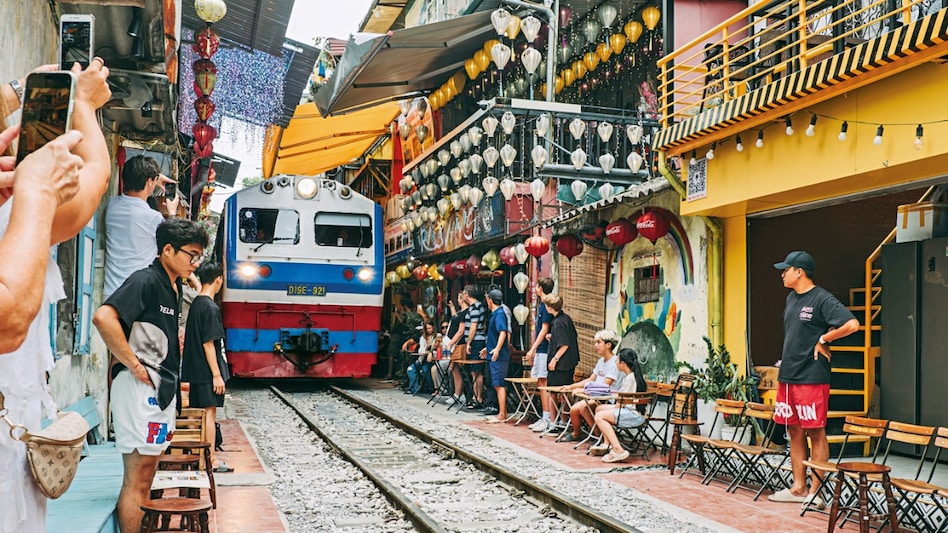
That younger traveller is visible across Hanoi, phone in hand, chasing the images that have made the city famous online. Train Street is the clearest example. Tourists sit in cafés along a narrow railway track, waiting for a train to pass between them. There is nothing especially ornate about the train itself. It is not a heritage steam train like the Darjeeling Himalayan Railway or the Nilgiri Mountain Railway. Yet, in the age of Instagram, it has become a ritual, and for many visitors, a non-negotiable stop.
Advertisement
But Hanoi is more than its ‘viral’ corners. At the centre of the city lies Hoan Kiem Lake, a pocket of calm beside the energy of the Old Quarter. Joggers circle its edges in the morning and elderly residents exercise under the trees. The lake has its own legend involving a magical sword, a courageous emperor, a Dragon King, and the Golden Turtle God, Kim Qui.
The city’s more formal historical memory is visible at the Ho Chi Minh Mausoleum, where Vietnam’s revolutionary leader, still affectionately called Uncle Ho, is remembered with reverence. He did not live to see the country’s final unification in 1975, but his role in Vietnam’s struggle for independence remains central to the national imagination. Other traces of that turbulent past survive at Hoa Lo Prison, associated with French colonial rule, and at the Sofitel Legend Metropole Hanoi, which once served as a wartime shelter.
The Metropole also signals another Hanoi: one of luxury, heritage hospitality, and old-world glamour. Its elegant Angelina bar is a lovely place to spend an evening over cocktails, watching the city’s well-dressed locals. The hotel is frequently sold out, which says something about Hanoi’s changing position in the travel market. It is no longer only a stop for backpackers. It is now a city where luxury travellers linger.
Advertisement
Food is central to this transformation. Hanoi’s street food remains spectacular, and no visit feels complete without bun cha—a dish of grilled pork patties and pork belly served with rice vermicelli, herbs, and dipping sauce. Bun Cha Huong Lien became globally famous after Barack Obama ate there with Anthony Bourdain in 2016, and today the restaurant remains a pilgrimage site, with photographs of Obama displayed proudly and regular queues outside.
Coffee is another Hanoi essential. Vietnam is the world’s second-largest coffee exporter and a major producer of robusta. At Giang Café in the Old Quarter, egg coffee is the star: egg yolks whipped with sugar and condensed milk into a creamy foam layered over strong black coffee. Rich, sweet, and almost dessert-like, it is one of the city’s most memorable rituals.
Yet Hanoi’s food scene is no longer only about street stalls and family cafés. In 2023, the Michelin Guide launched its first Vietnam edition, covering Hanoi and Ho Chi Minh City. By 2025, Vietnam had nine Michelin-starred restaurants. In Hanoi, Tam Vi stands out, offering North Vietnamese cuisine in a vintage tea-house setting with a lush courtyard, antique décor, English-speaking staff, and a tourist-friendly photo menu.
Advertisement
This is Hanoi’s great charm. While it is still a city of backpackers, scooters, bia hoi (beer), and crowded lanes, it is also home to luxury hotels, destination restaurants, and premium flights arriving full.
As I boarded Air India’s maiden 4.5-hour flight from Delhi to Hanoi on May 1, there was a palpable sense of occasion in the air. At check-in, passengers were greeted with a dedicated counter, a celebratory photo booth, and a small goodie bag containing a Vietnamese handheld fan, and a commemorative plaque marking the inaugural flight. For many on board, it felt like the start of a new chapter in Indian travel.
Advertisement
That excitement reflects a larger shift. Vietnam—long loved as a backpacker’s paradise for its affordability, hostels, street food, and easy charm—is now drawing a more varied Indian traveller. It still offers value, but is also becoming more polished, with luxury hotels, premium flights, curated experiences, and Michelin-starred restaurants joining the familiar world of scooters, night markets, and bowls of pho.
Air India clearly sensed this shift. Two years after launching its service to Ho Chi Minh City, the airline added Hanoi to its Vietnam network, with a 5x weekly non-stop service. On the maiden flight, both Business Class and Premium Economy were sold out, a telling sign of the demand. “Vietnam has rapidly evolved into a high potential market for Indian travellers supported by strong leisure demand, growing business exchanges and rising interest in multi-city holidays,” says Nipun Aggarwal, Chief Commercial Officer, Air India.
Advertisement
The welcome in Hanoi carried the same festive energy. As the aircraft landed, it received a water cannon salute—the ceremonial greeting reserved for special flights. Air India staff waited at the aerobridge, and the mood was celebratory.
Founded more than 1,000 years ago, Hanoi is one of Southeast Asia’s oldest capitals. The Old Quarter remains the city’s beating heart. Dating back to the 14th century, it is a maze of narrow streets, colonial-era buildings, family-run businesses, food stalls, temples, cafés, and the constant hum of scooters. Walk here alone and you never feel lonely. Vendors call out, monks pass through lanes, and the scent of pho drifts around every corner.
Advertisement
For Indian travellers, this mix has become increasingly attractive. Nearly four hundred thousand Indians visited Vietnam in 2024. Rajesh Magow, Co-Founder and Group CEO of online travel-booking platform MakeMyTrip, describes Vietnam as “one of the most exciting stories in Indian outbound travel,” adding that it now ranks among the company’s top short-haul international destinations and has entered the overall Top 10. According to him, Vietnam’s multi-airport connectivity to Hanoi, Ho Chi Minh City, and Da Nang has opened the country to travellers across metros, while its food, experiences, culture, beaches, cuisine and vibrant cities have made it especially appealing to younger, experience-seeking Indians.
That younger traveller is visible across Hanoi, phone in hand, chasing the images that have made the city famous online. Train Street is the clearest example. Tourists sit in cafés along a narrow railway track, waiting for a train to pass between them. There is nothing especially ornate about the train itself. It is not a heritage steam train like the Darjeeling Himalayan Railway or the Nilgiri Mountain Railway. Yet, in the age of Instagram, it has become a ritual, and for many visitors, a non-negotiable stop.
Advertisement
But Hanoi is more than its ‘viral’ corners. At the centre of the city lies Hoan Kiem Lake, a pocket of calm beside the energy of the Old Quarter. Joggers circle its edges in the morning and elderly residents exercise under the trees. The lake has its own legend involving a magical sword, a courageous emperor, a Dragon King, and the Golden Turtle God, Kim Qui.
The city’s more formal historical memory is visible at the Ho Chi Minh Mausoleum, where Vietnam’s revolutionary leader, still affectionately called Uncle Ho, is remembered with reverence. He did not live to see the country’s final unification in 1975, but his role in Vietnam’s struggle for independence remains central to the national imagination. Other traces of that turbulent past survive at Hoa Lo Prison, associated with French colonial rule, and at the Sofitel Legend Metropole Hanoi, which once served as a wartime shelter.
The Metropole also signals another Hanoi: one of luxury, heritage hospitality, and old-world glamour. Its elegant Angelina bar is a lovely place to spend an evening over cocktails, watching the city’s well-dressed locals. The hotel is frequently sold out, which says something about Hanoi’s changing position in the travel market. It is no longer only a stop for backpackers. It is now a city where luxury travellers linger.
Advertisement
Food is central to this transformation. Hanoi’s street food remains spectacular, and no visit feels complete without bun cha—a dish of grilled pork patties and pork belly served with rice vermicelli, herbs, and dipping sauce. Bun Cha Huong Lien became globally famous after Barack Obama ate there with Anthony Bourdain in 2016, and today the restaurant remains a pilgrimage site, with photographs of Obama displayed proudly and regular queues outside.
Coffee is another Hanoi essential. Vietnam is the world’s second-largest coffee exporter and a major producer of robusta. At Giang Café in the Old Quarter, egg coffee is the star: egg yolks whipped with sugar and condensed milk into a creamy foam layered over strong black coffee. Rich, sweet, and almost dessert-like, it is one of the city’s most memorable rituals.
Yet Hanoi’s food scene is no longer only about street stalls and family cafés. In 2023, the Michelin Guide launched its first Vietnam edition, covering Hanoi and Ho Chi Minh City. By 2025, Vietnam had nine Michelin-starred restaurants. In Hanoi, Tam Vi stands out, offering North Vietnamese cuisine in a vintage tea-house setting with a lush courtyard, antique décor, English-speaking staff, and a tourist-friendly photo menu.
Advertisement
This is Hanoi’s great charm. While it is still a city of backpackers, scooters, bia hoi (beer), and crowded lanes, it is also home to luxury hotels, destination restaurants, and premium flights arriving full.
Read more!