
Will AI trade reversal in Taiwan, South Korea benefit India stock markets in future?
Jefferies in a note said Samsung and Hynix are forecast to earn profits totalling $307 billion this year, three times the total forecast profits of $102 billion for India’s Nifty 50 universe.
- May 12, 2026,
- Updated May 12, 2026 2:04 PM IST
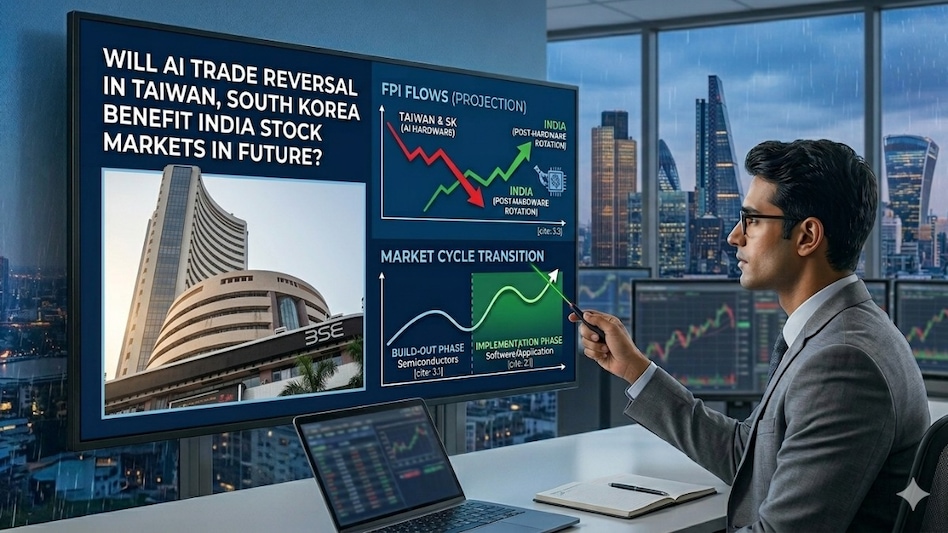
Global investors aggressively rotated out of Indian equities into AI-led trades namely Taiwan and South Korea since May 2025. Recent flow trends suggest the first sign of exhaustion in that positioning, analysts said.
Global equity inflows slowed sharply to $2.6 billion last week against an average of $22 billion over the prior five weeks, led primarily by softer US inflows. At the country level, said Elara Securities, South Korea saw a historic foreign outflow of $1.3 billion, while Taiwan inflows slowed sharply to $160 million from a six-month weekly average of $820 million. AI trade rotation into Taiwan & Korea has began to fade, Elara said calling the recent trend flows as first sign of exhaustion in the AI-led positioning.
On the other hand, India-focused funds continued to witness redemptions for the 11th week, but the pace has moderated, Elara said adding that the average weekly outflows have slowed to $230 million over past month versus $1 billion during March–April.
Data showed India’s weighting in the MSCI Emerging Markets Index has declined from 19.5 per cent to 11.5 per cent since the start of last year while Korea and Taiwan are up from 9 per cent to 20.6 per cent and 19.7 per cent to 25 per cent, respectively, during the same period.
For India, "The bulk of foreign selling is likely over, after record outflows over the recent months. Various approaches using flows, positioning and ownership trends suggest foreign flows are now close to downside scenarios. After record $22 billion outflows YTD, we estimate the downside risk of incremental foreign selling could be limited at about $4-5 billion, Goldman Sachs said.
Will FIIs return to D-Street? Jefferies in its latest GREED & fear note said Samsung and Hynix are forecast to earn profits totalling $307 billion this year, three times the total forecast profits of $102 billion for India’s Nifty 50 universe. It, however, noted that the supply of equity, monthly total equity supply has slowed in India from a peak of $10.4 billion last June and an average of $5.2 billion in calendar 2025 to an average of $1.7 billion in the first four months of 2026.
Compared to North Asian markets, India offers a less attractive risk-reward as it trades at significantly higher growth-adjusted valuations, on top of the ongoing investor concerns over the potential adverse impact of AI, Goldman Sachs said. It believes earnings revisions in India have become an increasingly important variable guiding foreign flows.
"While much of foreign selling may have already occurred in anticipation of the forthcoming downgrade cycle, low visibility around a recovery will likely limit foreign re-buying in the near-term," it said.
Data showed foreign ownership in Indian stocks has dropped to a 14-year low in the March quarter. It slipped below domestic institutions for the first time in over two decades.
Citi, meanwhile, on May 10 said MSCI India has underperformed EM by 58 per cent in the past one year due to AI trade and rise in crude oil prices. Citi India sentiment indicator is back to neutral; historically at these levels, Nifty has average high-single digit returns in the next 12 months, Citi said citing its back-testing.
Global investors aggressively rotated out of Indian equities into AI-led trades namely Taiwan and South Korea since May 2025. Recent flow trends suggest the first sign of exhaustion in that positioning, analysts said.
Global equity inflows slowed sharply to $2.6 billion last week against an average of $22 billion over the prior five weeks, led primarily by softer US inflows. At the country level, said Elara Securities, South Korea saw a historic foreign outflow of $1.3 billion, while Taiwan inflows slowed sharply to $160 million from a six-month weekly average of $820 million. AI trade rotation into Taiwan & Korea has began to fade, Elara said calling the recent trend flows as first sign of exhaustion in the AI-led positioning.
On the other hand, India-focused funds continued to witness redemptions for the 11th week, but the pace has moderated, Elara said adding that the average weekly outflows have slowed to $230 million over past month versus $1 billion during March–April.
Data showed India’s weighting in the MSCI Emerging Markets Index has declined from 19.5 per cent to 11.5 per cent since the start of last year while Korea and Taiwan are up from 9 per cent to 20.6 per cent and 19.7 per cent to 25 per cent, respectively, during the same period.
For India, "The bulk of foreign selling is likely over, after record outflows over the recent months. Various approaches using flows, positioning and ownership trends suggest foreign flows are now close to downside scenarios. After record $22 billion outflows YTD, we estimate the downside risk of incremental foreign selling could be limited at about $4-5 billion, Goldman Sachs said.
Will FIIs return to D-Street? Jefferies in its latest GREED & fear note said Samsung and Hynix are forecast to earn profits totalling $307 billion this year, three times the total forecast profits of $102 billion for India’s Nifty 50 universe. It, however, noted that the supply of equity, monthly total equity supply has slowed in India from a peak of $10.4 billion last June and an average of $5.2 billion in calendar 2025 to an average of $1.7 billion in the first four months of 2026.
Compared to North Asian markets, India offers a less attractive risk-reward as it trades at significantly higher growth-adjusted valuations, on top of the ongoing investor concerns over the potential adverse impact of AI, Goldman Sachs said. It believes earnings revisions in India have become an increasingly important variable guiding foreign flows.
"While much of foreign selling may have already occurred in anticipation of the forthcoming downgrade cycle, low visibility around a recovery will likely limit foreign re-buying in the near-term," it said.
Data showed foreign ownership in Indian stocks has dropped to a 14-year low in the March quarter. It slipped below domestic institutions for the first time in over two decades.
Citi, meanwhile, on May 10 said MSCI India has underperformed EM by 58 per cent in the past one year due to AI trade and rise in crude oil prices. Citi India sentiment indicator is back to neutral; historically at these levels, Nifty has average high-single digit returns in the next 12 months, Citi said citing its back-testing.