
Sensex crashes 2,494 points at open, Nifty slips below 23,700: Why market is falling
Sectoral performance remained negative, with declines seen across all segments. Banking, financials and automobile stocks emerged as the worst performers.
- Mar 9, 2026,
- Updated Mar 9, 2026 11:18 AM IST
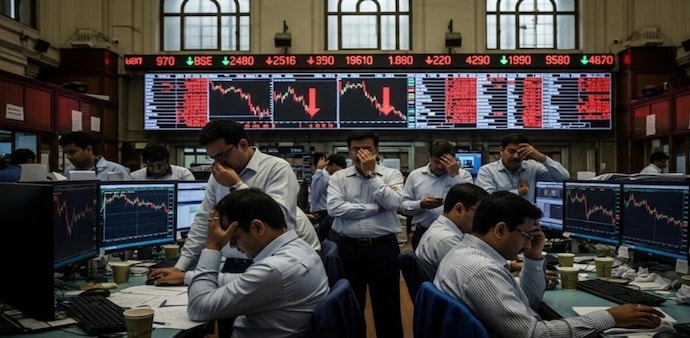
Indian equity benchmarks plunged in Monday's trade, dragged lower by weakness across sectors amid the ongoing conflict involving Iran, the United States and Israel. At the open, the 30-share BSE Sensex pack tumbled as much as 2,494.35 points to hit a low of 76,424.55, while the NSE Nifty index dropped 752.65 points to 23,697.80. Both benchmark indices slipped for the second straight session.
Sectoral performance remained negative, with declines seen across all segments. Banking, financials, automobile and energy stocks emerged as the worst performers. The broader market also mirrored the weakness in the benchmarks, as midcap and smallcap indices fell around 3.13 per cent to 3.16 per cent, pointing to a broad-based correction across the market.
Here's what is weighing on the market:
Crude on boil
Oil prices jumped more than 26 per cent today as the conflict in West Asia continued to disrupt supplies. The US-Israel-Iran war prompted major producers such as Iraq and Kuwait to cut output. Concerns over the security of the Strait of Hormuz further added to price volatility. Brent crude surged $24.39 or 26.31 per cent to $117.08 a barrel.
The primary trigger for the market weakness was the intensifying conflict in West Asia, which led to a sharp spike in global crude oil prices, said Ajit Mishra, SVP (Research) at Religare Broking.
FII outflows
"Persistent foreign institutional investor (FII) outflows further pressured the market. FIIs remained net sellers in the equity segment, with net outflows of nearly Rs 21,831 crore during the last week," Mishra said. "However, domestic institutional investors (DIIs) continued to provide support, infusing approximately Rs 32,786 crore, aided by steady SIP flows and long-term domestic participation," he also stated.
Weaking rupee
The Indian rupee is likely to drop further as rising oil and natural gas prices are expected to have an adverse impact on our economy, said Amit Pabari, Managing Director at CR Forex Advisors. For instance, he noted that a $10 rise in crude prices is estimated to widen India's annual trade deficit by nearly $13–15 billion.
Strategy ahead
"Given the heightened geopolitical risks, the sharp rise in crude oil prices, and continued FII outflows, investors should adopt a cautious and disciplined approach in the near term. Traders should prioritise capital preservation, maintain strict stop-loss levels, and avoid aggressive leverage amid rising volatility," Religare's Ajit Mishra said.
"Selective buying opportunities may emerge in sectors/themes such as pharma, defence, public sector enterprises (PSEs), select metals and energy stocks, while banking, realty, IT and select FMCG stocks may continue to face pressure," he added.
Indian equity benchmarks plunged in Monday's trade, dragged lower by weakness across sectors amid the ongoing conflict involving Iran, the United States and Israel. At the open, the 30-share BSE Sensex pack tumbled as much as 2,494.35 points to hit a low of 76,424.55, while the NSE Nifty index dropped 752.65 points to 23,697.80. Both benchmark indices slipped for the second straight session.
Sectoral performance remained negative, with declines seen across all segments. Banking, financials, automobile and energy stocks emerged as the worst performers. The broader market also mirrored the weakness in the benchmarks, as midcap and smallcap indices fell around 3.13 per cent to 3.16 per cent, pointing to a broad-based correction across the market.
Here's what is weighing on the market:
Crude on boil
Oil prices jumped more than 26 per cent today as the conflict in West Asia continued to disrupt supplies. The US-Israel-Iran war prompted major producers such as Iraq and Kuwait to cut output. Concerns over the security of the Strait of Hormuz further added to price volatility. Brent crude surged $24.39 or 26.31 per cent to $117.08 a barrel.
The primary trigger for the market weakness was the intensifying conflict in West Asia, which led to a sharp spike in global crude oil prices, said Ajit Mishra, SVP (Research) at Religare Broking.
FII outflows
"Persistent foreign institutional investor (FII) outflows further pressured the market. FIIs remained net sellers in the equity segment, with net outflows of nearly Rs 21,831 crore during the last week," Mishra said. "However, domestic institutional investors (DIIs) continued to provide support, infusing approximately Rs 32,786 crore, aided by steady SIP flows and long-term domestic participation," he also stated.
Weaking rupee
The Indian rupee is likely to drop further as rising oil and natural gas prices are expected to have an adverse impact on our economy, said Amit Pabari, Managing Director at CR Forex Advisors. For instance, he noted that a $10 rise in crude prices is estimated to widen India's annual trade deficit by nearly $13–15 billion.
Strategy ahead
"Given the heightened geopolitical risks, the sharp rise in crude oil prices, and continued FII outflows, investors should adopt a cautious and disciplined approach in the near term. Traders should prioritise capital preservation, maintain strict stop-loss levels, and avoid aggressive leverage amid rising volatility," Religare's Ajit Mishra said.
"Selective buying opportunities may emerge in sectors/themes such as pharma, defence, public sector enterprises (PSEs), select metals and energy stocks, while banking, realty, IT and select FMCG stocks may continue to face pressure," he added.