
'Most of Indian students graduating in the US won't find jobs': San Francisco-based VC makes big claim
US-based venture capitalist Debarghya Das on Monday took to social media to explain why that is the case.
- Sep 1, 2025,
- Updated Sep 1, 2025 11:38 AM IST
Going to the US for a Master's degree is no longer going to be as beneficial for Indians as it used to be. US-based venture capitalist Debarghya Das on Monday took to social media to explain why that is the case.
Das said that most of the 150,000 Indian students graduating after completing their Master's degree will not find a job in the US. Deep diving into the phenomenon, he said that the number of Indian students pursuing Master's courses in the US went up by 3 times in the last 5 years to 300,000, which is 2 times of pre-pandemic highs.
"They represent 81% of all Indian students and ~30% of all international students in the US. As discretional wages have expanded in India, many companies have sprung up to help lower the barrier to entry for Indians to come to the US for their Master's. 10 years ago, it was 4x less. Master's programs last 1-2 years, meaning ~150-200k students graduate this year and most will be out looking for a job," he wrote in a long post on X (formerly Twitter).
Furthermore, he laid out the dire reality of why most of these graduates wouldn't be getting jobs. The venture capitalist said that most of these students are surviving on loans, and around 70 per cent of them are studying computer science or engineering.
He explained that there are not enough tech jobs to meet this demand, citing Microsoft as an example. He further explained that it will be harder for Indians to secure visas due to the recent proposed rule for wage-based H1Bs.
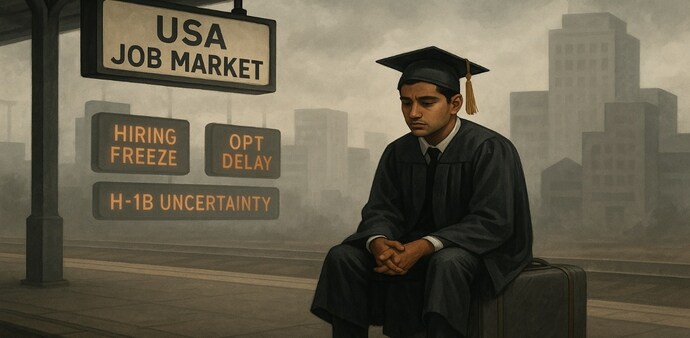
"Visas are harder than ever before. The recent proposed rule for wage-based H1Bs means fewer jobs will qualify. Add to that the 4-year F-1 cap means Day 1 CPT will no longer allow you to stay beyond the 3 years of OPT if you don't get into the lottery."
He further said that hiring in Big Tech has not recovered yet and going by trends, new graduates with 0-2 years of experience are the worst affected.
Going to the US for a Master's degree is no longer going to be as beneficial for Indians as it used to be. US-based venture capitalist Debarghya Das on Monday took to social media to explain why that is the case.
Das said that most of the 150,000 Indian students graduating after completing their Master's degree will not find a job in the US. Deep diving into the phenomenon, he said that the number of Indian students pursuing Master's courses in the US went up by 3 times in the last 5 years to 300,000, which is 2 times of pre-pandemic highs.
"They represent 81% of all Indian students and ~30% of all international students in the US. As discretional wages have expanded in India, many companies have sprung up to help lower the barrier to entry for Indians to come to the US for their Master's. 10 years ago, it was 4x less. Master's programs last 1-2 years, meaning ~150-200k students graduate this year and most will be out looking for a job," he wrote in a long post on X (formerly Twitter).
Furthermore, he laid out the dire reality of why most of these graduates wouldn't be getting jobs. The venture capitalist said that most of these students are surviving on loans, and around 70 per cent of them are studying computer science or engineering.
He explained that there are not enough tech jobs to meet this demand, citing Microsoft as an example. He further explained that it will be harder for Indians to secure visas due to the recent proposed rule for wage-based H1Bs.
"Visas are harder than ever before. The recent proposed rule for wage-based H1Bs means fewer jobs will qualify. Add to that the 4-year F-1 cap means Day 1 CPT will no longer allow you to stay beyond the 3 years of OPT if you don't get into the lottery."
He further said that hiring in Big Tech has not recovered yet and going by trends, new graduates with 0-2 years of experience are the worst affected.