
Australia ends 'visa hopping': How new rules affect Indian students from October 2
According to Australia's Department of Education, 687,810 international students were studying in the country in the year-to-date period through June 2026. Indian students accounted for 16%, making India the second-largest source country after China.
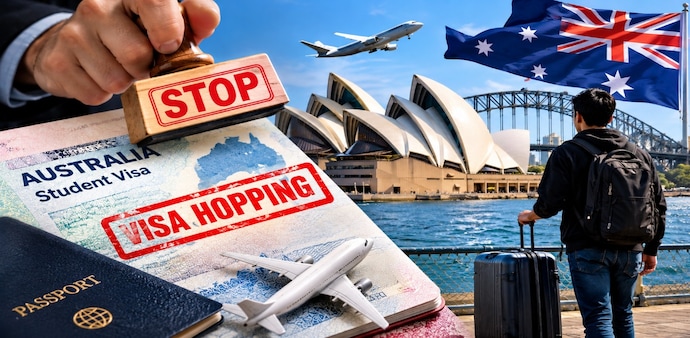
- Oct 3, 2026,
- Updated Oct 3, 2026 3:00 PM IST
Australia has introduced a fresh set of student visa integrity measures from October 2, 2026, tightening rules around visa hopping, switching education providers and bringing family members.
The changes are aimed at ensuring that the student visa remains primarily for genuine study, while limiting pathways that allow students to use the visa system to move between courses or visa categories.
The changes are particularly significant for Indians, who remain one of Australia's largest international student groups. According to Australia's Department of Education, 687,810 international students were studying in the country in the year-to-date period through June 2026. Indian students accounted for 16%, making India the second-largest source country after China.
What are the major changes?
One of the biggest changes is the restriction on onshore student visa applications. Most temporary visa holders, including people on Working Holiday Maker and Skills in Demand visas, will no longer be able to apply for a student visa while inside Australia. They will generally have to apply from outside the country.
MUST READ | Australia bans dependants on student visas: Key impacts on Indian applicants
Current Student visa holders seeking another Student visa in Australia will also face tighter conditions. Exceptions include certain PhD and school students, government-sponsored students and those who need additional time to complete their existing course.
Another important change concerns switching education providers. From October 2, non-school international students must generally complete 12 months of their principal course, compared with the previous six-month restriction, before transferring to another registered provider. The temporary 12-month rule will remain in place until June 30, 2027.
Australia is also stopping students from entering the country for higher education and then transferring onshore into vocational education and training (VET). From July 1, 2027, a new student visa transfer stream will apply, and students will generally need to receive their new visa before starting at the new provider.
What does it mean for Indians?
The impact could be substantial given India's position in Australia's education system. As of June 30, 2025, Australia had 107,038 Indian student visa holders, compared with 102,990 from China. India was ranked the second-largest international student source country in Australia's 2024-25 data.
DON'T READ | Planning to study in UK? 5 things Indian students must check before applying for student visa
For Indian students, the new system means greater importance of choosing the right course and institution before travelling to Australia. Students planning to change providers shortly after arrival will face additional restrictions, while those trying to move between visa categories from within Australia will have fewer options.
Concerns for students
The reforms could create concerns around flexibility, financial commitments and course selection. A student who discovers that a course or provider is unsuitable may have to remain enrolled for longer before transferring, except in specified circumstances.
The changes come as Australia's international education sector is already seeing a slowdown. In the year to June 2026, international student numbers were down 7%, while new student numbers fell 8% year-on-year.
The Australian government says the reforms are designed to protect the integrity and reputation of the international education sector, rather than close Australia to genuine students. For Indians planning to study there, however, the message is clear: course selection, provider choice and visa compliance will matter more than ever.
Australia has introduced a fresh set of student visa integrity measures from October 2, 2026, tightening rules around visa hopping, switching education providers and bringing family members.
The changes are aimed at ensuring that the student visa remains primarily for genuine study, while limiting pathways that allow students to use the visa system to move between courses or visa categories.
The changes are particularly significant for Indians, who remain one of Australia's largest international student groups. According to Australia's Department of Education, 687,810 international students were studying in the country in the year-to-date period through June 2026. Indian students accounted for 16%, making India the second-largest source country after China.
What are the major changes?
One of the biggest changes is the restriction on onshore student visa applications. Most temporary visa holders, including people on Working Holiday Maker and Skills in Demand visas, will no longer be able to apply for a student visa while inside Australia. They will generally have to apply from outside the country.
MUST READ | Australia bans dependants on student visas: Key impacts on Indian applicants
Current Student visa holders seeking another Student visa in Australia will also face tighter conditions. Exceptions include certain PhD and school students, government-sponsored students and those who need additional time to complete their existing course.
Another important change concerns switching education providers. From October 2, non-school international students must generally complete 12 months of their principal course, compared with the previous six-month restriction, before transferring to another registered provider. The temporary 12-month rule will remain in place until June 30, 2027.
Australia is also stopping students from entering the country for higher education and then transferring onshore into vocational education and training (VET). From July 1, 2027, a new student visa transfer stream will apply, and students will generally need to receive their new visa before starting at the new provider.
What does it mean for Indians?
The impact could be substantial given India's position in Australia's education system. As of June 30, 2025, Australia had 107,038 Indian student visa holders, compared with 102,990 from China. India was ranked the second-largest international student source country in Australia's 2024-25 data.
DON'T READ | Planning to study in UK? 5 things Indian students must check before applying for student visa
For Indian students, the new system means greater importance of choosing the right course and institution before travelling to Australia. Students planning to change providers shortly after arrival will face additional restrictions, while those trying to move between visa categories from within Australia will have fewer options.
Concerns for students
The reforms could create concerns around flexibility, financial commitments and course selection. A student who discovers that a course or provider is unsuitable may have to remain enrolled for longer before transferring, except in specified circumstances.
The changes come as Australia's international education sector is already seeing a slowdown. In the year to June 2026, international student numbers were down 7%, while new student numbers fell 8% year-on-year.
The Australian government says the reforms are designed to protect the integrity and reputation of the international education sector, rather than close Australia to genuine students. For Indians planning to study there, however, the message is clear: course selection, provider choice and visa compliance will matter more than ever.