
'Legal mobility must not be...': Jaishankar raises H-1B visa, green card concerns with Rubio in Delhi
The exchange took place at a joint press conference following wide-ranging talks between the two sides, set against the backdrop of a relationship that has been under strain for much of the past year
- May 25, 2026,
- Updated May 25, 2026 8:33 AM IST
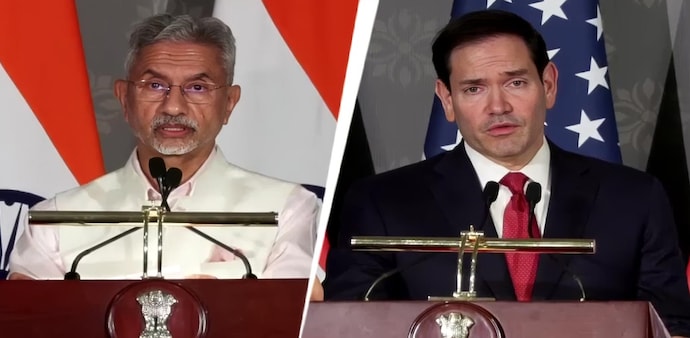
India raised its visa and immigration concerns directly with the United States on Sunday, and got an acknowledgement, if not a resolution. External Affairs Minister S Jaishankar told US Secretary of State Marco Rubio that legal mobility for Indian professionals should not become collateral damage in Washington's broader immigration overhaul. Rubio accepted there would be "some bumps" along the way, but held firm on the direction of the reforms.
The exchange took place at a joint press conference following wide-ranging talks between the two sides, set against the backdrop of a relationship that has been under strain for much of the past year.
What Jaishankar said
Jaishankar directly stated the concerns India was raising. "People-to-people ties are at the heart of the (India-US) relationship. I apprised Secretary Rubio of challenges that legitimate travellers face in respect to visa issuance," he said.
He made clear that India's expectation is for proportionality: that efforts to address illegal migration should not penalise those moving through legitimate channels. "While we cooperate to deal with illegal and irregular mobility, our expectation is that legal mobility would not be adversely impacted as a consequence. After all, this is very relevant to our business, technology and research cooperation," he said.
The concerns did not arise out of the blue. Washington's new approach to H1B visas has affected a significant number of Indians, and a recent directive from the US Citizenship and Immigration Services, requiring green card applicants to return to their home countries to apply, has generated considerable anxiety among Indian professionals already in the US.
What Rubio said
Rubio addressed the concerns but defended the administration's course. He framed the disruption as an unavoidable feature of systemic reform rather than a targeted measure. "Anytime you undertake a reform, any time you undertake a change in the system by which you admit people, there's going to be a period of transition that's going to create some friction points and some difficulties," he said.
He was emphatic that India was not the target. "It is not a system that is targeted at India; it is one that's being applied globally. But we're in a period of transition, and like any period of transition, there's going to be some bumps on that road."
On the green card changes specifically, Rubio pointed to the scale of illegal immigration the US had been dealing with. "We've had a migration crisis in the United States. This is not because of India, but broadly, we have had over 20 million people illegally enter the United States over the last few years, and we have had to address that challenge," he said. "The US is the most welcoming country in the world on immigration."
He said the end goal was a better system. "We think ultimately our destination is going to be a better system, a more efficient system, one that works better than the one that we had in place previously and more sustainable by the way."
The broader context: Repairing a strained relationship
Rubio's visit comes more than five weeks after Foreign Secretary Vikram Misri travelled to Washington to begin the process of stabilising ties that had deteriorated sharply. The relationship had taken several hits, Washington's punitive tariffs on India, Trump's repeated public claims that he had personally de-escalated the India-Pakistan military conflict last May, the H1B fee hike and the new immigration directives.
New Delhi consistently rejected Trump's characterisation of the India-Pakistan ceasefire, maintaining it was the result of direct bilateral talks between the two countries and had nothing to do with US involvement.
(With inputs from PTI)
India raised its visa and immigration concerns directly with the United States on Sunday, and got an acknowledgement, if not a resolution. External Affairs Minister S Jaishankar told US Secretary of State Marco Rubio that legal mobility for Indian professionals should not become collateral damage in Washington's broader immigration overhaul. Rubio accepted there would be "some bumps" along the way, but held firm on the direction of the reforms.
The exchange took place at a joint press conference following wide-ranging talks between the two sides, set against the backdrop of a relationship that has been under strain for much of the past year.
What Jaishankar said
Jaishankar directly stated the concerns India was raising. "People-to-people ties are at the heart of the (India-US) relationship. I apprised Secretary Rubio of challenges that legitimate travellers face in respect to visa issuance," he said.
He made clear that India's expectation is for proportionality: that efforts to address illegal migration should not penalise those moving through legitimate channels. "While we cooperate to deal with illegal and irregular mobility, our expectation is that legal mobility would not be adversely impacted as a consequence. After all, this is very relevant to our business, technology and research cooperation," he said.
The concerns did not arise out of the blue. Washington's new approach to H1B visas has affected a significant number of Indians, and a recent directive from the US Citizenship and Immigration Services, requiring green card applicants to return to their home countries to apply, has generated considerable anxiety among Indian professionals already in the US.
What Rubio said
Rubio addressed the concerns but defended the administration's course. He framed the disruption as an unavoidable feature of systemic reform rather than a targeted measure. "Anytime you undertake a reform, any time you undertake a change in the system by which you admit people, there's going to be a period of transition that's going to create some friction points and some difficulties," he said.
He was emphatic that India was not the target. "It is not a system that is targeted at India; it is one that's being applied globally. But we're in a period of transition, and like any period of transition, there's going to be some bumps on that road."
On the green card changes specifically, Rubio pointed to the scale of illegal immigration the US had been dealing with. "We've had a migration crisis in the United States. This is not because of India, but broadly, we have had over 20 million people illegally enter the United States over the last few years, and we have had to address that challenge," he said. "The US is the most welcoming country in the world on immigration."
He said the end goal was a better system. "We think ultimately our destination is going to be a better system, a more efficient system, one that works better than the one that we had in place previously and more sustainable by the way."
The broader context: Repairing a strained relationship
Rubio's visit comes more than five weeks after Foreign Secretary Vikram Misri travelled to Washington to begin the process of stabilising ties that had deteriorated sharply. The relationship had taken several hits, Washington's punitive tariffs on India, Trump's repeated public claims that he had personally de-escalated the India-Pakistan military conflict last May, the H1B fee hike and the new immigration directives.
New Delhi consistently rejected Trump's characterisation of the India-Pakistan ceasefire, maintaining it was the result of direct bilateral talks between the two countries and had nothing to do with US involvement.
(With inputs from PTI)