
US Visa Bulletin: China nearly 8 years ahead of India in EB-2, EB-3 green card queue
When the number of applicants waiting for green cards substantially exceeds the number of visas available, the backlog can persist for years
- Nov 28, 2026,
- Updated Nov 28, 2026 4:30 AM IST
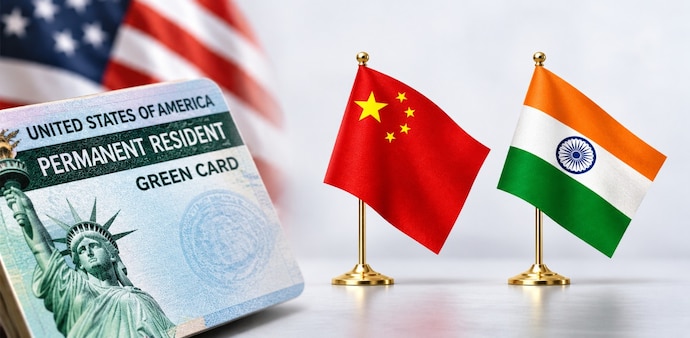
The December 2026 US Visa Bulletin highlights a significant disparity between Indian-born and mainland China-born applicants waiting for employment-based green cards, with China nearly eight years ahead of India in two major immigration categories.
According to the US Department of State’s December bulletin, the EB-2 Final Action Date for mainland China-born applicants is October 1, 2021, while the cut-off for India is November 1, 2013.
In the EB-3 category, China’s date is January 22, 2022, compared with January 22, 2014, for India. The difference is considerably smaller in EB-1, where China’s cut-off is August 1, 2023, and India’s is February 1, 2023.
The dates indicate how far each category’s queue has progressed. They do not represent the exact waiting period for every applicant, as individual timelines depend on priority dates, eligibility and future visa availability.
READ THIS: US Visa Bulletin December 2026: India EB-1, EB-2, EB-3 dates unchanged. Check details
India-China green card backlog: Key differences
| Employment-based category | China | India | Approximate gap |
|---|---|---|---|
| EB-1 | August 1, 2023 | February 1, 2023 | 6 months |
| EB-2 | October 1, 2021 Advertisement | November 1, 2013 | Nearly 8 years |
| EB-3 | January 22, 2022 | January 22, 2014 | 8 years |
Source: US Department of State, December 2026 Visa Bulletin.
Why is India’s green card backlog significantly larger?
Higher demand from Indian applicants
A key factor behind the disparity is the high volume of Indian professionals seeking permanent residence in the US. Immigration data compiled by the American Immigration Council has shown that Indian-born applicants account for a disproportionately large share of approved employment-based immigrant petitions awaiting visa availability.
When the number of applicants waiting for green cards substantially exceeds the number of visas available, the backlog can persist for years. Even after an employer-sponsored petition is approved, an applicant may have to wait until their priority date becomes eligible under the relevant Visa Bulletin category.
Annual visa limits and the per-country cap
The US immigration system operates under statutory limits on employment-based immigrant visas. It also generally applies a 7% per-country limit to the combined annual allocation for family-sponsored and employment-based preference immigrants, subject to exceptions under immigration law.
These limits are particularly significant for countries with high demand. India’s large pool of applicants means that available visa numbers cannot necessarily keep pace with the number of people waiting. China also faces substantial demand, but its cut-off dates in EB-2 and EB-3 are considerably more advanced than India’s.
The per-country limit is therefore an important part of the explanation, although it is not the only factor determining how quickly dates move.
Different levels of accumulated demand across categories
The December bulletin also shows that the gap is not uniform across all employment-based routes.
EB-1 covers priority workers, including people with extraordinary ability, certain outstanding professors and researchers, and qualifying multinational executives and managers. Its cut-off dates show a difference of around six months between China and India.
EB-2 covers professionals with advanced degrees and individuals with exceptional ability, while EB-3 includes skilled workers, professionals and certain other workers. The much larger gaps in EB-2 and EB-3 illustrate how accumulated demand can differ substantially between categories.
Applicants cannot simply switch between these categories to avoid a backlog. Each has separate eligibility requirements, and an applicant’s options depend on their qualifications and circumstances.