
Davos 2026: Savings shift to markets irreversible, banks to adjust funding strategy, says SBI chairman
SBI chairman C S Setty said a structural shift in household savings from bank deposits to market-linked instruments, which is reshaping the financial system and is unlikely to reverse. He said banks will need to adapt their funding strategies as India strengthens its resilience amid global uncertainty.
- Jan 22, 2026,
- Updated Jan 22, 2026 4:34 PM IST
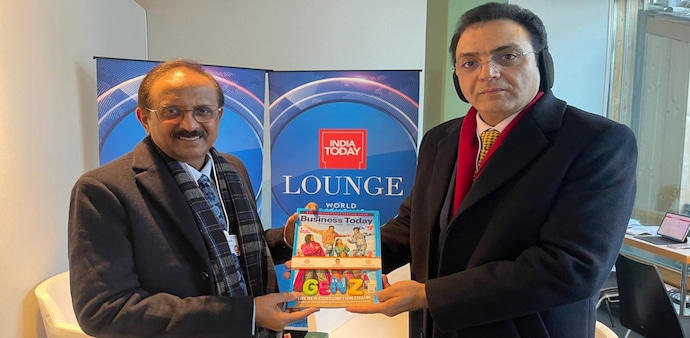
Challa Sreenivasulu Setty, Chairman of State Bank of India (SBI), on Thursday said a structural shift in household savings away from traditional bank deposits towards market-linked instruments such as mutual funds, insurance and pension products is firmly underway and largely irreversible. As financial markets deepen and households gain access to a wider range of investment options, this transition is expected to reshape how banks fund their balance sheets and support economic growth.
Setty noted that while bank deposit growth is currently tracking at about one times, mutual fund growth is running at nearly three times that pace. This divergence, he said, reflects changing investor behaviour as households increasingly seek higher returns and diversified savings avenues. “As economies mature and individuals gain access to non-banking financial savings instruments, this structural shift is here to stay,” he said. According to Setty, banks will need to adapt by accessing capital markets more actively, particularly debt markets, to fund asset growth. Over time, he added, savings flowing into mutual funds, pension funds and insurance will ultimately cycle back into the real economy, supporting bank capital-raising and credit expansion.
Speaking at Davos 2026 on the sidelines of global discussions, Setty placed these domestic shifts within the broader context of India’s economic resilience amid global uncertainty. He said India has managed geopolitical disruptions, tariff-related challenges and trade dislocations better than many peers. A combination of fiscal prudence, calibrated monetary support and sustained public investment in infrastructure has strengthened the country’s capacity to absorb external shocks, he said.
FTAs and trade strategy
Setty identified India’s evolving trade strategy as another key pillar underpinning resilience. He said the country’s approach to free trade agreements (FTAs) has become more pragmatic, moving away from rigid or ideological positions towards arrangements that deliver mutual benefits. “It is no longer about giving away everything or giving away nothing. The focus is on what kind of trade facilitation can be achieved,” he said. While the government negotiates FTAs, their effective use depends on industry, he added, expressing confidence that industry bodies are actively working to maximise these opportunities.
He also pointed out that FTAs have enabled greater geographical diversification of India’s trade, reducing reliance on a limited set of export destinations. This diversification, Setty said, has helped cushion exporters from region-specific volatility. As India’s largest trade finance provider, SBI continues to play a central role in this process. Of its $90 billion overseas book, around $25–27 billion is dedicated to trade finance, predominantly supporting Indian corporates accessing global markets.
Domestic credit environment
On the domestic front, Setty said policy rate cuts of about 125 basis points over the past 12 to 15 months have led to a broad softening of lending rates across retail and corporate loans. However, transmission on the corporate side has been slower than expected due to sticky deposit costs. Deposit growth has lagged credit growth, constraining banks’ ability to reduce lending rates more aggressively. Even so, Setty said a combination of monetary and fiscal measures is supporting healthy credit expansion, which he expects to remain sustainable in the 12–14% range.
Reflecting on discussions at Davos, Setty said India’s resilience story has been a recurring theme for the second consecutive year. He cited IMF estimates and internal projections that place India’s GDP growth at around 7.5%, reinforcing confidence in the medium-term outlook. “Both calendar year 2026 and FY27 are shaping up very well for India,” he said, pointing to a robust banking system and continued prudential fiscal management by the government.
Setty acknowledged that India remains interconnected with the global economy and cannot be completely insulated from external shocks. However, he said reforms over the past decade — including legislative changes, fiscal measures and a comprehensive clean-up of bank balance sheets through asset quality reviews and recapitalisation — have significantly strengthened the financial system. “India may not be decoupled from the world, but it is much better positioned to handle disruptions,” he said, expressing confidence that the country’s growth and stability will endure.
Challa Sreenivasulu Setty, Chairman of State Bank of India (SBI), on Thursday said a structural shift in household savings away from traditional bank deposits towards market-linked instruments such as mutual funds, insurance and pension products is firmly underway and largely irreversible. As financial markets deepen and households gain access to a wider range of investment options, this transition is expected to reshape how banks fund their balance sheets and support economic growth.
Setty noted that while bank deposit growth is currently tracking at about one times, mutual fund growth is running at nearly three times that pace. This divergence, he said, reflects changing investor behaviour as households increasingly seek higher returns and diversified savings avenues. “As economies mature and individuals gain access to non-banking financial savings instruments, this structural shift is here to stay,” he said. According to Setty, banks will need to adapt by accessing capital markets more actively, particularly debt markets, to fund asset growth. Over time, he added, savings flowing into mutual funds, pension funds and insurance will ultimately cycle back into the real economy, supporting bank capital-raising and credit expansion.
Speaking at Davos 2026 on the sidelines of global discussions, Setty placed these domestic shifts within the broader context of India’s economic resilience amid global uncertainty. He said India has managed geopolitical disruptions, tariff-related challenges and trade dislocations better than many peers. A combination of fiscal prudence, calibrated monetary support and sustained public investment in infrastructure has strengthened the country’s capacity to absorb external shocks, he said.
FTAs and trade strategy
Setty identified India’s evolving trade strategy as another key pillar underpinning resilience. He said the country’s approach to free trade agreements (FTAs) has become more pragmatic, moving away from rigid or ideological positions towards arrangements that deliver mutual benefits. “It is no longer about giving away everything or giving away nothing. The focus is on what kind of trade facilitation can be achieved,” he said. While the government negotiates FTAs, their effective use depends on industry, he added, expressing confidence that industry bodies are actively working to maximise these opportunities.
He also pointed out that FTAs have enabled greater geographical diversification of India’s trade, reducing reliance on a limited set of export destinations. This diversification, Setty said, has helped cushion exporters from region-specific volatility. As India’s largest trade finance provider, SBI continues to play a central role in this process. Of its $90 billion overseas book, around $25–27 billion is dedicated to trade finance, predominantly supporting Indian corporates accessing global markets.
Domestic credit environment
On the domestic front, Setty said policy rate cuts of about 125 basis points over the past 12 to 15 months have led to a broad softening of lending rates across retail and corporate loans. However, transmission on the corporate side has been slower than expected due to sticky deposit costs. Deposit growth has lagged credit growth, constraining banks’ ability to reduce lending rates more aggressively. Even so, Setty said a combination of monetary and fiscal measures is supporting healthy credit expansion, which he expects to remain sustainable in the 12–14% range.
Reflecting on discussions at Davos, Setty said India’s resilience story has been a recurring theme for the second consecutive year. He cited IMF estimates and internal projections that place India’s GDP growth at around 7.5%, reinforcing confidence in the medium-term outlook. “Both calendar year 2026 and FY27 are shaping up very well for India,” he said, pointing to a robust banking system and continued prudential fiscal management by the government.
Setty acknowledged that India remains interconnected with the global economy and cannot be completely insulated from external shocks. However, he said reforms over the past decade — including legislative changes, fiscal measures and a comprehensive clean-up of bank balance sheets through asset quality reviews and recapitalisation — have significantly strengthened the financial system. “India may not be decoupled from the world, but it is much better positioned to handle disruptions,” he said, expressing confidence that the country’s growth and stability will endure.