
Diwali boom: Can gold hit Rs 3 lakh by 2030? Expert weighs in after 67% rally in 2025
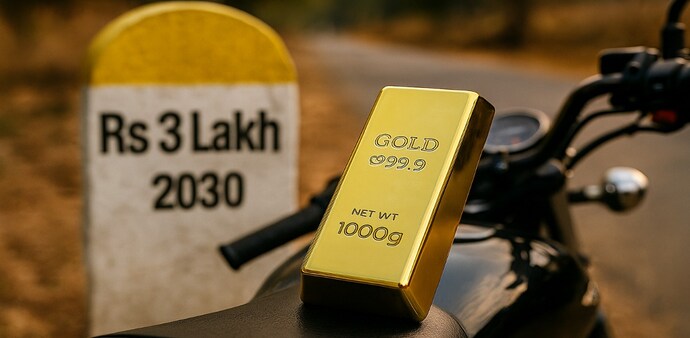
Gold’s record-breaking rally in 2025 has stunned markets and investors alike, sparking bold predictions about its future trajectory. As prices soar 67% this year alone, experts debate whether gold could touch Rs 3 lakh per 10 grams by 2030 — or if a correction is looming first.
- Oct 20, 2025,
- Updated Oct 20, 2025 10:50 AM IST
Gold’s spectacular rally through 2025 has reignited debate among investors about just how high the yellow metal can go. On October 16, gold prices in India hit an all-time high of Rs 1,28,395 per 10 grams, marking a stunning 67% rise since January.
Gold prices saw a sharp rally in 2025, significantly outperforming equity markets. Between December 31, 2024, and October 14, 2025, MCX gold futures jumped more than 64%, while the BSE Sensex recorded only a modest 5% gain during the same period.
The surge has left analysts split between two camps — one predicting a continued uptrend that could take gold to Rs 3 lakh per 10 grams by 2030, and another warning of an imminent correction.
According to Rahul Jain, SEBI-registered research analyst, “In the last 100 years of gold history, such a move has never happened. Gold prices have doubled in just 18 months. No economist or fortune teller predicted this kind of rally.”
While bulls cite long-term structural factors supporting gold’s rise, bears caution that the metal is now “overbought” and due for a pullback. Understanding the forces behind the rally can help investors separate hype from opportunity.
What's driving the boom?
Data suggests that the current gold rally is primarily driven by private investors, not central banks. In 2025 alone, global inflows into gold ETFs exceeded $64 billion by September — almost four times the total investment in 2024. Notably, over 50% of these flows came from North America, as U.S. investors sought refuge amid policy uncertainty, a weakening dollar, and lower bond yields.
“Trade tensions, US rate cuts, and momentum-driven demand have all contributed to the gold rush,” Jain explained. “When prices rise, more investors pile in, creating a self-reinforcing cycle.”
On the other hand, central banks — which were major buyers in 2023 — have slowed their purchases in 2025. Yet, countries like Poland, Kazakhstan, China, and Turkey continue to hoard gold aggressively, adding over 70 tonnes collectively this year. Analysts expect central bank demand to pick up again by 2026–2027, especially if geopolitical uncertainty persists.
Is Rs 3 lakh a realistic target?
Long-term data offers intriguing clues. Historically, private investors held nearly 8% of their wealth in gold during the 1980s. That figure dropped to 2–3% in the 2010s but is now rising again, suggesting ample headroom for continued accumulation. Similarly, central banks currently hold around 20–22% of reserves in gold, far below past levels of 50–60%.
“If both private investors and central banks move their gold allocation back to historical averages, demand could easily push prices far higher,” Jain said. “A 5–10 year upcycle could indeed make ₹3 lakh per 10 grams a possibility.”
Short-term warning
However, the short term may not be as glittering. Gold buying globally has already approached 1,250 tonnes in 2025 — a level that historically triggers corrections. The metal is also trading well above its 200-day moving average, a technical pattern that has often preceded downturns.
Jain cautioned investors to wait for prices to test the 200-day average before re-entering the market. “That’s my logical entry point,” he said. “Never chase highs — build your gold exposure gradually, ideally through SIPs or staggered purchases.”
How to invest smartly
For investors, gold ETFs remain a preferred route due to liquidity and transparency. Key metrics to check include 3-month average trading volume, expense ratio, and the difference between NAV and market price. “Avoid ETFs trading at a premium to NAV — it means you’re overpaying,” Jain advised.
Bottom line: Gold remains a strategic long-term hedge, especially amid global uncertainty. While a short-term correction is likely, the long-term trajectory — backed by sustained institutional and retail demand — keeps the dream of Rs 3 lakh gold by 2030 very much alive.
Gold’s spectacular rally through 2025 has reignited debate among investors about just how high the yellow metal can go. On October 16, gold prices in India hit an all-time high of Rs 1,28,395 per 10 grams, marking a stunning 67% rise since January.
Gold prices saw a sharp rally in 2025, significantly outperforming equity markets. Between December 31, 2024, and October 14, 2025, MCX gold futures jumped more than 64%, while the BSE Sensex recorded only a modest 5% gain during the same period.
The surge has left analysts split between two camps — one predicting a continued uptrend that could take gold to Rs 3 lakh per 10 grams by 2030, and another warning of an imminent correction.
According to Rahul Jain, SEBI-registered research analyst, “In the last 100 years of gold history, such a move has never happened. Gold prices have doubled in just 18 months. No economist or fortune teller predicted this kind of rally.”
While bulls cite long-term structural factors supporting gold’s rise, bears caution that the metal is now “overbought” and due for a pullback. Understanding the forces behind the rally can help investors separate hype from opportunity.
What's driving the boom?
Data suggests that the current gold rally is primarily driven by private investors, not central banks. In 2025 alone, global inflows into gold ETFs exceeded $64 billion by September — almost four times the total investment in 2024. Notably, over 50% of these flows came from North America, as U.S. investors sought refuge amid policy uncertainty, a weakening dollar, and lower bond yields.
“Trade tensions, US rate cuts, and momentum-driven demand have all contributed to the gold rush,” Jain explained. “When prices rise, more investors pile in, creating a self-reinforcing cycle.”
On the other hand, central banks — which were major buyers in 2023 — have slowed their purchases in 2025. Yet, countries like Poland, Kazakhstan, China, and Turkey continue to hoard gold aggressively, adding over 70 tonnes collectively this year. Analysts expect central bank demand to pick up again by 2026–2027, especially if geopolitical uncertainty persists.
Is Rs 3 lakh a realistic target?
Long-term data offers intriguing clues. Historically, private investors held nearly 8% of their wealth in gold during the 1980s. That figure dropped to 2–3% in the 2010s but is now rising again, suggesting ample headroom for continued accumulation. Similarly, central banks currently hold around 20–22% of reserves in gold, far below past levels of 50–60%.
“If both private investors and central banks move their gold allocation back to historical averages, demand could easily push prices far higher,” Jain said. “A 5–10 year upcycle could indeed make ₹3 lakh per 10 grams a possibility.”
Short-term warning
However, the short term may not be as glittering. Gold buying globally has already approached 1,250 tonnes in 2025 — a level that historically triggers corrections. The metal is also trading well above its 200-day moving average, a technical pattern that has often preceded downturns.
Jain cautioned investors to wait for prices to test the 200-day average before re-entering the market. “That’s my logical entry point,” he said. “Never chase highs — build your gold exposure gradually, ideally through SIPs or staggered purchases.”
How to invest smartly
For investors, gold ETFs remain a preferred route due to liquidity and transparency. Key metrics to check include 3-month average trading volume, expense ratio, and the difference between NAV and market price. “Avoid ETFs trading at a premium to NAV — it means you’re overpaying,” Jain advised.
Bottom line: Gold remains a strategic long-term hedge, especially amid global uncertainty. While a short-term correction is likely, the long-term trajectory — backed by sustained institutional and retail demand — keeps the dream of Rs 3 lakh gold by 2030 very much alive.