
'Indian love for gold is difficult to understand' - NITI Aayog VC Dr. Ashok Lahiri | India Today Exclusive
'Indian love for gold is difficult to understand' - NITI Aayog VC Dr. Ashok Lahiri | India Today Exclusive
Addressing the recent hike in gold import duties and India's cultural relationship with the precious metal, Dr. Lahiri noted: "If you do not buy gold, you will spend that money on something else, or, hopefully, save it in the bank where it can be reinvested by someone else."
Business Today Desk
- May 17, 2026,
- Updated May 17, 2026 2:11 AM IST
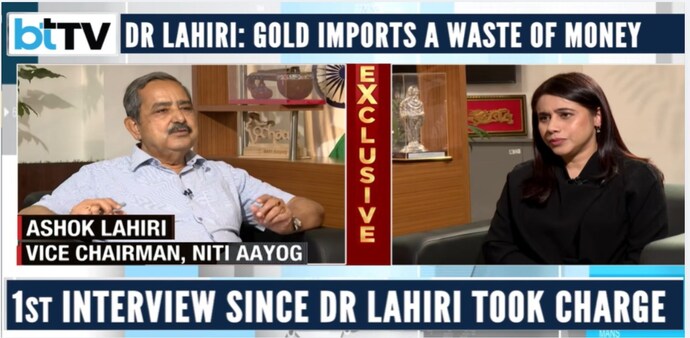
In an exclusive interview with India Today Group’s Marya Shakil, Dr. Ashok Lahiri, the Vice Chairperson of NITI Aayog, spoke on a wide range of economic topics. In his first interview since taking charge, Dr. Lahiri addressed the West Asia crisis, the gold import duty hike, investments, savings, forex reserves, consumption, and national growth.
Advertisement
On the West Asia crisis and appeal by PM Modi
Responding to Prime Minister Narendra Modi's appeal for citizens to conserve foreign exchange by watching their expenditures, Dr. Lahiri explained the reason behind the call for financial caution:
"I'm surprised that some people are questioning this national austerity. National austerity is simply another term for national savings, and avoiding unnecessary spending is always a good thing. Take avoiding gold imports, for example. We import more when we spend more than what we earn. That is just natural arithmetic."
On Consumption vs. Growth
When asked if a drop in consumption would negatively impact economic growth, Dr. Lahiri explained the balance between consumption and investment using the Asian economic model:
-
The Demand Equation: Consumption is only one source of demand; the other is investment. Total demand equals consumption plus investment.
Advertisement -
The Balance of Savings: A problem arises if people stop both consuming and investing. However, investments must be funded from somewhere—specifically, from domestic savings borrowed through banks.
-
When Under-Consumption is a Problem: Under-consumption is only an issue if investment is slow. If investment is stagnant, you encourage people to consume. But if investment picks up, it drives the economy.
-
The Global Models: The US developed using a high-consumption model, financing investments through foreign savings. Conversely, the "Asian model" seen in East Asia and China relies on financing investment through domestic savings.
Dr. Lahiri concluded this point by stating, "So, are we suffering from an under-consumption problem? I doubt it."
On the Gold Import Duty Hike
Addressing the recent hike in gold import duties and India's cultural relationship with the precious metal, Dr. Lahiri noted:
Advertisement
"If you do not buy gold, you will spend that money on something else, or, hopefully, save it in the bank where it can be reinvested by someone else. Personally, I don't quite understand gold—though perhaps it's in my blood, too. Our love for gold, the Indian love for gold, is absolutely difficult to understand."
WATCH Full Interview of Dr. Ashok Lahiri here:-
FAQs
- +−
Why did PM Modi appeal to citizens to conserve foreign exchange, according to Dr. Ashok Lahiri?
Dr. Lahiri said the appeal reflects national austerity, which is another way of saying higher national savings. He explained that avoiding unnecessary spending, especially on imports like gold, can help reduce pressure on foreign exchange.
- +−
What was Dr. Ashok Lahiri’s view on the gold import duty hike and India’s love for gold?
He suggested that if people buy less gold, the money may be spent elsewhere or saved in banks, where it can support investment. He also remarked that India’s deep attachment to gold is culturally strong and not easy to explain.
- +−
Does lower consumption always hurt economic growth?
No. Dr. Lahiri said consumption is only one part of total demand, while investment is the other. If investment rises strongly, it can support growth even when consumption is relatively weak.
- +−
When does under-consumption become a real economic problem?
Dr. Lahiri said under-consumption becomes a concern mainly when investment is slow or stagnant. In such a situation, encouraging people to spend more may help support demand and economic activity.
- +−
How does the Asian growth model differ from the US growth model?
According to Dr. Lahiri, the US followed a high-consumption model and often financed investment through foreign savings. In contrast, many Asian economies, including East Asia and China, relied more on domestic savings to fund investment.
In an exclusive interview with India Today Group’s Marya Shakil, Dr. Ashok Lahiri, the Vice Chairperson of NITI Aayog, spoke on a wide range of economic topics. In his first interview since taking charge, Dr. Lahiri addressed the West Asia crisis, the gold import duty hike, investments, savings, forex reserves, consumption, and national growth.
Advertisement
On the West Asia crisis and appeal by PM Modi
Responding to Prime Minister Narendra Modi's appeal for citizens to conserve foreign exchange by watching their expenditures, Dr. Lahiri explained the reason behind the call for financial caution:
"I'm surprised that some people are questioning this national austerity. National austerity is simply another term for national savings, and avoiding unnecessary spending is always a good thing. Take avoiding gold imports, for example. We import more when we spend more than what we earn. That is just natural arithmetic."
On Consumption vs. Growth
When asked if a drop in consumption would negatively impact economic growth, Dr. Lahiri explained the balance between consumption and investment using the Asian economic model:
-
The Demand Equation: Consumption is only one source of demand; the other is investment. Total demand equals consumption plus investment.
Advertisement -
The Balance of Savings: A problem arises if people stop both consuming and investing. However, investments must be funded from somewhere—specifically, from domestic savings borrowed through banks.
-
When Under-Consumption is a Problem: Under-consumption is only an issue if investment is slow. If investment is stagnant, you encourage people to consume. But if investment picks up, it drives the economy.
-
The Global Models: The US developed using a high-consumption model, financing investments through foreign savings. Conversely, the "Asian model" seen in East Asia and China relies on financing investment through domestic savings.
Dr. Lahiri concluded this point by stating, "So, are we suffering from an under-consumption problem? I doubt it."
On the Gold Import Duty Hike
Addressing the recent hike in gold import duties and India's cultural relationship with the precious metal, Dr. Lahiri noted:
Advertisement
"If you do not buy gold, you will spend that money on something else, or, hopefully, save it in the bank where it can be reinvested by someone else. Personally, I don't quite understand gold—though perhaps it's in my blood, too. Our love for gold, the Indian love for gold, is absolutely difficult to understand."
WATCH Full Interview of Dr. Ashok Lahiri here:-
Read more!