
Ray Dalio urges 10–15% gold allocation amid US stock market 'heart attack' fears
Ray Dalio, founder of Bridgewater Associates, warns that mounting US debt and geopolitical tensions put stock markets at risk of a 'heart attack', advising investors to allocate 10–15% of portfolios to gold as a hedge. Gold prices have risen 40% this year.
- Sep 13, 2025,
- Updated Sep 13, 2025 11:03 AM IST
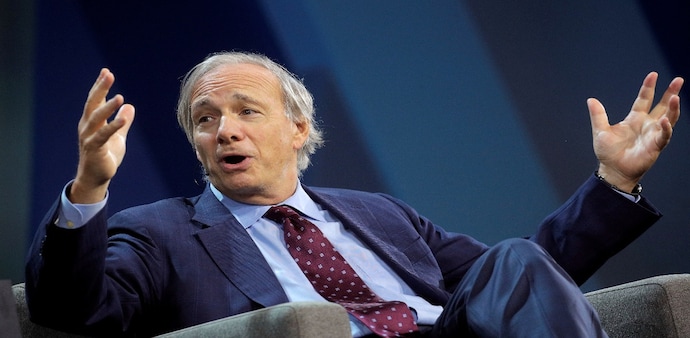
Billionaire investor Ray Dalio, founder of Bridgewater Associates, has issued a stark warning: the US stock market could be headed for a “heart attack”. His analogy points to record-high equity valuations and ballooning US debt that risks crowding out future spending—similar to how plaque clogs arteries.
Dalio cited record-high equity valuations and mounting US government debt as key factors contributing to potential instability. He stated that as the US spends more to service its debt, it "squeezes out other spending", drawing a parallel to plaque accumulation in a human circulatory system. Dalio's comments, delivered at an Abu Dhabi Finance Week event, come as geopolitical tensions escalate and economic uncertainties persist.
Dalio’s prescription for investors? Rebalance portfolios and allocate 10–15% to gold. He argues that gold is a time-tested store of value, offering diversification and protection when traditional assets stumble. “A well-diversified portfolio would have somewhere between 10% and 15% in gold,” he noted, emphasising its role as a crisis hedge.
Dalio argued that gold's lack of correlation with other asset classes makes it especially valuable when markets are volatile, as its price tends to rise when other investments falter. This strategic allocation is intended to help preserve wealth amid uncertain economic conditions.
The advice comes as US markets remain buoyant, with the S&P 500 and Nasdaq up double digits this year. Yet Dalio warns that investors must look past short-term rallies and ask, “Whose money do you own?”—a reminder to assess risks carefully in a debt-laden economy.
The backdrop to Dalio's warning is a buoyant US equities market, with the S&P 500 and Nasdaq indices rising over 11% and 13% this year, respectively, according to recent reports. Both indices recently closed at record highs, buoyed by softer inflation data and expectations of a US Federal Reserve interest rate cut. Despite this optimism, Dalio has cautioned investors to ask themselves, "Whose money do you own?" when constructing robust and resilient portfolios, stressing the importance of careful risk assessment as market conditions evolve.
Gold prices have surged by about 40% this year, marking a fourth consecutive weekly gain and reflecting increased demand amid global uncertainty, dovish monetary policy, and strong central bank buying. The yellow metal’s record performance underscores Dalio’s view that gold remains an effective portfolio hedge. As economic and geopolitical risks persist, investors are increasingly turning to gold to offset the vulnerabilities exposed by mounting global debt and fluctuating market sentiment
Central bank buying, a weaker US dollar, and geopolitical tensions have all pushed prices higher, underlining its appeal. Still, for new investors, chasing gold at peaks may feel risky. Experts suggest a phased, staggered approach: accumulate gradually through gold ETFs or sovereign gold bonds, instead of deploying large sums at once.
Billionaire investor Ray Dalio, founder of Bridgewater Associates, has issued a stark warning: the US stock market could be headed for a “heart attack”. His analogy points to record-high equity valuations and ballooning US debt that risks crowding out future spending—similar to how plaque clogs arteries.
Dalio cited record-high equity valuations and mounting US government debt as key factors contributing to potential instability. He stated that as the US spends more to service its debt, it "squeezes out other spending", drawing a parallel to plaque accumulation in a human circulatory system. Dalio's comments, delivered at an Abu Dhabi Finance Week event, come as geopolitical tensions escalate and economic uncertainties persist.
Dalio’s prescription for investors? Rebalance portfolios and allocate 10–15% to gold. He argues that gold is a time-tested store of value, offering diversification and protection when traditional assets stumble. “A well-diversified portfolio would have somewhere between 10% and 15% in gold,” he noted, emphasising its role as a crisis hedge.
Dalio argued that gold's lack of correlation with other asset classes makes it especially valuable when markets are volatile, as its price tends to rise when other investments falter. This strategic allocation is intended to help preserve wealth amid uncertain economic conditions.
The advice comes as US markets remain buoyant, with the S&P 500 and Nasdaq up double digits this year. Yet Dalio warns that investors must look past short-term rallies and ask, “Whose money do you own?”—a reminder to assess risks carefully in a debt-laden economy.
The backdrop to Dalio's warning is a buoyant US equities market, with the S&P 500 and Nasdaq indices rising over 11% and 13% this year, respectively, according to recent reports. Both indices recently closed at record highs, buoyed by softer inflation data and expectations of a US Federal Reserve interest rate cut. Despite this optimism, Dalio has cautioned investors to ask themselves, "Whose money do you own?" when constructing robust and resilient portfolios, stressing the importance of careful risk assessment as market conditions evolve.
Gold prices have surged by about 40% this year, marking a fourth consecutive weekly gain and reflecting increased demand amid global uncertainty, dovish monetary policy, and strong central bank buying. The yellow metal’s record performance underscores Dalio’s view that gold remains an effective portfolio hedge. As economic and geopolitical risks persist, investors are increasingly turning to gold to offset the vulnerabilities exposed by mounting global debt and fluctuating market sentiment
Central bank buying, a weaker US dollar, and geopolitical tensions have all pushed prices higher, underlining its appeal. Still, for new investors, chasing gold at peaks may feel risky. Experts suggest a phased, staggered approach: accumulate gradually through gold ETFs or sovereign gold bonds, instead of deploying large sums at once.