
'When sticker shock hits...': CA explains why gold’s glitter is fading as record prices hit demand
The financial expert noted that while jewellery demand is weakening, investment demand — in the form of coins, bars and ETFs — is gaining momentum. Consumers are increasingly preferring the asset value of gold rather than paying additional making charges attached to ornaments.
- Oct 2, 2025,
- Updated Oct 2, 2025 2:40 PM IST
India’s traditional festive sparkle may look a little subdued this year. Gold jewelry sales — a cultural staple during Navratri, Dhanteras and Diwali — are expected to fall by 25-30% in volume, as soaring prices test the limits of consumer sentiment.
In a post on X (formerly Twitter), CA Nitin Kaushik highlighted the changing trend, “Gold jewelry sales in India may fall by nearly 25-30% in volume this festive season. Domestic gold is trading at ₹1,06,800+ per 10g, up 44% this year. Jewelry demand is softening as buyers shift to lighter pieces or alternatives. The love for gold stays, only the form changes.”
Kaushik noted that while jewellery demand is weakening, investment demand — in the form of coins, bars and ETFs — is gaining momentum. Consumers are increasingly preferring the asset value of gold rather than paying additional making charges attached to ornaments.
Gold’s surge
Gold’s climb to over ₹1.06 lakh per 10g is one of the sharpest increases in recent memory. Just a year ago, prices hovered around ₹74,000 per 10g — marking a 44% year-on-year jump.
- Global Drivers: Rising geopolitical tensions, sustained inflationary concerns, and central banks aggressively stocking up on bullion have fueled the rally.
- Domestic Impact: A weaker rupee against the US dollar has amplified the price rise in India, making gold even costlier for local buyers.
- Historical Context: In 2010, gold traded at around ₹18,500 per 10g. Over 15 years, prices have surged nearly six-fold, reinforcing gold’s status as a long-term wealth protector.
Sentiment vs Sticker Shock
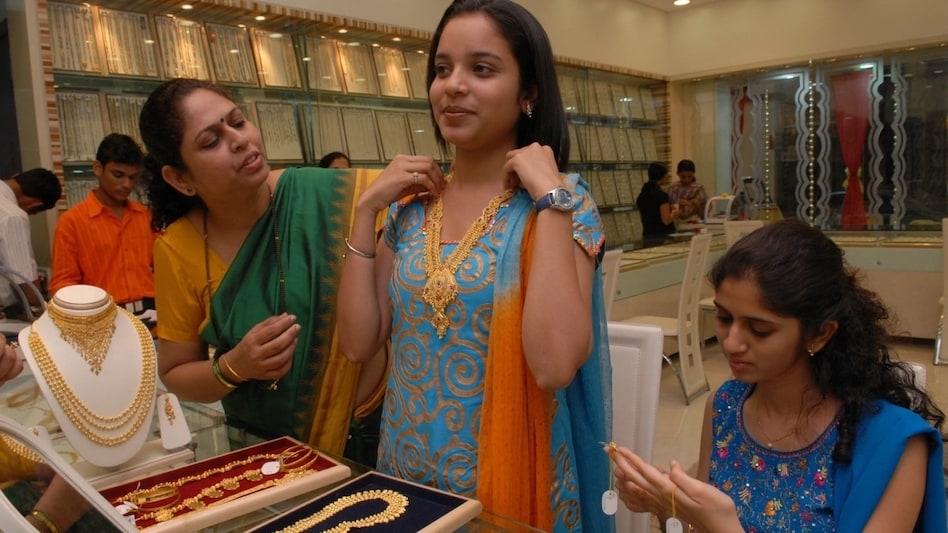
While gold remains an emotional and cultural cornerstone in India, the current price tag is forcing a shift. Consumers are either opting for lighter designs, gold-plated ornaments, or switching to investment-grade bullion. The sentiment endures, but the mode of purchase is adapting to economic realities.
As Kaushik observed, “Emotion drives gold buying in India — but when sticker shock hits, people adapt.” This festive season, the country’s love affair with gold continues, though the jewelry box may look lighter than usual.
India’s traditional festive sparkle may look a little subdued this year. Gold jewelry sales — a cultural staple during Navratri, Dhanteras and Diwali — are expected to fall by 25-30% in volume, as soaring prices test the limits of consumer sentiment.
In a post on X (formerly Twitter), CA Nitin Kaushik highlighted the changing trend, “Gold jewelry sales in India may fall by nearly 25-30% in volume this festive season. Domestic gold is trading at ₹1,06,800+ per 10g, up 44% this year. Jewelry demand is softening as buyers shift to lighter pieces or alternatives. The love for gold stays, only the form changes.”
Kaushik noted that while jewellery demand is weakening, investment demand — in the form of coins, bars and ETFs — is gaining momentum. Consumers are increasingly preferring the asset value of gold rather than paying additional making charges attached to ornaments.
Gold’s surge
Gold’s climb to over ₹1.06 lakh per 10g is one of the sharpest increases in recent memory. Just a year ago, prices hovered around ₹74,000 per 10g — marking a 44% year-on-year jump.
- Global Drivers: Rising geopolitical tensions, sustained inflationary concerns, and central banks aggressively stocking up on bullion have fueled the rally.
- Domestic Impact: A weaker rupee against the US dollar has amplified the price rise in India, making gold even costlier for local buyers.
- Historical Context: In 2010, gold traded at around ₹18,500 per 10g. Over 15 years, prices have surged nearly six-fold, reinforcing gold’s status as a long-term wealth protector.
Sentiment vs Sticker Shock
While gold remains an emotional and cultural cornerstone in India, the current price tag is forcing a shift. Consumers are either opting for lighter designs, gold-plated ornaments, or switching to investment-grade bullion. The sentiment endures, but the mode of purchase is adapting to economic realities.
As Kaushik observed, “Emotion drives gold buying in India — but when sticker shock hits, people adapt.” This festive season, the country’s love affair with gold continues, though the jewelry box may look lighter than usual.