
Women hold bank accounts but miss wealth gains; prosperity index flags big gap: Report
A new report by Lxme and EY India reveals that the country scored 28.1 out of 100 on the Women’s Financial Prosperity Index (WFPI), highlighting how structural barriers continue to limit women’s ability to build wealth.
- Mar 5, 2026,
- Updated Mar 5, 2026 7:49 PM IST
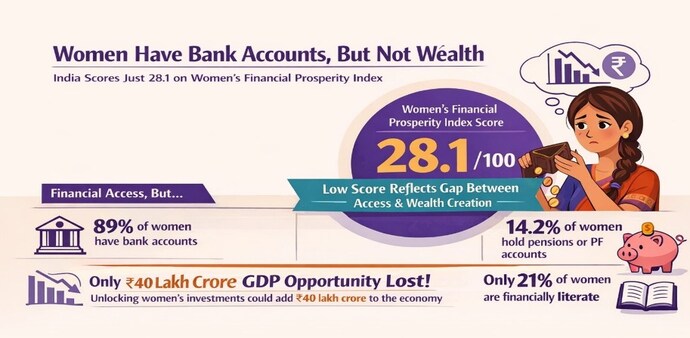
India’s women may have gained unprecedented access to the financial system in recent years, but most remain far from achieving long-term financial prosperity. A new report by Lxme and EY India reveals that the country scored 28.1 out of 100 on the Women’s Financial Prosperity Index (WFPI), highlighting how structural barriers continue to limit women’s ability to build wealth despite significant improvements in financial inclusion.
The report highlights a striking paradox: while financial access among women has expanded rapidly, it has not translated into meaningful financial agency or wealth creation. According to the findings, over 89% of Indian women now hold bank accounts, reflecting one of the fastest expansions of financial inclusion globally. However, most of these accounts are primarily used for transactions or withdrawals rather than for long-term financial planning or investments.
The Women’s Financial Prosperity Index measures not just access to financial services but also women’s participation, decision-making power and ability to accumulate assets. The index evaluates four dimensions — access, inclusion, agency and outcomes — and India’s low overall score indicates that a large portion of women’s financial journey toward wealth creation remains blocked.
For instance, the report found that only 8.6% of Indian women invest in mutual funds or equities, compared with 22.3% of men. Similarly, just 14.2% of women hold pension or provident fund accounts, significantly lower than the 32.8% of men who do so. These gaps highlight how women’s participation in formal financial markets remains limited.
Women also tend to start investing later in life and with smaller amounts. According to the report, women begin investing around five years later than men, and their first investments are typically almost half the size of men’s initial investments. This delay significantly reduces the long-term wealth accumulation potential that comes from compounding returns.
Income disparities and labour force participation also contribute to the challenge. The report notes that women earn ₹73 for every ₹100 earned by men, while only 41.7% of working-age women participate in the labour force, compared with 78.8% of men. A large share of women are employed in informal sectors where income is often volatile and irregular, making consistent investment more difficult.
Financial literacy is another major barrier. Only 21% of Indian women are financially literate, limiting their ability to make informed decisions about savings, investments and retirement planning.
Despite these challenges, the report suggests that empowering women financially could unlock significant economic potential for the country. It estimates that enabling women’s participation in long-term financial investments could create a ₹40 lakh crore GDP-equivalent opportunity, driven by higher domestic savings, deeper capital market participation and sustained long-term investment.
The findings indicate that financial inclusion alone is not enough to achieve economic equality. Policymakers, financial institutions and fintech platforms may need to design products and financial systems that reflect women’s income patterns, life cycles and investment behaviour.
Bridging the gap between financial access and actual wealth creation will be crucial not only for improving women’s financial outcomes but also for strengthening India’s economic growth in the years ahead.
India’s women may have gained unprecedented access to the financial system in recent years, but most remain far from achieving long-term financial prosperity. A new report by Lxme and EY India reveals that the country scored 28.1 out of 100 on the Women’s Financial Prosperity Index (WFPI), highlighting how structural barriers continue to limit women’s ability to build wealth despite significant improvements in financial inclusion.
The report highlights a striking paradox: while financial access among women has expanded rapidly, it has not translated into meaningful financial agency or wealth creation. According to the findings, over 89% of Indian women now hold bank accounts, reflecting one of the fastest expansions of financial inclusion globally. However, most of these accounts are primarily used for transactions or withdrawals rather than for long-term financial planning or investments.
The Women’s Financial Prosperity Index measures not just access to financial services but also women’s participation, decision-making power and ability to accumulate assets. The index evaluates four dimensions — access, inclusion, agency and outcomes — and India’s low overall score indicates that a large portion of women’s financial journey toward wealth creation remains blocked.
For instance, the report found that only 8.6% of Indian women invest in mutual funds or equities, compared with 22.3% of men. Similarly, just 14.2% of women hold pension or provident fund accounts, significantly lower than the 32.8% of men who do so. These gaps highlight how women’s participation in formal financial markets remains limited.
Women also tend to start investing later in life and with smaller amounts. According to the report, women begin investing around five years later than men, and their first investments are typically almost half the size of men’s initial investments. This delay significantly reduces the long-term wealth accumulation potential that comes from compounding returns.
Income disparities and labour force participation also contribute to the challenge. The report notes that women earn ₹73 for every ₹100 earned by men, while only 41.7% of working-age women participate in the labour force, compared with 78.8% of men. A large share of women are employed in informal sectors where income is often volatile and irregular, making consistent investment more difficult.
Financial literacy is another major barrier. Only 21% of Indian women are financially literate, limiting their ability to make informed decisions about savings, investments and retirement planning.
Despite these challenges, the report suggests that empowering women financially could unlock significant economic potential for the country. It estimates that enabling women’s participation in long-term financial investments could create a ₹40 lakh crore GDP-equivalent opportunity, driven by higher domestic savings, deeper capital market participation and sustained long-term investment.
The findings indicate that financial inclusion alone is not enough to achieve economic equality. Policymakers, financial institutions and fintech platforms may need to design products and financial systems that reflect women’s income patterns, life cycles and investment behaviour.
Bridging the gap between financial access and actual wealth creation will be crucial not only for improving women’s financial outcomes but also for strengthening India’s economic growth in the years ahead.