
Budget 2026: Tax breaks on affordable rental housing, seamless regional logistics policies, real estate sector’s demands get more real
As the luxury housing model that ruled the market for four years moderates, the industry has switched attention to affordable housing, which is the biggest unmet need.
- Jan 30, 2026,
- Updated Jan 30, 2026 2:21 PM IST
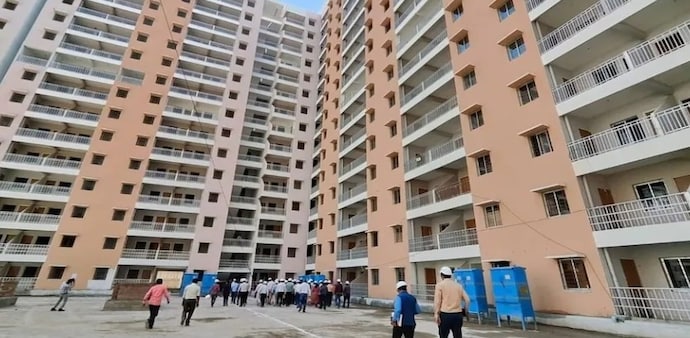
Why is the real estate industry asking for rental housing in Budget 2026? As the luxury housing model that ruled the market for four years moderates, the industry has switched attention to affordable housing, which is the biggest unmet need. As government after government grandly announces slum free cities, there has to be a provision to accommodate those who cannot afford premium housing and need to stay in institutional rental housing at affordable rates.
Says Parveen Jain, President, National Real Estate Development Council (Naredco) “Nobody makes houses for rental housing. Policy should be present where investors and developers are given incentives to make these houses. Returns are about 3%. It can be launched on a PPP model where land comes from governments or taxes are dropped on these, so that there are better returns.” The Covid era experiment in Maharashtra, especially in Mumbai, where the state government, on the advice of the Deepak Parekh committee, dropped stamp duty and registration charges on property in the city. This move, with a graded return to full stamp duty, roused the housing sector out of its lethargy and restarted the buying process.
It will also help to bring down the 30 million unmet housing demand in Indian cities by 2030. The Confederation of Real Estate Developers Association of India (Credai) has suggested that the government start a mission for large-scale rental housing stock across Tier 1 and Tier 2 cities, where land is more affordable. Real estate consultancy Knight Frank had asked for 100% tax exemption on rental income of up to Rs 3 lakh for homes priced at Rs 50 lakh or less for three years to off-set the low yield.
As returns make this segment attractive and investors seek small, but steady returns, demand would soar and the private sector would end up launching homes in the sub-Rs 50 lakh category. At low GST rates or no GST rates, it would afford returns enough to attract investors and state and city governments. With a 17% decline in this category from 54% in 2018 to 21% in 2025, only budgetary support could revive this sector.
Affordable Housing
This is especially so as the only way to bring affordable housing into large cities like Delhi, Mumbai and Bengaluru can only be with institutional affordable housing. If there is not enough rental housing of all categories, slums and urban villages would become the norm.
Also, 53% of luxury houses were bought over the past four years as investment. For that investment to yield returns, a robust rental housing policy is the need of the hour.
Corporate housing
Over Rs 45 trillion has been disbursed in the past year as housing finance. SBI itself has given out Rs 9.23 trillion as home loans. Naredco wants everyone to earn in PMAY2. Industrial worker housing benefits have already been announced in the last Budget. Naredco wants tax benefits for corporate housing in this Budget. Also, like the charitable trusts that built chawls in the early 1950s in Mumbai to give affordable housing to the poorest of the poor, Niranjan Hiranandani seeks this budgetary incentive for charitable trusts and CSR funds, today to make pucca rental housing viable to them.
Stock-in-trade
Developers who hold rental houses as stock in trade are taxed under Sec 23 (5) for empty houses. They can't sell at a lower rate when the circle rates are higher. The industry wants ready reckoner rates to be in tandem with the market and Section 71 of the IT Act to be modified so that the developers can sell the rental houses and offset the loss.
“About half the cost of premium housing goes in taxes,” says Hiranandani. If these taxes are dropped for affordable housing, it becomes viable for the private sector to build in this segment.
Even though tax incentives are only available to tax payers under the old scheme currently, the real estate industry wants the benefits to be back to individuals and the 80C benefit to be increased from Rs 2 lakh to Rs 5 lakh.
There was also a request to reinstate the Income-tax Settlement Commission, which was scrapped in 2021. This would reduce pressure on appellate courts.
Logistics
The industry is asking for business policy continuity assurance. Also, another infusion of Rs 11 lakh crore to complete infrastructure is a big demand. Says Dr Ashvani Jakhar, Founder and CEO of Prozo, “With hyperlocal warehousing demands, the industry wants seamless rules between states and municipal governance structures. Digitized approval seamlessly over states, cities and municipalities is the demand.” That needs budgetary intervention. In line with dedicated freight corridors, they are looking at dedicated logistics zones or corridors with uniform policy.
Explains Dr Jakhar, Founder and CEO of Prozo, “India’s supply chains are operating under sustained pressure from faster delivery expectations, wider distribution footprints, and structurally higher service intensity across categories. In this environment, the biggest policy lever remains execution-led infrastructure that improves predictability, not fragmented capacity creation. Logistics costs fall when freight movement becomes reliable, through lower transit variability, faster turnaround times, and better asset utilisation.”
This Budget is crucial in declaring the Indian government’s intent in boosting domestic growth, in a rapidly polarising world. In addition, the industry has shown signs of moderation. As a result, it is seeking the Budgetary pushes that could take the sting away from a tariffed world.
Why is the real estate industry asking for rental housing in Budget 2026? As the luxury housing model that ruled the market for four years moderates, the industry has switched attention to affordable housing, which is the biggest unmet need. As government after government grandly announces slum free cities, there has to be a provision to accommodate those who cannot afford premium housing and need to stay in institutional rental housing at affordable rates.
Says Parveen Jain, President, National Real Estate Development Council (Naredco) “Nobody makes houses for rental housing. Policy should be present where investors and developers are given incentives to make these houses. Returns are about 3%. It can be launched on a PPP model where land comes from governments or taxes are dropped on these, so that there are better returns.” The Covid era experiment in Maharashtra, especially in Mumbai, where the state government, on the advice of the Deepak Parekh committee, dropped stamp duty and registration charges on property in the city. This move, with a graded return to full stamp duty, roused the housing sector out of its lethargy and restarted the buying process.
It will also help to bring down the 30 million unmet housing demand in Indian cities by 2030. The Confederation of Real Estate Developers Association of India (Credai) has suggested that the government start a mission for large-scale rental housing stock across Tier 1 and Tier 2 cities, where land is more affordable. Real estate consultancy Knight Frank had asked for 100% tax exemption on rental income of up to Rs 3 lakh for homes priced at Rs 50 lakh or less for three years to off-set the low yield.
As returns make this segment attractive and investors seek small, but steady returns, demand would soar and the private sector would end up launching homes in the sub-Rs 50 lakh category. At low GST rates or no GST rates, it would afford returns enough to attract investors and state and city governments. With a 17% decline in this category from 54% in 2018 to 21% in 2025, only budgetary support could revive this sector.
Affordable Housing
This is especially so as the only way to bring affordable housing into large cities like Delhi, Mumbai and Bengaluru can only be with institutional affordable housing. If there is not enough rental housing of all categories, slums and urban villages would become the norm.
Also, 53% of luxury houses were bought over the past four years as investment. For that investment to yield returns, a robust rental housing policy is the need of the hour.
Corporate housing
Over Rs 45 trillion has been disbursed in the past year as housing finance. SBI itself has given out Rs 9.23 trillion as home loans. Naredco wants everyone to earn in PMAY2. Industrial worker housing benefits have already been announced in the last Budget. Naredco wants tax benefits for corporate housing in this Budget. Also, like the charitable trusts that built chawls in the early 1950s in Mumbai to give affordable housing to the poorest of the poor, Niranjan Hiranandani seeks this budgetary incentive for charitable trusts and CSR funds, today to make pucca rental housing viable to them.
Stock-in-trade
Developers who hold rental houses as stock in trade are taxed under Sec 23 (5) for empty houses. They can't sell at a lower rate when the circle rates are higher. The industry wants ready reckoner rates to be in tandem with the market and Section 71 of the IT Act to be modified so that the developers can sell the rental houses and offset the loss.
“About half the cost of premium housing goes in taxes,” says Hiranandani. If these taxes are dropped for affordable housing, it becomes viable for the private sector to build in this segment.
Even though tax incentives are only available to tax payers under the old scheme currently, the real estate industry wants the benefits to be back to individuals and the 80C benefit to be increased from Rs 2 lakh to Rs 5 lakh.
There was also a request to reinstate the Income-tax Settlement Commission, which was scrapped in 2021. This would reduce pressure on appellate courts.
Logistics
The industry is asking for business policy continuity assurance. Also, another infusion of Rs 11 lakh crore to complete infrastructure is a big demand. Says Dr Ashvani Jakhar, Founder and CEO of Prozo, “With hyperlocal warehousing demands, the industry wants seamless rules between states and municipal governance structures. Digitized approval seamlessly over states, cities and municipalities is the demand.” That needs budgetary intervention. In line with dedicated freight corridors, they are looking at dedicated logistics zones or corridors with uniform policy.
Explains Dr Jakhar, Founder and CEO of Prozo, “India’s supply chains are operating under sustained pressure from faster delivery expectations, wider distribution footprints, and structurally higher service intensity across categories. In this environment, the biggest policy lever remains execution-led infrastructure that improves predictability, not fragmented capacity creation. Logistics costs fall when freight movement becomes reliable, through lower transit variability, faster turnaround times, and better asset utilisation.”
This Budget is crucial in declaring the Indian government’s intent in boosting domestic growth, in a rapidly polarising world. In addition, the industry has shown signs of moderation. As a result, it is seeking the Budgetary pushes that could take the sting away from a tariffed world.