
EPFO big changes: Pension hike, E-PRAAPTI portal, Form 121 — What PF subscribers should know
EPFO is set to introduce key reforms, including a new portal to track dormant accounts and a simplified Form 121 for TDS compliance. At the same time, a proposal to raise EPS pensions is under active consideration. These changes reflect a broader push toward digitisation, efficiency, and stronger retirement security.
- Apr 30, 2026,
- Updated Apr 30, 2026 9:10 AM IST
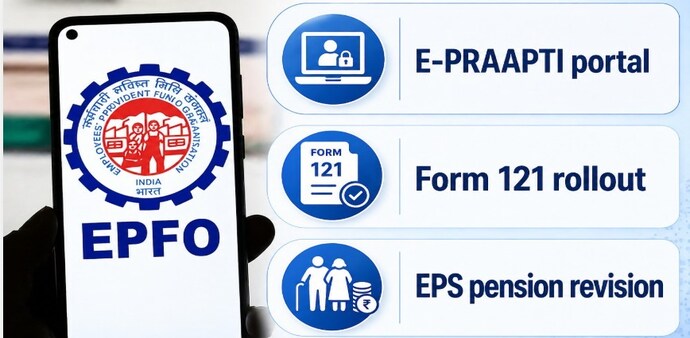
The Employees’ Provident Fund Organisation (EPFO) is rolling out a series of major changes, from launching the E-PRAAPTI portal to simplify access to old accounts to introducing Form 121 for TDS compliance. At the same time, the government is considering a long-pending hike in EPS pensions, potentially impacting millions of subscribers. Together, these moves signal a shift toward digitisation, tighter compliance, and improved social security benefits.
E-PRAAPTI portal
EPFO is set to launch a new digital platform aimed at helping members identify and reactivate dormant or unclaimed EPF accounts using Aadhaar-based authentication, even if these accounts are not linked to a Universal Account Number (UAN). Labour Minister Mansukh Mandaviya said the proposed portal, named E-PRAAPTI (EPF Aadhaar-Based Access Portal for Tracking Inoperative Accounts), will enable users to access legacy accounts, update their profiles, and complete UAN linking without requiring employer intervention.
In its initial phase, the platform will function on a member ID-based system, allowing individuals with older account details to initiate retrieval and activation. Over time, it is expected to expand to include users who may not recall or have access to their member IDs.
The initiative is part of EPFO’s broader push toward digitisation and process automation. The organisation settled a record 83.1 million claims in FY26, up from 60.1 million a year earlier, with a growing share processed through auto mode within three days. Simplified procedures, including easier bank account seeding and reduced documentation, have significantly improved user access and efficiency, while helping unlock inactive accounts and enhance transparency.
MUST READ: EPFO subscribers alert! Finance Ministry set to notify PF interest rate for FY26
EPS Pension
The Ministry of Labour and Employment is considering a proposal to increase the minimum pension under the Employees’ Pension Scheme (EPS-95) beyond ₹1,000 per month, a move that could benefit millions of EPFO subscribers but significantly raise the government’s fiscal burden. Currently, the Centre contributes over ₹950 crore annually to maintain the ₹1,000 minimum pension. Labour unions and pensioners have been pushing for a hike to ₹7,500, arguing that the existing amount is insufficient to meet basic living costs. Discussions are ongoing, and a decision may be announced soon, with a parliamentary panel also backing a revision to strengthen social security.
Meanwhile, EPFO reported a 38.3% surge in claim settlements in FY26, processing a record 83.1 million claims compared to 60.1 million in FY25. In April 2026 alone, 6.1 million claims were settled, with nearly 99% processed within 20 days. The government also plans to launch an Aadhaar-based portal, E-PRAAPTI, to help users track and activate inoperative EPF accounts efficiently.
MUST READ: Big relief for EPS-95 pensioners? Govt may hike pension from ₹1,000 to...
Form 15G/15H replaced with Form 121
Effective April 1, the Employees’ Provident Fund Organisation (EPFO) has introduced Form 121, replacing Forms 15G and 15H, to simplify the process of claiming TDS exemption on EPF withdrawals. Aligned with the Income Tax Act, 2025, the move aims to streamline compliance while strengthening verification.
Earlier, subscribers had to choose between Form 15G (for individuals below 60) and Form 15H (for senior citizens), often leading to confusion. Form 121 removes this distinction by introducing a single declaration applicable to all eligible individuals, regardless of age.
The new system enables faster processing and reduces errors by integrating EPFO records with income tax databases. However, while the process is simpler, scrutiny has become stricter. Subscribers must ensure that their PAN, Aadhaar, and bank details are correctly linked and verified, as mismatches can lead to TDS deductions.
Form 121 allows individuals with income below the taxable limit to avoid TDS on EPF withdrawals above ₹50,000. However, the form must be filed each financial year and before initiating withdrawal requests.
Experts caution that incorrect declarations, delayed submissions, or incomplete KYC can result in rejection or unnecessary tax deductions. Overall, the shift reflects a move toward data-driven compliance with tighter checks but smoother processing.
MUST READ: No job, no EPF deposit — Can your EPF balance still earn you interest?
The Employees’ Provident Fund Organisation (EPFO) is rolling out a series of major changes, from launching the E-PRAAPTI portal to simplify access to old accounts to introducing Form 121 for TDS compliance. At the same time, the government is considering a long-pending hike in EPS pensions, potentially impacting millions of subscribers. Together, these moves signal a shift toward digitisation, tighter compliance, and improved social security benefits.
E-PRAAPTI portal
EPFO is set to launch a new digital platform aimed at helping members identify and reactivate dormant or unclaimed EPF accounts using Aadhaar-based authentication, even if these accounts are not linked to a Universal Account Number (UAN). Labour Minister Mansukh Mandaviya said the proposed portal, named E-PRAAPTI (EPF Aadhaar-Based Access Portal for Tracking Inoperative Accounts), will enable users to access legacy accounts, update their profiles, and complete UAN linking without requiring employer intervention.
In its initial phase, the platform will function on a member ID-based system, allowing individuals with older account details to initiate retrieval and activation. Over time, it is expected to expand to include users who may not recall or have access to their member IDs.
The initiative is part of EPFO’s broader push toward digitisation and process automation. The organisation settled a record 83.1 million claims in FY26, up from 60.1 million a year earlier, with a growing share processed through auto mode within three days. Simplified procedures, including easier bank account seeding and reduced documentation, have significantly improved user access and efficiency, while helping unlock inactive accounts and enhance transparency.
MUST READ: EPFO subscribers alert! Finance Ministry set to notify PF interest rate for FY26
EPS Pension
The Ministry of Labour and Employment is considering a proposal to increase the minimum pension under the Employees’ Pension Scheme (EPS-95) beyond ₹1,000 per month, a move that could benefit millions of EPFO subscribers but significantly raise the government’s fiscal burden. Currently, the Centre contributes over ₹950 crore annually to maintain the ₹1,000 minimum pension. Labour unions and pensioners have been pushing for a hike to ₹7,500, arguing that the existing amount is insufficient to meet basic living costs. Discussions are ongoing, and a decision may be announced soon, with a parliamentary panel also backing a revision to strengthen social security.
Meanwhile, EPFO reported a 38.3% surge in claim settlements in FY26, processing a record 83.1 million claims compared to 60.1 million in FY25. In April 2026 alone, 6.1 million claims were settled, with nearly 99% processed within 20 days. The government also plans to launch an Aadhaar-based portal, E-PRAAPTI, to help users track and activate inoperative EPF accounts efficiently.
MUST READ: Big relief for EPS-95 pensioners? Govt may hike pension from ₹1,000 to...
Form 15G/15H replaced with Form 121
Effective April 1, the Employees’ Provident Fund Organisation (EPFO) has introduced Form 121, replacing Forms 15G and 15H, to simplify the process of claiming TDS exemption on EPF withdrawals. Aligned with the Income Tax Act, 2025, the move aims to streamline compliance while strengthening verification.
Earlier, subscribers had to choose between Form 15G (for individuals below 60) and Form 15H (for senior citizens), often leading to confusion. Form 121 removes this distinction by introducing a single declaration applicable to all eligible individuals, regardless of age.
The new system enables faster processing and reduces errors by integrating EPFO records with income tax databases. However, while the process is simpler, scrutiny has become stricter. Subscribers must ensure that their PAN, Aadhaar, and bank details are correctly linked and verified, as mismatches can lead to TDS deductions.
Form 121 allows individuals with income below the taxable limit to avoid TDS on EPF withdrawals above ₹50,000. However, the form must be filed each financial year and before initiating withdrawal requests.
Experts caution that incorrect declarations, delayed submissions, or incomplete KYC can result in rejection or unnecessary tax deductions. Overall, the shift reflects a move toward data-driven compliance with tighter checks but smoother processing.
MUST READ: No job, no EPF deposit — Can your EPF balance still earn you interest?