
Why do we queue for the latest iPhone? Devina Mehra explains the tribal instinct behind iPhone, luxury, investment FOMO
An iPhone queue, a luxury handbag waiting list and an investor chasing the latest market trend may seem unrelated. Why do people spend more for products they may not necessarily need, or rush into investments after others have made money? Devina Mehra says both behaviours can be traced to the same evolutionary instinct: the powerful human desire to belong.
- Sep 9, 2026,
- Updated Sep 9, 2026 1:48 PM IST
Why are consumers willing to queue for hours, spend heavily or even take loans to buy the latest iPhone when the new model may offer only incremental improvements? Devina Mehra, Founder and CMD of First Global, says the answer may have less to do with technology and more with an instinct deeply embedded in the human brain.
It’s not really about the iPhone
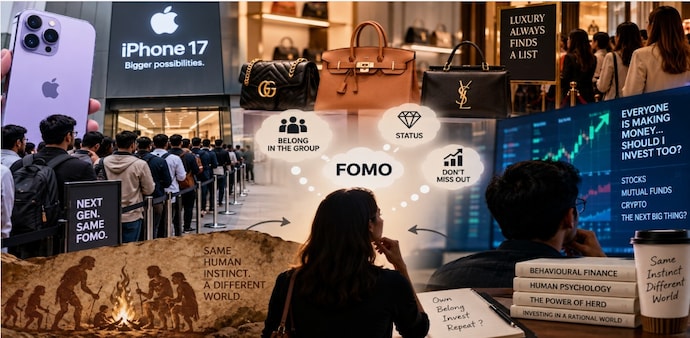
In a recent commentary, Mehra questioned why people rush to buy the latest iPhone and why luxury handbags can have waiting lists. She argued that the behaviour is not simply about being attracted to “bright, shiny objects”. Instead, it reflects the human desire to belong to a tribe.
According to Mehra, this instinct can be traced back to early human evolution, when survival was closely linked to being part of a group. Belonging to a tribe offered protection and improved the chances of survival, while being excluded could have serious consequences.
The tribal instinct
That evolutionary wiring, she said, continues to influence modern behaviour, even though the nature of the “tribe” has changed.
Today, the tribe could be a social circle, a professional group or a particular aspirational lifestyle. Owning the latest iPhone, carrying a luxury handbag or using a particular brand can become a way of signalling that a person belongs to a particular group.
MUST READ: Apple’s most ambitious iPhone yet? The decade-long road to its $2,000+ foldable
Mehra pointed out that this explains why functionality alone cannot account for some consumer choices. A newer smartphone may not dramatically change what a person can do, but owning it can provide a sense of identification with a desired group.
From iPhone queues to investment FOMO
The same behavioural pattern, she said, extends beyond consumption and into investing.
In financial markets, investors can feel compelled to follow the crowd when a particular asset, sector or investment theme becomes popular. If “everyone” appears to be making money in a particular area, staying out can create an intense fear of missing out, or FOMO.
This is essentially the bandwagon effect—the tendency to follow what others are doing, partly because being outside the group can feel uncomfortable.
Why understanding our biases may not be enough
Knowing that these biases exist does not necessarily make them disappear. Mehra points to psychologist and Nobel laureate Daniel Kahneman, who spent a lifetime studying cognitive biases but acknowledged that all his research had barely changed his own decision-making.
The reason, she argues, is that these tendencies are not recent habits that can simply be unlearned. They are hardwired into humans through thousands of years of evolution, when staying with the tribe could determine whether an individual survived and reproduced.
ALSO READ: Apple Event 2026: How to watch live in India, iPhone 18 Pro, iPhone Ultra, and more to debut
Mehra describes evolution as a “hacker”—it does not seek to optimise human behaviour, but relies on shortcuts that were good enough to ensure survival and pass genes to the next generation.
That leaves modern humans with instincts designed for a very different world. The same impulse that once encouraged our ancestors to stick with the tribe can today show up in an iPhone queue, the desire for a luxury bag or the rush to join an investment trend because everyone else appears to be making money.
And recognising that instinct may not be enough to escape it. The products and markets have changed dramatically; the brain responding to them, Mehra’s argument suggests, has changed far less.
Why are consumers willing to queue for hours, spend heavily or even take loans to buy the latest iPhone when the new model may offer only incremental improvements? Devina Mehra, Founder and CMD of First Global, says the answer may have less to do with technology and more with an instinct deeply embedded in the human brain.
It’s not really about the iPhone
In a recent commentary, Mehra questioned why people rush to buy the latest iPhone and why luxury handbags can have waiting lists. She argued that the behaviour is not simply about being attracted to “bright, shiny objects”. Instead, it reflects the human desire to belong to a tribe.
According to Mehra, this instinct can be traced back to early human evolution, when survival was closely linked to being part of a group. Belonging to a tribe offered protection and improved the chances of survival, while being excluded could have serious consequences.
The tribal instinct
That evolutionary wiring, she said, continues to influence modern behaviour, even though the nature of the “tribe” has changed.
Today, the tribe could be a social circle, a professional group or a particular aspirational lifestyle. Owning the latest iPhone, carrying a luxury handbag or using a particular brand can become a way of signalling that a person belongs to a particular group.
MUST READ: Apple’s most ambitious iPhone yet? The decade-long road to its $2,000+ foldable
Mehra pointed out that this explains why functionality alone cannot account for some consumer choices. A newer smartphone may not dramatically change what a person can do, but owning it can provide a sense of identification with a desired group.
From iPhone queues to investment FOMO
The same behavioural pattern, she said, extends beyond consumption and into investing.
In financial markets, investors can feel compelled to follow the crowd when a particular asset, sector or investment theme becomes popular. If “everyone” appears to be making money in a particular area, staying out can create an intense fear of missing out, or FOMO.
This is essentially the bandwagon effect—the tendency to follow what others are doing, partly because being outside the group can feel uncomfortable.
Why understanding our biases may not be enough
Knowing that these biases exist does not necessarily make them disappear. Mehra points to psychologist and Nobel laureate Daniel Kahneman, who spent a lifetime studying cognitive biases but acknowledged that all his research had barely changed his own decision-making.
The reason, she argues, is that these tendencies are not recent habits that can simply be unlearned. They are hardwired into humans through thousands of years of evolution, when staying with the tribe could determine whether an individual survived and reproduced.
ALSO READ: Apple Event 2026: How to watch live in India, iPhone 18 Pro, iPhone Ultra, and more to debut
Mehra describes evolution as a “hacker”—it does not seek to optimise human behaviour, but relies on shortcuts that were good enough to ensure survival and pass genes to the next generation.
That leaves modern humans with instincts designed for a very different world. The same impulse that once encouraged our ancestors to stick with the tribe can today show up in an iPhone queue, the desire for a luxury bag or the rush to join an investment trend because everyone else appears to be making money.
And recognising that instinct may not be enough to escape it. The products and markets have changed dramatically; the brain responding to them, Mehra’s argument suggests, has changed far less.