
Apollo 13: 'Houston, we’ve had a problem' — mission that turned into NASA’s greatest survival story
The mission’s goal was to land astronauts on the Moon’s Fra Mauro region and conduct scientific experiments, including geological sampling and deployment of instruments to study lunar seismic activity.
- Apr 7, 2026,
- Updated Apr 7, 2026 6:30 AM IST
The Apollo 13 mission remains one of the most dramatic episodes in the history of human spaceflight. Originally planned as NASA’s third mission to land astronauts on the Moon, Apollo 13 instead turned into a life-threatening emergency in space — and ultimately one of the greatest survival stories of the Apollo program.
Apollo 13 launched on April 11, 1970, from the Kennedy Space Center in Florida aboard the powerful Saturn V rocket.
The mission’s goal was to land astronauts on the Moon’s Fra Mauro region and conduct scientific experiments, including geological sampling and deployment of instruments to study lunar seismic activity.
The crew consisted of:
- James A. Lovell – Mission Commander
- Jack Swigert – Command Module Pilot
- Fred Haise – Lunar Module Pilot
Lovell was already a veteran astronaut and had previously flown on Apollo 8, the first crewed mission to orbit the Moon.
Explosion that changed the mission
About 56 hours after launch, disaster struck.
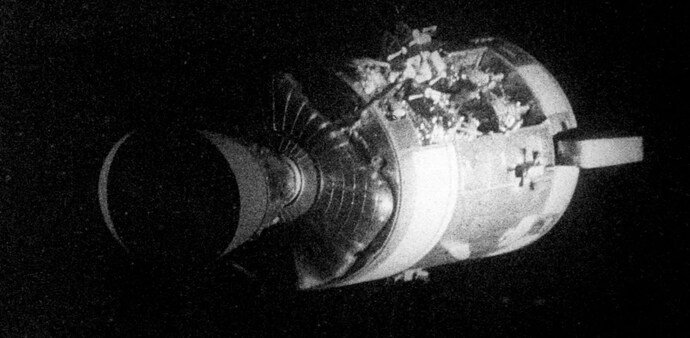
An oxygen tank in the spacecraft’s Apollo Command and Service Module exploded while the crew was en route to the Moon. The blast severely damaged the spacecraft’s power, oxygen supply, and propulsion systems.
Astronaut Jack Swigert radioed mission control with the now-legendary line: “Houston, we’ve had a problem.”
The explosion forced NASA to immediately cancel the planned Moon landing and shift the mission into emergency survival mode.
Using the lunar module as a lifeboat
To survive, the astronauts powered down the command module and moved into the Apollo Lunar Module Aquarius, which was originally meant to land on the Moon.
Instead, it became an improvised lifeboat in deep space.
Engineers at NASA’s Johnson Space Center worked around the clock to develop solutions for several critical problems:
- Limited oxygen and electrical power
- Rising carbon dioxide levels inside the spacecraft
- Navigation adjustments needed to return to Earth
One famous improvised fix involved building a carbon dioxide filter adapter using onboard materials, including plastic bags and duct tape.
Looping around the Moon
Because turning the spacecraft around immediately was impossible, Apollo 13 followed a free-return trajectory that used the Moon’s gravity to sling the spacecraft back toward Earth.
During this maneuver, the crew passed behind the Moon and reached the farthest distance humans have ever traveled from Earth, a record that stood for decades.
Safe return to Earth
After nearly six days in space, the astronauts re-entered Earth’s atmosphere.
On April 17, 1970, the command module safely splashed down in the South Pacific Ocean, where recovery teams from the USS Iwo Jima (LPH‑2) retrieved the crew.
Despite the near-fatal accident, all three astronauts survived.
Why Apollo 13 is called a 'successful failure'
Although the mission failed to land on the Moon, Apollo 13 is often described as a “successful failure.”
The phrase reflects how NASA engineers and astronauts managed to overcome extraordinary technical challenges to bring the crew home safely.
The mission became a symbol of:
- Engineering ingenuity
- Teamwork between astronauts and mission control
- Resilience under extreme pressure
The story of Apollo 13 later inspired the acclaimed Apollo 13 (1995), starring Tom Hanks as Jim Lovell. The film helped cement the mission’s place in public memory and popular culture.
The Apollo 13 mission remains one of the most dramatic episodes in the history of human spaceflight. Originally planned as NASA’s third mission to land astronauts on the Moon, Apollo 13 instead turned into a life-threatening emergency in space — and ultimately one of the greatest survival stories of the Apollo program.
Apollo 13 launched on April 11, 1970, from the Kennedy Space Center in Florida aboard the powerful Saturn V rocket.
The mission’s goal was to land astronauts on the Moon’s Fra Mauro region and conduct scientific experiments, including geological sampling and deployment of instruments to study lunar seismic activity.
The crew consisted of:
- James A. Lovell – Mission Commander
- Jack Swigert – Command Module Pilot
- Fred Haise – Lunar Module Pilot
Lovell was already a veteran astronaut and had previously flown on Apollo 8, the first crewed mission to orbit the Moon.
Explosion that changed the mission
About 56 hours after launch, disaster struck.
An oxygen tank in the spacecraft’s Apollo Command and Service Module exploded while the crew was en route to the Moon. The blast severely damaged the spacecraft’s power, oxygen supply, and propulsion systems.
Astronaut Jack Swigert radioed mission control with the now-legendary line: “Houston, we’ve had a problem.”
The explosion forced NASA to immediately cancel the planned Moon landing and shift the mission into emergency survival mode.
Using the lunar module as a lifeboat
To survive, the astronauts powered down the command module and moved into the Apollo Lunar Module Aquarius, which was originally meant to land on the Moon.
Instead, it became an improvised lifeboat in deep space.
Engineers at NASA’s Johnson Space Center worked around the clock to develop solutions for several critical problems:
- Limited oxygen and electrical power
- Rising carbon dioxide levels inside the spacecraft
- Navigation adjustments needed to return to Earth
One famous improvised fix involved building a carbon dioxide filter adapter using onboard materials, including plastic bags and duct tape.
Looping around the Moon
Because turning the spacecraft around immediately was impossible, Apollo 13 followed a free-return trajectory that used the Moon’s gravity to sling the spacecraft back toward Earth.
During this maneuver, the crew passed behind the Moon and reached the farthest distance humans have ever traveled from Earth, a record that stood for decades.
Safe return to Earth
After nearly six days in space, the astronauts re-entered Earth’s atmosphere.
On April 17, 1970, the command module safely splashed down in the South Pacific Ocean, where recovery teams from the USS Iwo Jima (LPH‑2) retrieved the crew.
Despite the near-fatal accident, all three astronauts survived.
Why Apollo 13 is called a 'successful failure'
Although the mission failed to land on the Moon, Apollo 13 is often described as a “successful failure.”
The phrase reflects how NASA engineers and astronauts managed to overcome extraordinary technical challenges to bring the crew home safely.
The mission became a symbol of:
- Engineering ingenuity
- Teamwork between astronauts and mission control
- Resilience under extreme pressure
The story of Apollo 13 later inspired the acclaimed Apollo 13 (1995), starring Tom Hanks as Jim Lovell. The film helped cement the mission’s place in public memory and popular culture.