
'Going farther than ever': NASA’s Artemis II head towards Moon’s far side. Here's how to watch live
Another major milestone arrives when Orion enters the Moon’s “sphere of influence,” the region where the Moon’s gravity becomes the dominant force shaping the spacecraft’s trajectory.
- Apr 6, 2026,
- Updated Apr 6, 2026 7:24 PM IST
Humanity’s return to deep space is reaching a historic milestone as the crew of Artemis II prepares to travel farther from Earth than any astronauts before them. The mission marks the first crewed journey toward the Moon under NASA’s modern lunar exploration program and a crucial step toward future lunar landings.
In a post on X (formally twitter), NASA announced that the Artemis II astronauts are set to break the record for the farthest distance humans have ever traveled from Earth as their spacecraft flies around the far side of the Moon.
The astronauts aboard the Orion spacecraft include NASA commander Reid Wiseman, pilot Victor Glover, mission specialist Christina Koch, and Canadian Space Agency astronaut Jeremy Hansen.
In India, the live event will be available for live coverage from 10:30 pm tonight and will the whole event will extend till 8:00 am on April 7.
Watch live coverage of the Artemis II lunar flyby on NASA+, Amazon Prime, Apple TV, Hulu, Netflix, HBO Max and Roku beginning at 1 p.m., alongside the agency’s 24/7 coverage on its YouTube channel.
Course correction keeps Orion on path
Mission control teams in Houston recently completed an outbound correction burn designed to fine-tune Orion’s trajectory toward the Moon. The engine burn began at 11:03 p.m. EDT and lasted about 17.5 seconds, ensuring the spacecraft remains on a precise path for the upcoming lunar flyby.
These trajectory adjustments are routine but critical during deep-space missions. Even minor corrections help ensure that the spacecraft reaches the correct position and timing for its journey around the Moon.
Astronauts test key safety systems
During the crew’s workday, astronauts carried out one of the mission’s key objectives: testing the Orion Crew Survival System (OCSS) suit.
All four astronauts conducted a full sequence of evaluations, including donning and pressurizing the suits, performing leak checks, simulating entry into their seats, and testing mobility. The crew also assessed their ability to eat and drink while wearing the suit.
The OCSS suit is designed to protect astronauts during the most demanding phases of flight. It provides life support if the spacecraft cabin loses pressure and helps sustain the crew during survival operations after splashdown back on Earth.
Entering the Moon’s gravitational domain
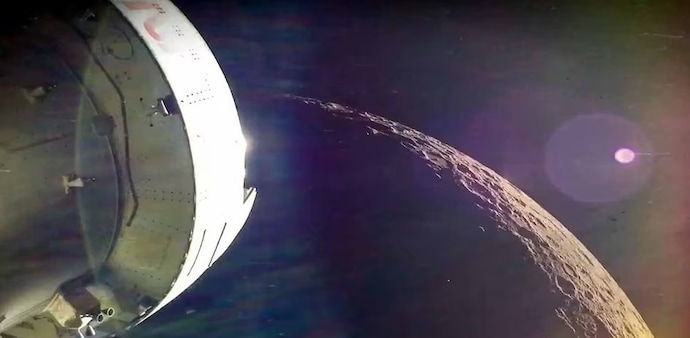
Another major milestone arrives when Orion enters the Moon’s “sphere of influence,” the region where the Moon’s gravity becomes the dominant force shaping the spacecraft’s trajectory.
According to NASA, this transition occurs when the spacecraft moves into the gravitational domain of the Moon, setting the stage for the mission’s defining moment: the crew’s flight around the far side of the Moon.
Key lunar flyby timeline & milestones
NASA has outlined a detailed schedule for the lunar flyby operations, though timings may shift depending on real-time mission conditions. (All times Eastern subject to change based on real-time operations)
- 1:00 pm (10:30 pm in India) – NASA+ begins live coverage of the lunar flyby.
- 1:56 pm (11:26 pm in India) – The crew surpasses the record for the farthest distance humans have traveled from Earth, previously set during Apollo 13.
- 2:10 pm (11:40 pm in India) – Astronauts deliver remarks after breaking the Apollo 13 distance record (audio only).
- 2:15 pm (11:45 pm in India) – Crew configures Orion’s cabin for lunar flyby operations.
- 2:45 pm (12:15 am in India) – Lunar observation activities begin.
- 6:44 pm (4:14 am in India) – Predicted loss of communications as Orion moves behind the Moon, lasting roughly 40 minutes.
- 7:02 pm (4:32 am in India) – Orion reaches its closest approach to the Moon at approximately 4,070 miles above the surface.
- 7:07 pm (4:38 am in India) – The spacecraft reaches its maximum distance from Earth at about 252,757 miles.
- 7:25 pm (5:55 am in India) – “Earthrise” occurs as Earth reappears over the Moon’s horizon and communications are re-established with mission control.
- 8:35-9:32 pm (7:00-8:00 am in India) – From the crew’s perspective, a solar eclipse unfolds as the Sun passes behind the Moon.
- 9:20 pm (6:50 am in India) – Lunar observation operations conclude.
The Artemis II flyby represents a major demonstration mission for NASA’s Artemis program, testing the spacecraft, life-support systems, and deep-space operations needed for future lunar landings.
Humanity’s return to deep space is reaching a historic milestone as the crew of Artemis II prepares to travel farther from Earth than any astronauts before them. The mission marks the first crewed journey toward the Moon under NASA’s modern lunar exploration program and a crucial step toward future lunar landings.
In a post on X (formally twitter), NASA announced that the Artemis II astronauts are set to break the record for the farthest distance humans have ever traveled from Earth as their spacecraft flies around the far side of the Moon.
The astronauts aboard the Orion spacecraft include NASA commander Reid Wiseman, pilot Victor Glover, mission specialist Christina Koch, and Canadian Space Agency astronaut Jeremy Hansen.
In India, the live event will be available for live coverage from 10:30 pm tonight and will the whole event will extend till 8:00 am on April 7.
Watch live coverage of the Artemis II lunar flyby on NASA+, Amazon Prime, Apple TV, Hulu, Netflix, HBO Max and Roku beginning at 1 p.m., alongside the agency’s 24/7 coverage on its YouTube channel.
Course correction keeps Orion on path
Mission control teams in Houston recently completed an outbound correction burn designed to fine-tune Orion’s trajectory toward the Moon. The engine burn began at 11:03 p.m. EDT and lasted about 17.5 seconds, ensuring the spacecraft remains on a precise path for the upcoming lunar flyby.
These trajectory adjustments are routine but critical during deep-space missions. Even minor corrections help ensure that the spacecraft reaches the correct position and timing for its journey around the Moon.
Astronauts test key safety systems
During the crew’s workday, astronauts carried out one of the mission’s key objectives: testing the Orion Crew Survival System (OCSS) suit.
All four astronauts conducted a full sequence of evaluations, including donning and pressurizing the suits, performing leak checks, simulating entry into their seats, and testing mobility. The crew also assessed their ability to eat and drink while wearing the suit.
The OCSS suit is designed to protect astronauts during the most demanding phases of flight. It provides life support if the spacecraft cabin loses pressure and helps sustain the crew during survival operations after splashdown back on Earth.
Entering the Moon’s gravitational domain
Another major milestone arrives when Orion enters the Moon’s “sphere of influence,” the region where the Moon’s gravity becomes the dominant force shaping the spacecraft’s trajectory.
According to NASA, this transition occurs when the spacecraft moves into the gravitational domain of the Moon, setting the stage for the mission’s defining moment: the crew’s flight around the far side of the Moon.
Key lunar flyby timeline & milestones
NASA has outlined a detailed schedule for the lunar flyby operations, though timings may shift depending on real-time mission conditions. (All times Eastern subject to change based on real-time operations)
- 1:00 pm (10:30 pm in India) – NASA+ begins live coverage of the lunar flyby.
- 1:56 pm (11:26 pm in India) – The crew surpasses the record for the farthest distance humans have traveled from Earth, previously set during Apollo 13.
- 2:10 pm (11:40 pm in India) – Astronauts deliver remarks after breaking the Apollo 13 distance record (audio only).
- 2:15 pm (11:45 pm in India) – Crew configures Orion’s cabin for lunar flyby operations.
- 2:45 pm (12:15 am in India) – Lunar observation activities begin.
- 6:44 pm (4:14 am in India) – Predicted loss of communications as Orion moves behind the Moon, lasting roughly 40 minutes.
- 7:02 pm (4:32 am in India) – Orion reaches its closest approach to the Moon at approximately 4,070 miles above the surface.
- 7:07 pm (4:38 am in India) – The spacecraft reaches its maximum distance from Earth at about 252,757 miles.
- 7:25 pm (5:55 am in India) – “Earthrise” occurs as Earth reappears over the Moon’s horizon and communications are re-established with mission control.
- 8:35-9:32 pm (7:00-8:00 am in India) – From the crew’s perspective, a solar eclipse unfolds as the Sun passes behind the Moon.
- 9:20 pm (6:50 am in India) – Lunar observation operations conclude.
The Artemis II flyby represents a major demonstration mission for NASA’s Artemis program, testing the spacecraft, life-support systems, and deep-space operations needed for future lunar landings.