
Beyond PM2.5 and PM10: Can 'artificial lungs' remove toxic gases from Delhi's polluted air?
Delhi's persistent air pollution is driving interest in technologies that promise to capture airborne particles and harmful gases. But can artificial lungs effectively remove pollutants such as nitrogen dioxide and sulphur dioxide, and how reliable are their claims?
- Nov 17, 2026,
- Updated Nov 17, 2026 11:47 AM IST
Delhi's air quality deteriorated on Tuesday morning, with the Air Quality Index (AQI) rising to 246 at 7 am from 216 on Monday, according to Central Pollution Control Board (CPCB) data. Pollution remained widespread, with 52 of the city's 58 monitoring stations recording AQI levels above 200, including 11 locations in the ‘very poor’ category.
With PM2.5 identified as the prominent pollutant, attention is turning towards technologies capable of removing airborne contaminants. However, capturing particulate matter and eliminating harmful gases present different scientific challenges.
Can artificial lungs tackle multiple pollutants?
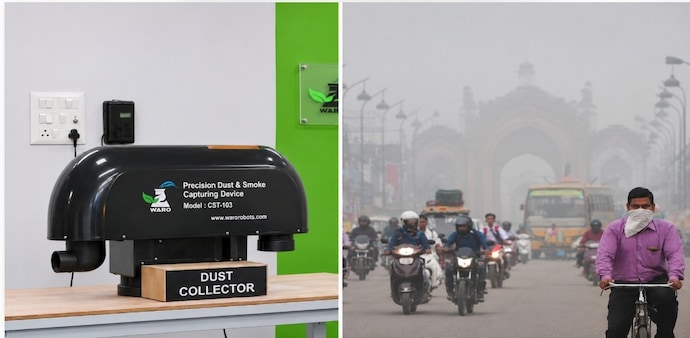
Mumbai-based Zero Carbon Tech24 Pvt. Ltd., founded by Dr. Prithvi P. Singh, has developed WARO-C6, a pollution-control technology designed to capture dust, smoke and harmful gaseous pollutants.
The company describes its innovation as an "Artificial Lungs" system that could be deployed across polluted cities and industrial locations.
"My vision is to install Artificial Lungs in polluted cities — to save human lungs and lives," said Singh, Founder and Director of Zero Carbon Tech24.
The company claims WARO-C6 offers low energy consumption, self-cleaning capabilities and minimal maintenance requirements.
It also reports deployments in Delhi, where particulate pollution reductions were observed under specific testing conditions. However, detailed independent test results were not provided in the company's statement.
Why removing toxic gases is more challenging
Unlike PM2.5 and PM10, which are airborne particles, pollutants such as nitrogen dioxide (NO2), sulphur dioxide (SO2) and volatile organic compounds (VOCs) exist in gaseous form.
Conventional particulate filters can capture dust and smoke particles but generally cannot remove gases effectively without additional technologies.
Gas removal may require activated carbon, chemical adsorption, specialised sorbents or other treatment mechanisms, depending on the pollutant.
Consequently, a system capable of reducing particulate concentrations may not necessarily deliver comparable reductions in gaseous pollutants.
DO READ: From classroom fan to air purifier: Delhi teen wins 2026 Diana Award for ₹140 innovation
Independent testing remains critical
For technologies such as WARO-C6, independent laboratory testing would be necessary to establish pollutant-specific removal efficiency, operating costs and performance under real-world conditions.
Experts would also need to assess airflow capacity, energy consumption and effectiveness across different pollution concentrations.
Delhi-NCR remains under Stage III of the Graded Response Action Plan, which includes restrictions on construction activities and tighter controls on polluting industries.
While emerging air-cleaning technologies could potentially reduce exposure in specific locations, their effectiveness across large urban areas remains uncertain.
Ultimately, artificial lungs may complement pollution-control measures, but preventing emissions at their source remains essential to improving Delhi's air quality.
ALSO READ: Global fossil CO₂ emissions to fall in 2026: Has the world finally reached peak carbon pollution?