
SpaceX Starship's 15th test flight: Booster explodes, but spacecraft pulls off a key space milestone
SpaceX planned for the upper-stage spacecraft to complete 14 orbits around Earth before returning approximately 22 hours after launch
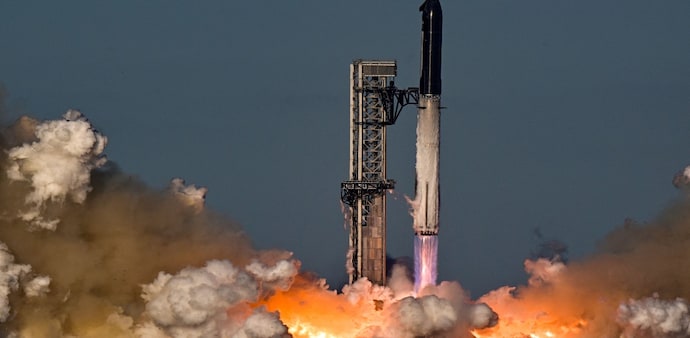
- Nov 14, 2026,
- Updated Nov 14, 2026 2:33 PM IST
SpaceX launched its 15th Starship test flight from South Texas on Friday, aiming to achieve a major milestone in its efforts to develop a fully reusable rocket system. However, the mission suffered a setback after the rocket’s Super Heavy booster failed to return to the launch site and exploded over the Gulf of Mexico, as reported by Reuters.
The upper-stage spacecraft successfully reached orbit and began deploying satellites for SpaceX’s Starlink internet network. The company is now aiming to recover the spacecraft at its Texas launch facility in a first-of-its-kind attempt to bring it back to the same location from which it took off.
Standing 407 feet (124 metres) tall, Starship is the world’s largest and most powerful rocket system. The vehicle consists of the Starship spacecraft mounted on the Super Heavy booster. Both stages are designed to be reusable, potentially reducing launch costs and allowing SpaceX to conduct missions more frequently.
READ THIS: SpaceX and Tesla merger: Elon Musk's trillion-dollar mega-deal could come as soon as December 2026
Super Heavy booster recovery fails
During Friday’s launch, SpaceX attempted to bring the Super Heavy booster back to its launch tower using a pair of large mechanical arms, commonly known as “chopsticks”. However, the booster was diverted from its planned return trajectory towards the Gulf of Mexico, where it briefly hovered before exploding above the water.
The reason for the failed recovery attempt was not immediately clear. SpaceX had successfully caught the Super Heavy booster at its launch tower on three previous occasions, with the last successful recovery taking place in March 2025.
Despite the setback, the upper stage continued its flight and reached orbit approximately 27 minutes after liftoff. It subsequently began deploying 26 Starlink satellites, marking the second time Starship has carried operational satellites into orbit.
Starship’s first landing attempt
SpaceX planned for the upper-stage spacecraft to complete 14 orbits around Earth before returning approximately 22 hours after launch. The company aims to guide the vehicle back to its Texas launch tower for a controlled descent, using the mechanical arms to catch it.
A successful recovery would mark a significant milestone in SpaceX’s efforts to develop a fully reusable orbital rocket system.
Starship is also central to the company’s plans to expand Starlink and support future space exploration. NASA has committed approximately $3.2 billion towards its development as a lunar lander for the Artemis programme, while SpaceX has invested at least $15 billion of its own funds.