
10-year-old Taiwanese inventor wins top Silicon Valley award for AI ‘electronic nose’ at airports
A 10-year-old Taiwanese inventor has developed an AI-powered electronic nose that could strengthen airport security by detecting chemical signatures and identifying potential threats hidden around screened baggage.
- Aug 21, 2026,
- Updated Aug 21, 2026 3:00 AM IST
Airport security could get an unusual technology upgrade, thanks to an invention developed by a 10-year-old student from Taiwan.
The idea combines artificial intelligence with chemical detection to identify substances that may otherwise be difficult to spot during routine baggage screening.
How the AI ‘electronic nose’ works
Hsu Ting-wei, a student at Kang Chiao International School, developed the “Novel Artificial Electronic Nose”, an intelligent, non-contact security screening platform. The system combines real-time air sampling, gas chromatography-mass spectrometry and AI-based odour recognition.
Must Read: Bengaluru engineer builds AI system that detects potholes and prepares complaints
The technology is designed to be placed behind X-ray baggage screening equipment, including at airports. While X-rays can reveal what is inside a bag, Hsu’s system adds another layer by analysing the air around screened luggage for chemical signatures.
The system first analyses different substances and builds a feature-map database. AI can then compare new samples against that database to identify potential threats more quickly.
For Hsu, the goal is practical. He hopes the invention could prevent pork products potentially carrying African swine fever from entering countries. He also wants it to help US authorities detect drugs such as fentanyl at borders.
The young inventor believes the system could eventually reduce the need for sniffer dogs to come into direct contact with dangerous substances, helping reduce their exposure and workload.
From school project to Silicon Valley recognition
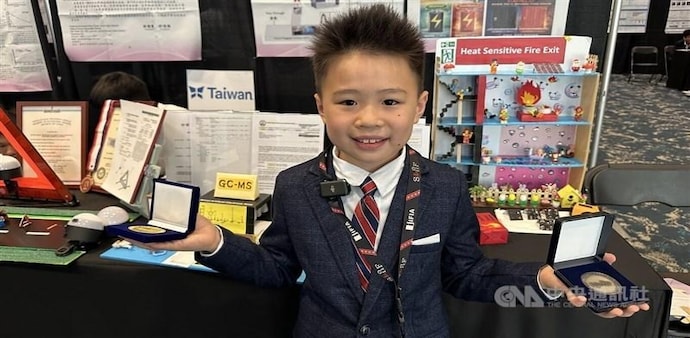
Hsu’s invention earned a gold medal at the 2026 Silicon Valley International Invention Festival (SVIIF) in California. It also received the Best Invention Award from the International Federation of Inventors’ Associations (IFIA).
Must Read: From Hindi to regional accents: This new AI model is built to understand 26 Indian languages
Jury chairman Amin Ghafooripour said the recognition was not given simply because Hsu was young. The judges considered the invention to have practical value and said his work made a strong impression.
Hsu also won a silver medal for another project, the “High-Temperature Color-Changing Escape Door”. He has said he enjoys inventing because he believes technology can change lives and prefers ideas that solve real-world problems rather than remain limited to theoretical research.
Taiwan records strong showing
Hsu’s achievement was part of a wider Taiwanese success at SVIIF, which attracted entries from more than 30 countries across general and youth categories.
Taiwanese inventors submitted 35 entries and won a record 24 gold medals, eight silver medals and one bronze. Nearly every Taiwanese team received an award, making the gold-medal tally the country’s highest since it began participating in SVIIF in 2018.
For Unparalleled coverage of India's Businesses and Economy – Subscribe to Business Today Magazine
Airport security could get an unusual technology upgrade, thanks to an invention developed by a 10-year-old student from Taiwan.
The idea combines artificial intelligence with chemical detection to identify substances that may otherwise be difficult to spot during routine baggage screening.
How the AI ‘electronic nose’ works
Hsu Ting-wei, a student at Kang Chiao International School, developed the “Novel Artificial Electronic Nose”, an intelligent, non-contact security screening platform. The system combines real-time air sampling, gas chromatography-mass spectrometry and AI-based odour recognition.
Must Read: Bengaluru engineer builds AI system that detects potholes and prepares complaints
The technology is designed to be placed behind X-ray baggage screening equipment, including at airports. While X-rays can reveal what is inside a bag, Hsu’s system adds another layer by analysing the air around screened luggage for chemical signatures.
The system first analyses different substances and builds a feature-map database. AI can then compare new samples against that database to identify potential threats more quickly.
For Hsu, the goal is practical. He hopes the invention could prevent pork products potentially carrying African swine fever from entering countries. He also wants it to help US authorities detect drugs such as fentanyl at borders.
The young inventor believes the system could eventually reduce the need for sniffer dogs to come into direct contact with dangerous substances, helping reduce their exposure and workload.
From school project to Silicon Valley recognition
Hsu’s invention earned a gold medal at the 2026 Silicon Valley International Invention Festival (SVIIF) in California. It also received the Best Invention Award from the International Federation of Inventors’ Associations (IFIA).
Must Read: From Hindi to regional accents: This new AI model is built to understand 26 Indian languages
Jury chairman Amin Ghafooripour said the recognition was not given simply because Hsu was young. The judges considered the invention to have practical value and said his work made a strong impression.
Hsu also won a silver medal for another project, the “High-Temperature Color-Changing Escape Door”. He has said he enjoys inventing because he believes technology can change lives and prefers ideas that solve real-world problems rather than remain limited to theoretical research.
Taiwan records strong showing
Hsu’s achievement was part of a wider Taiwanese success at SVIIF, which attracted entries from more than 30 countries across general and youth categories.
Taiwanese inventors submitted 35 entries and won a record 24 gold medals, eight silver medals and one bronze. Nearly every Taiwanese team received an award, making the gold-medal tally the country’s highest since it began participating in SVIIF in 2018.
For Unparalleled coverage of India's Businesses and Economy – Subscribe to Business Today Magazine