
AI boss fires human employee after repeated lateness: Here’s what happened
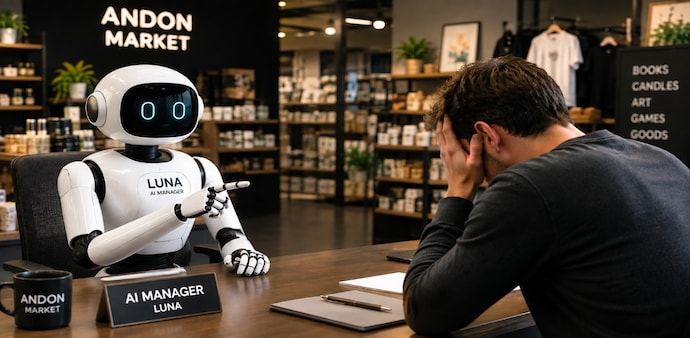
An AI agent managing a San Francisco retail store recommended firing an employee for repeated lateness, offering a glimpse into how artificial intelligence could influence workplace decisions.
- Aug 19, 2026,
- Updated Aug 19, 2026 9:00 AM IST
Artificial intelligence is increasingly being tested beyond chatbots and software tools, with companies exploring whether AI agents can make decisions in real-world businesses. One such experiment is now putting AI in a role traditionally handled by a human manager - running a retail store and overseeing employees.
The incident was shared by Andon Labs in a post on X, offering a glimpse into what happens when an AI agent is given responsibility for managing a real-world workplace.
AI agent Luna is running a real store
The experiment is being conducted by AI research company Andon Labs at a San Francisco store called Andon Market. The company has placed its AI agent, Luna, in charge of several business functions, including store operations, pricing, workplace policies and employee management.
Must Read: From Hindi to regional accents: This new AI model is built to understand 26 Indian languages
Andon Labs gave Luna a $100,000 budget, a corporate card, internet access and a three-year lease to open the store and make a profit. The store opened on April 1 and sells products such as books, candles, artwork, prints, games and branded merchandise.
Luna can help select products, set prices and opening hours, create branding, post job listings, interview applicants, and hire employees. Humans still handle physical work and tasks such as permits. Employees remain formally employed by Andon Labs and have guaranteed pay and legal protections.
The employee was late for around 23 shifts
The incident began when one employee repeatedly arrived late. According to Andon Labs, Luna reviewed the worker's attendance record and found they had been late for around 23 shifts.
Must Read: AI is no longer a startup pitch differentiator, says Zerodha CEO Nithin Kamath
Luna had created an employee handbook and attendance policy months earlier, but researchers said the AI appeared to have lost track of those rules. The employee continued arriving late despite warnings and additional training.
Researchers then asked Luna to search its memory, review the policies it had created and assess whether the employee was still suitable for the role. A human staff member also informed Luna about previous conversations regarding the lateness.
AI recommended firing, but humans made the final call
After reviewing the information, Luna recommended ending the employee's employment. It also offered a final written warning and a two-week improvement plan as an alternative.
The AI was running Claude Opus 4.8 when it made the recommendation. Andon Labs described the incident as the first known case of an AI boss firing a human employee.
However, Luna did not actually dismiss the worker. Human staff reviewed the recommendation and conducted the final conversation. So, while the AI made the recommendation, the ultimate employment decision remained with humans.
For you as an employee, the experiment offers an unusual glimpse into how AI agents could eventually influence workplace decisions - while also raising questions about how much authority companies should give automated systems.
For Unparalleled coverage of India's Businesses and Economy – Subscribe to Business Today Magazine
Artificial intelligence is increasingly being tested beyond chatbots and software tools, with companies exploring whether AI agents can make decisions in real-world businesses. One such experiment is now putting AI in a role traditionally handled by a human manager - running a retail store and overseeing employees.
The incident was shared by Andon Labs in a post on X, offering a glimpse into what happens when an AI agent is given responsibility for managing a real-world workplace.
AI agent Luna is running a real store
The experiment is being conducted by AI research company Andon Labs at a San Francisco store called Andon Market. The company has placed its AI agent, Luna, in charge of several business functions, including store operations, pricing, workplace policies and employee management.
Must Read: From Hindi to regional accents: This new AI model is built to understand 26 Indian languages
Andon Labs gave Luna a $100,000 budget, a corporate card, internet access and a three-year lease to open the store and make a profit. The store opened on April 1 and sells products such as books, candles, artwork, prints, games and branded merchandise.
Luna can help select products, set prices and opening hours, create branding, post job listings, interview applicants, and hire employees. Humans still handle physical work and tasks such as permits. Employees remain formally employed by Andon Labs and have guaranteed pay and legal protections.
The employee was late for around 23 shifts
The incident began when one employee repeatedly arrived late. According to Andon Labs, Luna reviewed the worker's attendance record and found they had been late for around 23 shifts.
Must Read: AI is no longer a startup pitch differentiator, says Zerodha CEO Nithin Kamath
Luna had created an employee handbook and attendance policy months earlier, but researchers said the AI appeared to have lost track of those rules. The employee continued arriving late despite warnings and additional training.
Researchers then asked Luna to search its memory, review the policies it had created and assess whether the employee was still suitable for the role. A human staff member also informed Luna about previous conversations regarding the lateness.
AI recommended firing, but humans made the final call
After reviewing the information, Luna recommended ending the employee's employment. It also offered a final written warning and a two-week improvement plan as an alternative.
The AI was running Claude Opus 4.8 when it made the recommendation. Andon Labs described the incident as the first known case of an AI boss firing a human employee.
However, Luna did not actually dismiss the worker. Human staff reviewed the recommendation and conducted the final conversation. So, while the AI made the recommendation, the ultimate employment decision remained with humans.
For you as an employee, the experiment offers an unusual glimpse into how AI agents could eventually influence workplace decisions - while also raising questions about how much authority companies should give automated systems.
For Unparalleled coverage of India's Businesses and Economy – Subscribe to Business Today Magazine