
Apple launches AI health study app as more people turn to chatbots for medical answers
From understanding unusual symptoms to making sense of medical reports, AI chatbots are becoming a source of health information. Apple now wants to study how people use them.
- Nov 16, 2026,
- Updated Nov 16, 2026 10:18 AM IST
The next time you have a health-related question, you might find yourself turning to an AI chatbot before scheduling a doctor's appointment. Whether it is understanding an unusual symptom, interpreting a medical report or figuring out how to improve your sleep, conversational AI is emerging as another way to access health information.
But how reliable are these answers, and can people understand and trust medical guidance generated by artificial intelligence? Apple is now looking to examine these questions through a new research initiative.
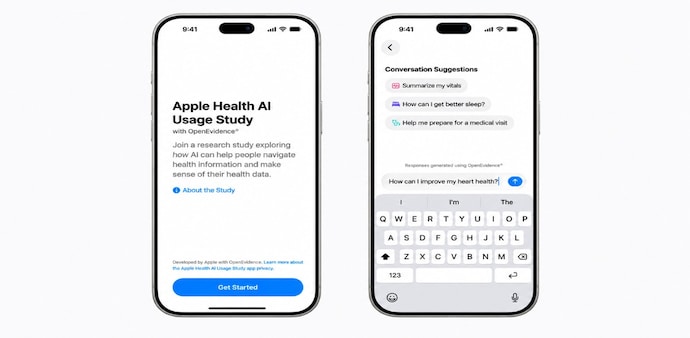
The company has launched a dedicated AI health research study in the US, along with an iPhone app developed in collaboration with clinical AI platform OpenEvidence. The study will explore how you interact with AI-generated medical information and whether these tools can help you make better sense of your health.
MUST READ | Vivo X500 series India prices may start at ₹1.69 lakh ahead of November 26 launch
Apple launches AI health study app with OpenEvidence
Announced on November 15, the Apple Health AI Usage Study app will examine what drives user trust, the quality of AI-generated responses, comprehension and how you use the information in your everyday life.
Through the dedicated app, participants can ask everyday health questions, explore complex medical topics explained in simpler language and access linked, peer-reviewed clinical references. Responses are generated using OpenEvidence, a clinical AI platform widely used by healthcare professionals. It draws on established medical publications, including The New England Journal of Medicine, the Journal of the American Medical Association (JAMA) and Nature.
DON'T MISS | Diwali smartphone sales decline 20% as higher prices curb demand across India’s offline market
Participants can also voluntarily share HealthKit information, including resting heart rate, physical activity, sleep patterns and laboratory results. Apple wants to understand whether integrating personal health data makes AI responses more relevant and easier to understand. The study will also examine whether AI can help people prepare for appointments with their doctors.
Robert M. Wachter, professor and chair of the Department of Medicine at the University of California, San Francisco (UCSF), said, "Patients and clinicians are both turning to AI, but the tools they use are being built and tested in separate worlds."
Who can use Apple's AI health study app?
The research programme can accommodate up to 200,000 eligible participants aged 21 and above across the US. Participants must have an Apple Intelligence-enabled iPhone 15 Pro or later running iOS 26 or later. They can download the dedicated app to learn more and choose to enrol.
Privacy and medical safety are also central to the initiative. Apple says study data will not be used to train AI models. Participants retain control over sharing their HealthKit metrics and survey responses, while safety measures can flag certain concerning questions and suggest contacting a healthcare provider or other resources.
However, the app is not intended to diagnose or treat medical conditions or replace professional medical advice. Apple advises participants to consult a doctor or clinician about health concerns or to verify medical information.
For Unparalleled coverage of India's Businesses and Economy – Subscribe to Business Today Magazine