
Apple claims evidence against ex-employee amid trade secret theft lawsuit, OpenAI fires back
OpenAI denied the allegations at the recent hearing, saying that Apple failed to show any evidence of confidential information that was allegedly stolen by former employees.
- Sep 1, 2026,
- Updated Sep 1, 2026 2:50 PM IST
Apple’s legal case against OpenAI escalates as the iPhone maker claims to have new and serious evidence of alleged trade-secret misuse. It alleges that former Apple employees took confidential information and used it for OpenAI’s benefit.
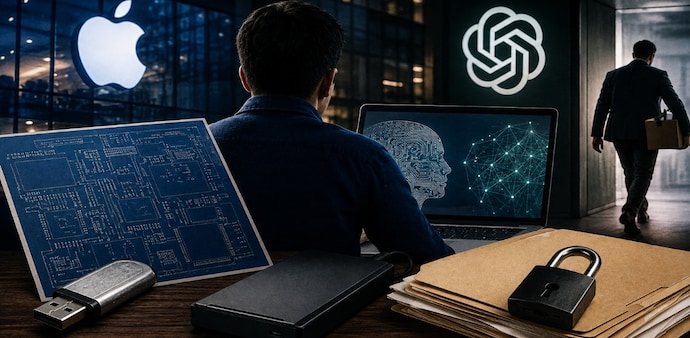
One of those employees is Chang Liu, whose old Apple work laptop was submitted by lawyers for examination. Apple says its examination of the laptop uncovered what it calls “shocking evidence.” Now, Apple alleges that Liu used a confidential Apple circuit schematic while working at OpenAI. This circuit is said to be a technical blueprint showing how electronic components are designed and connected.
Must read: Apple vs OpenAI: Legal battle escalates as iPhone maker rejects dismissal plea
The company also alleges that Liu used a tool with the same name as an internal Apple engineering application, suggesting its internal resources may have been carried over into his work at OpenAI. It also says that Liu asked an OpenAI colleague, Yu-Ting Peng, to help destroy evidence.
“The MacBook represents the very limited information Defendants provided so far (and only after weeks of delay), and shows Apple is not conducting ‘fishing expeditions’ but that its trade secrets are being used and evidence is being destroyed,” the filing states.
OpenAI denies allegations
Now, according to a Reuters report, OpenAI denied the allegations at the recent hearing, saying that Apple failed to show any evidence of confidential information that was allegedly stolen by former employees. "This dispute is a mess of Apple's own making, and it is trying to blame everyone else," OpenAI said in a filing late Monday in U.S. District Court in San Jose, California.
The AI giant also stated that Apple’s own policies make it difficult to separate company data from personal data as it allows employees to use their personal iCloud accounts to access work documents. It argues that with such a setup, it can be difficult to determine which information is personal and which belongs to Apple.
Must read: Tim Cook’s successor: Who will lead Apple as the next CEO?
The company also highlighted Apple's practice of immediately escorting departing employees out of its offices. According to OpenAI, employees may not have enough time to return company devices, transfer work files back to Apple, or properly hand over their responsibilities.
Liu also stated that his access to Apple documents after he left the company was done to help his former Apple colleagues. He also stated that Apple employees contacted him for files or to answer questions about work he had previously handled.
For Unparalleled coverage of India's Businesses and Economy – Subscribe to Business Today Magazine
Apple’s legal case against OpenAI escalates as the iPhone maker claims to have new and serious evidence of alleged trade-secret misuse. It alleges that former Apple employees took confidential information and used it for OpenAI’s benefit.
One of those employees is Chang Liu, whose old Apple work laptop was submitted by lawyers for examination. Apple says its examination of the laptop uncovered what it calls “shocking evidence.” Now, Apple alleges that Liu used a confidential Apple circuit schematic while working at OpenAI. This circuit is said to be a technical blueprint showing how electronic components are designed and connected.
Must read: Apple vs OpenAI: Legal battle escalates as iPhone maker rejects dismissal plea
The company also alleges that Liu used a tool with the same name as an internal Apple engineering application, suggesting its internal resources may have been carried over into his work at OpenAI. It also says that Liu asked an OpenAI colleague, Yu-Ting Peng, to help destroy evidence.
“The MacBook represents the very limited information Defendants provided so far (and only after weeks of delay), and shows Apple is not conducting ‘fishing expeditions’ but that its trade secrets are being used and evidence is being destroyed,” the filing states.
OpenAI denies allegations
Now, according to a Reuters report, OpenAI denied the allegations at the recent hearing, saying that Apple failed to show any evidence of confidential information that was allegedly stolen by former employees. "This dispute is a mess of Apple's own making, and it is trying to blame everyone else," OpenAI said in a filing late Monday in U.S. District Court in San Jose, California.
The AI giant also stated that Apple’s own policies make it difficult to separate company data from personal data as it allows employees to use their personal iCloud accounts to access work documents. It argues that with such a setup, it can be difficult to determine which information is personal and which belongs to Apple.
Must read: Tim Cook’s successor: Who will lead Apple as the next CEO?
The company also highlighted Apple's practice of immediately escorting departing employees out of its offices. According to OpenAI, employees may not have enough time to return company devices, transfer work files back to Apple, or properly hand over their responsibilities.
Liu also stated that his access to Apple documents after he left the company was done to help his former Apple colleagues. He also stated that Apple employees contacted him for files or to answer questions about work he had previously handled.
For Unparalleled coverage of India's Businesses and Economy – Subscribe to Business Today Magazine