
BlackRock sees AI agents creating a new economy for stablecoins, blockchain and compute
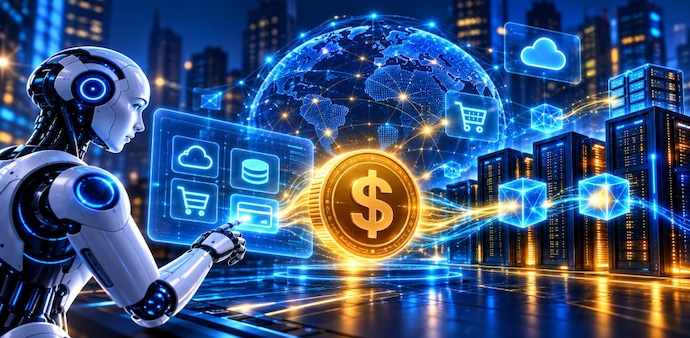
In its report, The Machine-Native Economy, the asset manager argues that AI and digital assets are converging, with AI providing machine-native intelligence and blockchains providing machine-native money.
- Sep 26, 2026,
- Updated Sep 26, 2026 1:35 AM IST
The rapid development of artificial intelligence could create a new source of demand for digital assets as AI agents become capable of interacting with financial and economic networks, according to BlackRock. In its report, The Machine-Native Economy, the asset manager argues that AI and digital assets are beginning to converge, with AI providing machine-native intelligence and blockchains providing machine-native money.
AI agents could drive demand for new payment rails
The report highlights the rise of agentic AI — systems that can plan and execute multistep tasks while interacting with external tools and infrastructure with limited human intervention. As these systems increasingly make purchases, access data and initiate transactions, they could require payment infrastructure designed for machine-to-machine commerce.
BlackRock says crypto-native blockchain rails could be particularly suited to high-frequency, low-value transactions such as API calls, on-demand data and consumption-based compute. Stablecoins, native cryptoassets and tokenised real-world assets could provide programmable instruments for payments and digital ownership.
Stablecoins already show significant scale
Stablecoins could become an important transactional asset for agentic commerce because they are designed to maintain a stable value against a reference currency, most commonly the US dollar. BlackRock notes that stablecoins had more than $300 billion in circulating market capitalisation as of September 2026.
Adjusted stablecoin transaction volume exceeded $11 trillion in 2025, according to the report. Between 2020 and 2025, adjusted volume grew at an 80% compound annual growth rate, compared with approximately 8.5% for ACH. BlackRock says growing regulatory clarity in markets including the US, EU, Hong Kong and Singapore could support further adoption.
Compute emerges as another digital asset opportunity
The report also identifies computing capacity as a potentially large economic resource. BlackRock cites estimates that combined revenues from Amazon Web Services, Microsoft’s Intelligent Cloud segment and Google Cloud could reach approximately $1.1 trillion by 2030, representing a 29% CAGR from 2025 levels.
As demand for AI training and inference expands, standardized claims on compute capacity could potentially be tokenised, transferred, pledged as collateral and settled through programmable infrastructure. The report says standardized compute products, including exchange-traded compute futures, could eventually support price discovery and hedging.
AI agents could eventually procure compute autonomously
BlackRock outlines a potential model in which AI agents compare computing capacity based on price, performance, latency, location and hardware specialization, then provision resources and settle payments automatically. Protocols such as MCP, A2A and x402 could facilitate data access, agent coordination and machine payments.
However, BlackRock stresses that the ecosystem remains nascent, with agentic payment activity and compute-market liquidity still limited. The report’s central thesis is that as AI adoption broadens, digital assets could become increasingly important infrastructure for an economy in which machines can transact, allocate resources and pay for services with limited human intervention.
For Unparalleled coverage of India's Businesses and Economy – Subscribe to Business Today Magazine
The rapid development of artificial intelligence could create a new source of demand for digital assets as AI agents become capable of interacting with financial and economic networks, according to BlackRock. In its report, The Machine-Native Economy, the asset manager argues that AI and digital assets are beginning to converge, with AI providing machine-native intelligence and blockchains providing machine-native money.
AI agents could drive demand for new payment rails
The report highlights the rise of agentic AI — systems that can plan and execute multistep tasks while interacting with external tools and infrastructure with limited human intervention. As these systems increasingly make purchases, access data and initiate transactions, they could require payment infrastructure designed for machine-to-machine commerce.
BlackRock says crypto-native blockchain rails could be particularly suited to high-frequency, low-value transactions such as API calls, on-demand data and consumption-based compute. Stablecoins, native cryptoassets and tokenised real-world assets could provide programmable instruments for payments and digital ownership.
Stablecoins already show significant scale
Stablecoins could become an important transactional asset for agentic commerce because they are designed to maintain a stable value against a reference currency, most commonly the US dollar. BlackRock notes that stablecoins had more than $300 billion in circulating market capitalisation as of September 2026.
Adjusted stablecoin transaction volume exceeded $11 trillion in 2025, according to the report. Between 2020 and 2025, adjusted volume grew at an 80% compound annual growth rate, compared with approximately 8.5% for ACH. BlackRock says growing regulatory clarity in markets including the US, EU, Hong Kong and Singapore could support further adoption.
Compute emerges as another digital asset opportunity
The report also identifies computing capacity as a potentially large economic resource. BlackRock cites estimates that combined revenues from Amazon Web Services, Microsoft’s Intelligent Cloud segment and Google Cloud could reach approximately $1.1 trillion by 2030, representing a 29% CAGR from 2025 levels.
As demand for AI training and inference expands, standardized claims on compute capacity could potentially be tokenised, transferred, pledged as collateral and settled through programmable infrastructure. The report says standardized compute products, including exchange-traded compute futures, could eventually support price discovery and hedging.
AI agents could eventually procure compute autonomously
BlackRock outlines a potential model in which AI agents compare computing capacity based on price, performance, latency, location and hardware specialization, then provision resources and settle payments automatically. Protocols such as MCP, A2A and x402 could facilitate data access, agent coordination and machine payments.
However, BlackRock stresses that the ecosystem remains nascent, with agentic payment activity and compute-market liquidity still limited. The report’s central thesis is that as AI adoption broadens, digital assets could become increasingly important infrastructure for an economy in which machines can transact, allocate resources and pay for services with limited human intervention.
For Unparalleled coverage of India's Businesses and Economy – Subscribe to Business Today Magazine