
Gold’s hidden role in AI: From chips and connectors to data centres powering the AI boom
Gold’s hidden role in AI: From chips and connectors to data centres powering the AI boom
Gold plays a quiet but important role in modern electronics, from high-end chips and connectors to sensors and data-centre infrastructure. Goldman Sachs says the AI boom could support future demand, but high prices and miniaturisation are also pushing manufacturers to reduce gold usage.
Business Today Desk
- Sep 26, 2026,
- Updated Sep 26, 2026 7:42 AM IST
Gold is not just a jewellery and investment asset; it is also a critical material in modern electronics. As artificial intelligence drives demand for increasingly powerful chips and data-centre infrastructure, the precious metal continues to play a role in the high-end technology ecosystem, according to Goldman Sachs’ analysis.
Advertisement
Gold has a combination of properties that makes it useful in electronic applications. It is an excellent conductor of electricity and highly resistant to corrosion and oxidation. It can also be formed into extremely thin wires, films and coatings without losing its performance characteristics.
These properties have made gold important in high-reliability applications ranging from early computers and telecommunications equipment to defence systems and spacecraft. As electronics became smaller and more complex, the metal found applications across microprocessors, memory chips, connectors, sensors and networking infrastructure.
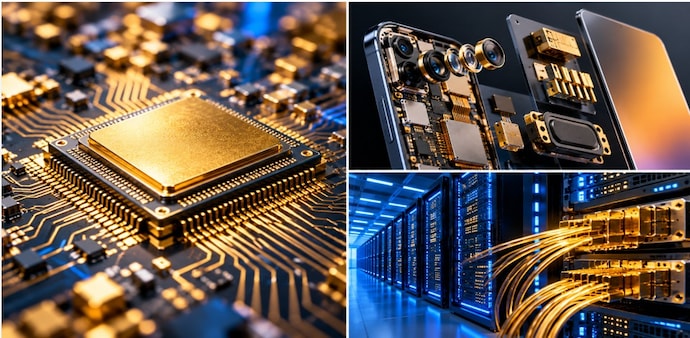
Today, gold can be found in high-end chips and devices including smartphones, laptops, vehicles and smartwatches. It is also used in large-scale data centres and other infrastructure that supports digital services.
AI creates a complicated demand picture
Advertisement
The rapid expansion of AI has increased demand for advanced electronics and chips, but that has not yet translated into a significant increase in gold consumption.
MUST READ: India is going deeper into smartphone manufacturing, beyond final assembly: Ashwini Vaishnaw
According to Goldman Sachs, annual technology demand for gold was 323 tonnes in 2025, virtually unchanged from 2024. The electronics sector accounts for around 80% of gold used in industrial applications.
The relatively flat demand reflects competing forces. The growing requirement for AI chips can increase gold demand, but manufacturers are simultaneously trying to reduce their use of the expensive metal. Advances in miniaturisation also mean newer, smaller chips can require less gold or, in some cases, no gold.
Advertisement
Data centres could open a new avenue
One emerging technology Goldman Sachs highlights is co-packaged optics (CPO). As AI models become more complex, the amount of data moving between processors and memory systems is increasing, putting pressure on conventional electronic connections.
CPO integrates optical communication components more closely with processors and could help improve bandwidth, reduce data-transfer bottlenecks and improve energy efficiency.
DON'T MISS: AI is already making developers 50% more productive, says Zoho’s Sridhar Vembu
Gold has several potential applications within these systems, including some optical and photonic components and high-frequency electrodes. While CPO remains at an early adoption stage, wider deployment across large AI data centres could create a new, albeit potentially modest, source of gold demand.
Why gold remains difficult to replace
High gold prices have encouraged manufacturers to reduce the quantity of gold used in electronics through thinner bonding wires and coatings. However, Goldman Sachs notes that much of the relatively easy “thrifting” has already occurred.
DO CHECKOUT: Nvidia CEO Jensen Huang says there is a “0% chance AI will end the world by 2030”
Advertisement
High-end and safety-critical devices may continue to require gold because manufacturers prioritise reliability and longevity. For now, the AI boom and efforts to minimise gold usage remain competing forces, leaving technology demand for the metal broadly stable.
For Unparalleled coverage of India's Businesses and Economy – Subscribe to Business Today Magazine
Gold is not just a jewellery and investment asset; it is also a critical material in modern electronics. As artificial intelligence drives demand for increasingly powerful chips and data-centre infrastructure, the precious metal continues to play a role in the high-end technology ecosystem, according to Goldman Sachs’ analysis.
Advertisement
Gold has a combination of properties that makes it useful in electronic applications. It is an excellent conductor of electricity and highly resistant to corrosion and oxidation. It can also be formed into extremely thin wires, films and coatings without losing its performance characteristics.
These properties have made gold important in high-reliability applications ranging from early computers and telecommunications equipment to defence systems and spacecraft. As electronics became smaller and more complex, the metal found applications across microprocessors, memory chips, connectors, sensors and networking infrastructure.
Today, gold can be found in high-end chips and devices including smartphones, laptops, vehicles and smartwatches. It is also used in large-scale data centres and other infrastructure that supports digital services.
AI creates a complicated demand picture
Advertisement
The rapid expansion of AI has increased demand for advanced electronics and chips, but that has not yet translated into a significant increase in gold consumption.
MUST READ: India is going deeper into smartphone manufacturing, beyond final assembly: Ashwini Vaishnaw
According to Goldman Sachs, annual technology demand for gold was 323 tonnes in 2025, virtually unchanged from 2024. The electronics sector accounts for around 80% of gold used in industrial applications.
The relatively flat demand reflects competing forces. The growing requirement for AI chips can increase gold demand, but manufacturers are simultaneously trying to reduce their use of the expensive metal. Advances in miniaturisation also mean newer, smaller chips can require less gold or, in some cases, no gold.
Advertisement
Data centres could open a new avenue
One emerging technology Goldman Sachs highlights is co-packaged optics (CPO). As AI models become more complex, the amount of data moving between processors and memory systems is increasing, putting pressure on conventional electronic connections.
CPO integrates optical communication components more closely with processors and could help improve bandwidth, reduce data-transfer bottlenecks and improve energy efficiency.
DON'T MISS: AI is already making developers 50% more productive, says Zoho’s Sridhar Vembu
Gold has several potential applications within these systems, including some optical and photonic components and high-frequency electrodes. While CPO remains at an early adoption stage, wider deployment across large AI data centres could create a new, albeit potentially modest, source of gold demand.
Why gold remains difficult to replace
High gold prices have encouraged manufacturers to reduce the quantity of gold used in electronics through thinner bonding wires and coatings. However, Goldman Sachs notes that much of the relatively easy “thrifting” has already occurred.
DO CHECKOUT: Nvidia CEO Jensen Huang says there is a “0% chance AI will end the world by 2030”
Advertisement
High-end and safety-critical devices may continue to require gold because manufacturers prioritise reliability and longevity. For now, the AI boom and efforts to minimise gold usage remain competing forces, leaving technology demand for the metal broadly stable.
For Unparalleled coverage of India's Businesses and Economy – Subscribe to Business Today Magazine
Read more!