
Why Nvidia could fire Jensen Huang but Meta and Tesla cannot remove Zuckerberg, Musk -- Devina Mehra explains
Why could Nvidia's board remove Jensen Huang while Mark Zuckerberg and Elon Musk retain control of their companies? First Global's Devina Mehra explains how corporate governance risks, undisclosed relationships and dual-class share structures determine the power of boards over technology founders.
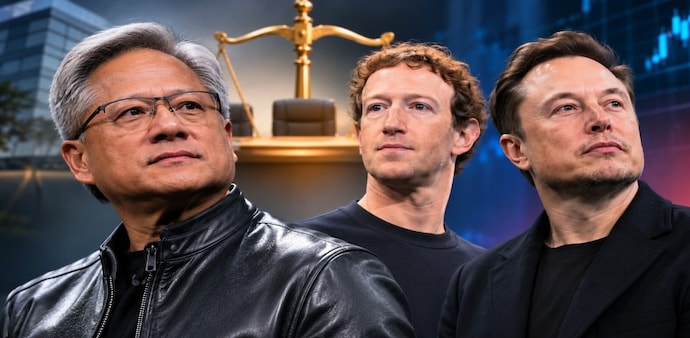
- Nov 13, 2026,
- Updated Nov 13, 2026 2:30 PM IST
First Global's Devina Mehra says Nvidia's board faced serious governance and legal risks over alleged undisclosed relationships and preferential chip allocations. She explains how dual-class share structures protect founders such as Mark Zuckerberg and Elon Musk from losing control of their companies.
The reported resignation of Nvidia co-founder Jensen Huang has triggered a wider debate over corporate governance, board accountability and the extraordinary voting powers enjoyed by technology founders. Devina Mehra, founder, chairperson and managing director of First Global, has explained why Nvidia's board could remove Huang while founders such as Meta's Mark Zuckerberg and Tesla's Elon Musk enjoy significantly greater protection.
In a post, Mehra argued that the central issue was not Huang's alleged extramarital affairs but the potential governance violations arising from undisclosed relationships involving employees and clients.
"It is not about an extramarital affair. That is easily papered over. But American boards cannot tolerate an undisclosed relationship with an employee," she wrote.
Why Nvidia's board acted
Mehra pointed out that executives at McDonald's, Intel and other major companies have previously faced consequences over undisclosed workplace relationships.
She argued that Huang's reported relationship with Alice Huang raised additional concerns because of allegations involving preferential access to advanced AI chips.
"Whether Alice Huang was acting for the Chinese military or not, the fact is that what was effectively a shell company got out of turn allotment of almost 5 billion dollars of cutting edge AI chips - something Jensen had the discretion to give," Mehra wrote.
These remain allegations, and the claims concerning chip allocations and intelligence connections have not been independently established.
"The possible downside and even legal liability for the board would have been huge - that is why they acted," she added.
According to Mehra, directors were primarily responsible for mitigating legal and governance risks rather than protecting short-term business interests.
Why Zuckerberg and Musk are different
Mehra attributed the difference to dual-class shareholding structures, commonly known as A/B shares, which give founders disproportionate voting rights relative to their economic ownership.
"It is no longer ‘one share one vote’ which has traditionally been the basis for good corporate governance," she wrote.
She traced the mechanism's history to the 1920s, its subsequent restrictions and its revival during the 1980s. Google's 2004 listing subsequently popularised founder-controlled voting structures among technology companies.
ALSO READ: Who will lead Nvidia after Jensen Huang? Colette Kress, Ian Buck and 5 others in focus
Mehra noted that approximately 25–30% of recent US IPOs have featured dual-class shares.
Nvidia, however, went public in 1999 without comparable founder voting protections. Huang's voting power broadly reflected his single-digit equity holding, leaving the board with authority to remove him.
What happened at Nvidia?
According to the supplied Reuters-attributed account, Huang resigned on Thursday following reports of multiple alleged relationships, including those involving Nvidia executive Kimberly Powell and Alice Huang.
The account says Nvidia appointed chief financial officer Colette Kress as interim CEO while initiating a search for a permanent successor.
It also reports that Nvidia shares declined 5.5% on Thursday, extending losses from their October peak.
MUST READ | 'A legend replaces a legend': Trump backs Apple's Tim Cook to succeed Jensen Huang as Nvidia CEO
For Unparalleled coverage of India's Businesses and Economy – Subscribe to Business Today Magazine