
'AI won't replace you, someone who knows AI will': Microsoft India chief on job loss fears
AI itself won’t take away jobs, but individuals who resist learning and adding AI into their skill set risk being outperformed and ultimately replaced by those who know it, says Microsoft India head Puneet Chandok
- Feb 18, 2026,
- Updated Feb 18, 2026 4:43 PM IST
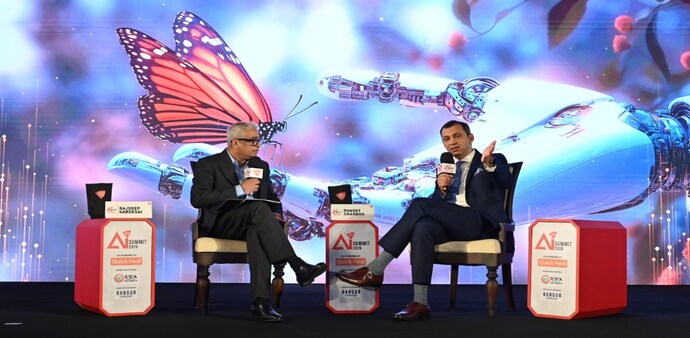
Puneet Chandok, President of Microsoft India and South Asia, delivered a compelling message about the future of work in the artificial intelligence era. His core assertion was clear: artificial intelligence will not directly eliminate jobs, but professionals who fail to adapt to AI tools may find themselves replaced by those who do.
"The thing that I worry most is not so much jobs going away but our ability to scale in India," Chandok said while speaking at India Today AI Summit. "We have to scale a billion Indians. At Microsoft, we are committed to scaling to 20 million people over the next few years. I don't think that's enough; we have to do more. We all have to do more, but for a billion Indians to rise with AI, we need to scale them."
The Microsoft executive said that professionals need to know how to use AI. "People will not lose jobs to AI, people will lose jobs to people who know AI - and you better be on the right side of that equation."
Defining “Atmanirbhar AI” for India
During the session titled Life, Work, Home: Atmanirbhar AI, Chandok outlined what self-reliant AI truly means for India. According to him, Atmanirbhar AI is about designing, deploying and benefiting from AI systems tailored to India’s distinct economic and social needs.
He emphasised that India is evolving from being a consumer of global AI technologies to becoming a creator and exporter of AI-driven solutions.
For Chandok, technological independence is not about isolation from global ecosystems. Instead, it involves building strong local capabilities on top of global platforms while aligning innovation with national priorities.
“Atmanirbhar AI is about empowering every individual, every organisation and every government institution in India to achieve more using AI,” he said.
AI’s Growing Impact on Life, Work and Homes
Chandok highlighted how AI-powered tools are helping students enhance learning outcomes, enabling doctors to diagnose diseases more quickly, and allowing entrepreneurs and MSMEs to scale efficiently. From multilingual AI systems to automation solutions for small businesses, the technology is driving productivity at scale.
He stressed that India’s AI applications must address real-world challenges from improving healthcare access and increasing agricultural output to expanding financial inclusion and strengthening governance systems.
“AI is not just about efficiency. It is about impact,” he remarked, underscoring the opportunity to solve problems at a population scale.
Can India Become a Global AI Powerhouse?
Chandok expressed confidence that India possesses the essential ingredients to lead in the global AI economy: a vast talent pool, a large and dynamic market, and robust digital public infrastructure.
He pointed to India’s success in implementing large-scale digital public goods such as identity and payment systems as proof of the country’s ability to deploy technology at scale. The next step, he suggested, is embedding AI into these platforms and developing export-ready AI models that reflect India’s linguistic and cultural diversity.
For Unparalleled coverage of India's Businesses and Economy – Subscribe to Business Today Magazine
Puneet Chandok, President of Microsoft India and South Asia, delivered a compelling message about the future of work in the artificial intelligence era. His core assertion was clear: artificial intelligence will not directly eliminate jobs, but professionals who fail to adapt to AI tools may find themselves replaced by those who do.
"The thing that I worry most is not so much jobs going away but our ability to scale in India," Chandok said while speaking at India Today AI Summit. "We have to scale a billion Indians. At Microsoft, we are committed to scaling to 20 million people over the next few years. I don't think that's enough; we have to do more. We all have to do more, but for a billion Indians to rise with AI, we need to scale them."
The Microsoft executive said that professionals need to know how to use AI. "People will not lose jobs to AI, people will lose jobs to people who know AI - and you better be on the right side of that equation."
Defining “Atmanirbhar AI” for India
During the session titled Life, Work, Home: Atmanirbhar AI, Chandok outlined what self-reliant AI truly means for India. According to him, Atmanirbhar AI is about designing, deploying and benefiting from AI systems tailored to India’s distinct economic and social needs.
He emphasised that India is evolving from being a consumer of global AI technologies to becoming a creator and exporter of AI-driven solutions.
For Chandok, technological independence is not about isolation from global ecosystems. Instead, it involves building strong local capabilities on top of global platforms while aligning innovation with national priorities.
“Atmanirbhar AI is about empowering every individual, every organisation and every government institution in India to achieve more using AI,” he said.
AI’s Growing Impact on Life, Work and Homes
Chandok highlighted how AI-powered tools are helping students enhance learning outcomes, enabling doctors to diagnose diseases more quickly, and allowing entrepreneurs and MSMEs to scale efficiently. From multilingual AI systems to automation solutions for small businesses, the technology is driving productivity at scale.
He stressed that India’s AI applications must address real-world challenges from improving healthcare access and increasing agricultural output to expanding financial inclusion and strengthening governance systems.
“AI is not just about efficiency. It is about impact,” he remarked, underscoring the opportunity to solve problems at a population scale.
Can India Become a Global AI Powerhouse?
Chandok expressed confidence that India possesses the essential ingredients to lead in the global AI economy: a vast talent pool, a large and dynamic market, and robust digital public infrastructure.
He pointed to India’s success in implementing large-scale digital public goods such as identity and payment systems as proof of the country’s ability to deploy technology at scale. The next step, he suggested, is embedding AI into these platforms and developing export-ready AI models that reflect India’s linguistic and cultural diversity.
For Unparalleled coverage of India's Businesses and Economy – Subscribe to Business Today Magazine