
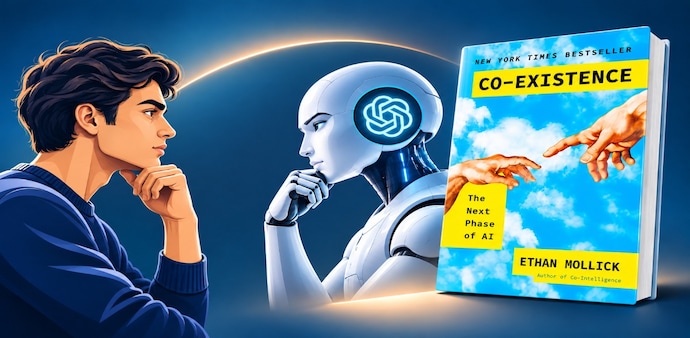
ChatGPT made homework easier, but grades fell 17%: Wharton professor explains how to use AI in new book
A 2025 MIT Media Lab study found that students who used ChatGPT to write essays were less engaged and remembered less about their work. Four months later, they performed worse when writing without AI, the professor cites in the book, 'Co-Existence: The Next Phase of AI'
- Nov 18, 2026,
- Updated Nov 18, 2026 2:16 PM IST
AI is getting smarter by the day. But are we using it the right way? A Wharton professor's new book offers some answers, including when and how to use AI and when to stay away from it.
Ethan Mollick, an AI researcher and associate professor at the Wharton School, has written a practical guide examining how people can work with AI without compromising their ability to think.
He writes that AI is not a replacement for one's own thinking, and the value it provides depends entirely on how a person chooses to use it.
"Today's AI is much more capable than most people think, creating what is called a 'capability overhang' where a lot of AI ability is currently unused," Mollick writes in his book, 'Co-Existence: The Next Phase of AI'.
"And, I believe much stronger AIs are coming. Financial crashes or technological blockers might slow the rate of advancement. Government might restrict development. But even if that happens, AI is too useful and too ubiquitous to disappear."
In the 220-page book, which draws on several studies, Mollick also addresses a key concern: Does using AI damage the human brain?
He writes that people often ask him, "Does AI damage your brain?" "I think that is revealing, not because AI causes literal brain damage but because the question itself shows how deeply we fear what AI might do to our ability to think."
Mollick cites a 2025 MIT Media Lab study that found students who used ChatGPT to write essays were less engaged and remembered less about their work. Four months later, they performed worse when writing without AI.
This was not surprising, according to the professor, as students who engaged less with their essays remembered less about them. What made the study noteworthy, however, was its use of brain scans to argue that students using AI showed less brain activity when recalling their essays.
He notes that other scholars quickly questioned whether the sample size and methodology supported such conclusions. Nevertheless, the idea stuck: "AI damages your brain."
Mollick says this reflects an old anxiety about technology, going all the way back to when Plato wrote about the worry that writing would spoil men's memories and take away their understanding. "And, in a lot of ways, Plato was right. Humans give up mental skills all the time. Writing did reduce how much people had to remember, and other technologies have had the same effect."
The researcher also recalls that his grandfather helped build the launchpads at Cape Canaveral using a slide rule and mental arithmetic. With the arrival of calculators, Mollick says he no longer knows how to use a slide rule, "and I have let my mental math skills fade."
But does this mean using AI damages the brain?
"No, AI does not physically damage your brain," the Wharton professor says. "But we latched on to the dramatic interpretation because it confirmed what we already suspected: that outsourcing our thinking to machines might atrophy our ability to think at all."
The real issue, he argues, is more subtle.
According to the researcher, the default personality for new AIs is to be a helpful assistant. And a helpful assistant answers questions for you rather than force you to answer them yourself. "But this creates a problem."
Mollick writes that his colleagues at the University of Pennsylvania documented when they studied Turkish students using ChatGPT in an unrestricted way for homework. Even students who were genuinely trying to learn and not cheat saw their grades drop by 17 per cent compared to students who didn't use AI.
"They would ask the AI to help, and they would get a wonderfully detailed step-by-step approach to the solution. It felt like learning, but it wasn't," the author writes.
"The problem was that AI was making learning too easy. Learning needs to be at least somewhat effortful if you are going to retain anything, but the helpful assistant doesn't want you to exert effort."
Don't Miss: ChatGPT can suspend accounts over CSAM requests: What you need to know about OpenAI’s new rules
When not to use AI
The professor argues that asking AI to summarise material is not the same as reading it yourself. Similarly, having AI solve a problem, even with a detailed explanation, is not the same thing as solving a problem yourself. The trouble is, he adds, that reading the AI summary or solution feels like learning.
In the Turkish study, students who used AI reported greater confidence and found their work easier, but performed worse on subsequent tests.
"This is because we need 'desirable difficulties' to learn; work that challenges you can strengthen memory and understanding over time. Desirable difficulties are annoying precisely because they are difficult. As people increasingly turn to AI for difficult problems, they can short-circuit their learning."
However, Mollick does not argue against using AI in education. "AI has a big role to play in education, but you can't use it mindlessly," he warns. "That Turkish study found that when AI was told to act like a tutor, the negative impact of AI disappeared."
A second study conducted in Taipei by some of the same researchers found that appropriately guided AI could improve students' test scores. "But if you are using AI to avoid the hard work of understanding, you are undermining yourself."
For Unparalleled coverage of India's Businesses and Economy – Subscribe to Business Today Magazine