
India AI Impact Summit 2026: 'If you don't do AI, AI will be done to you,' Sanjeev Bikhchandani's message to young professionals
India AI Impact Summit 2026: When new technology comes in, there is almost always great fear of job loss. But very often productivity goes up, and people are doing more things, says Sanjeev Bikhchandani
- Feb 16, 2026,
- Updated Feb 16, 2026 4:44 PM IST
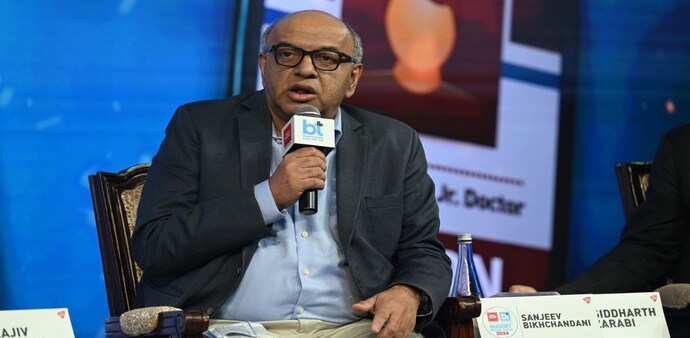
India AI Impact Summit 2026 | InfoEdge founder Sanjeev Bikhchandani on Monday said the arrival of artificial intelligence (AI) may transform work, but does not automatically translate into mass job losses. He urged the workers and young graduates to adapt and learn new AI tools.
"When new technology comes in, there is almost always great fear of job loss. But very often productivity goes up, and people are doing more things. The same number of people is doing more things. They're doing different and more useful things," he said while speaking at a panel during the AI Impact Summit 2026 held at Bharat Mandapam.
He, however, said the present moment could still unfold differently, but not necessarily so. "Can it be different this time? It's possible. Anything's possible. But will it necessarily be different? The answer is not necessarily. People might learn to do different things. People might learn to do stuff that is not getting done might get done."
Reaching customers previously left out
He illustrated the point with the company's recruitment platform, Naukri, which serves more than a lakh clients at different levels of engagement - from field sales visits for large customers to tele-calling for mid-tier clients. Smaller customers earlier received no outreach because it was uneconomical.
AI allowed the company to contact that segment. "So, we put a chatbot, a voice, and automated calls. You can't make out. It's not a human being. That's how it's advanced. And suddenly we are calling them up. Now, what is happening here is stuff that is not getting done. We have served an underserved segment, underserved market by using AI."
He said the result has been additional activity rather than job loss. "Thus far, at least nobody's lost a job in our company because of AI. I don't know what will happen going forward, but right now it's being used to increase productivity. It is being used to do stuff better."
Doing work that earlier went undone
Bikhchandani said he also uses AI in daily work to summarise long interviews and podcasts he would otherwise skip because of time. "Every time an interesting podcast comes, or an interesting interview comes, I just ask a colleague of mine...get me a summary."
Advice for young professionals
To explain how workers adapt to new tools, Bikhchandani recalled his first job in 1989, when personal computers had just entered offices, but few employees knew how to use them. In a marketing team of MBA graduates, access to computers was limited,d and even fewer people were familiar with the systems. He had learned presentation software during business school, which suddenly made him unusually valuable.
"There was no PowerPoint. There was a software called Harvard Graphics, all pirated. So I was the only guy who knew how to use it," he said.
While colleagues prepared slides by hand on overhead transparencies, he produced computer-printed presentations and quickly became the person others relied on. "Suddenly, there's a new tech, and it was sexy. I became the go-to guy. I was the most useful guy at the ground level because I had a skill with a technology that is actually easy to use."
He said artificial intelligence may follow a similar pattern: workers do not need to build complex systems but simply learn to use them earlier than others.
"Now AI is like that. You don't have to build LLMs."
From that, he offered practical advice to younger professionals — focus less on broad policy debates and more on adapting to tools. "You don't worry about systemic problems. You don't worry about policy issues. You just worry about your individual job and career. What should you do? What should you do to make sure AI doesn't make you lose your job or enable you to get your job? Just learn 5-10-15 useful AI tools."
The InfoEdge founder said that the older people in any company will not know new tools "because they are not quick learners". "But if you learn them, you will get a job. Now, so the one message I want to leave is - AI is happening. It is relentless. So if you don't do AI, AI will be done to you. So you better do AI."
For Unparalleled coverage of India's Businesses and Economy – Subscribe to Business Today Magazine
India AI Impact Summit 2026 | InfoEdge founder Sanjeev Bikhchandani on Monday said the arrival of artificial intelligence (AI) may transform work, but does not automatically translate into mass job losses. He urged the workers and young graduates to adapt and learn new AI tools.
"When new technology comes in, there is almost always great fear of job loss. But very often productivity goes up, and people are doing more things. The same number of people is doing more things. They're doing different and more useful things," he said while speaking at a panel during the AI Impact Summit 2026 held at Bharat Mandapam.
He, however, said the present moment could still unfold differently, but not necessarily so. "Can it be different this time? It's possible. Anything's possible. But will it necessarily be different? The answer is not necessarily. People might learn to do different things. People might learn to do stuff that is not getting done might get done."
Reaching customers previously left out
He illustrated the point with the company's recruitment platform, Naukri, which serves more than a lakh clients at different levels of engagement - from field sales visits for large customers to tele-calling for mid-tier clients. Smaller customers earlier received no outreach because it was uneconomical.
AI allowed the company to contact that segment. "So, we put a chatbot, a voice, and automated calls. You can't make out. It's not a human being. That's how it's advanced. And suddenly we are calling them up. Now, what is happening here is stuff that is not getting done. We have served an underserved segment, underserved market by using AI."
He said the result has been additional activity rather than job loss. "Thus far, at least nobody's lost a job in our company because of AI. I don't know what will happen going forward, but right now it's being used to increase productivity. It is being used to do stuff better."
Doing work that earlier went undone
Bikhchandani said he also uses AI in daily work to summarise long interviews and podcasts he would otherwise skip because of time. "Every time an interesting podcast comes, or an interesting interview comes, I just ask a colleague of mine...get me a summary."
Advice for young professionals
To explain how workers adapt to new tools, Bikhchandani recalled his first job in 1989, when personal computers had just entered offices, but few employees knew how to use them. In a marketing team of MBA graduates, access to computers was limited,d and even fewer people were familiar with the systems. He had learned presentation software during business school, which suddenly made him unusually valuable.
"There was no PowerPoint. There was a software called Harvard Graphics, all pirated. So I was the only guy who knew how to use it," he said.
While colleagues prepared slides by hand on overhead transparencies, he produced computer-printed presentations and quickly became the person others relied on. "Suddenly, there's a new tech, and it was sexy. I became the go-to guy. I was the most useful guy at the ground level because I had a skill with a technology that is actually easy to use."
He said artificial intelligence may follow a similar pattern: workers do not need to build complex systems but simply learn to use them earlier than others.
"Now AI is like that. You don't have to build LLMs."
From that, he offered practical advice to younger professionals — focus less on broad policy debates and more on adapting to tools. "You don't worry about systemic problems. You don't worry about policy issues. You just worry about your individual job and career. What should you do? What should you do to make sure AI doesn't make you lose your job or enable you to get your job? Just learn 5-10-15 useful AI tools."
The InfoEdge founder said that the older people in any company will not know new tools "because they are not quick learners". "But if you learn them, you will get a job. Now, so the one message I want to leave is - AI is happening. It is relentless. So if you don't do AI, AI will be done to you. So you better do AI."
For Unparalleled coverage of India's Businesses and Economy – Subscribe to Business Today Magazine