
India AI Impact Summit 2026: ‘You must be dreaming if you think AI will generate employment,’ says Vineet Nayar
India AI Impact Summit 2026: Sanjeev Bikhchandani asked young professionals to not worry about larger policy debates or development of LLMs, but to focus on building practical AI skills that would be relevant to their careers.
- Feb 16, 2026,
- Updated Feb 16, 2026 11:35 AM IST
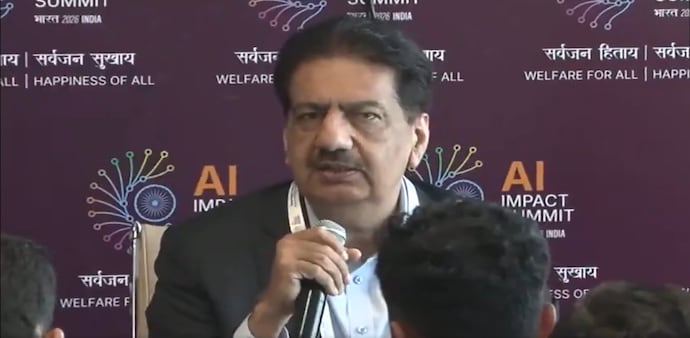
India AI Impact Summit 2026: While InfoEdge founder and Executive Vice Chairman Sanjeev Bikhchandani said learning a handful of artificial intelligence (AI) tools would be enough, Vineet Nayar, founder Chairman and CEO of Sampark Foundation & former CEO of HCL Technologies, said that one should not believe that AI would generate employment.
Bikhchandani and Nayar were speaking at the ‘Future of Employability and AI’ session at the AI Impact Summit 2026.
Bikhchandani said it is usually unviable for companies to assign employees to serve thousands of low-paying clients. But AI-powered bots can now handle such outreach effectively, and without the need for an increased headcount.
"You can sit in the office and you can make phone calls. Now, the bottom 5,100 clients who really don't pay that much – it doesn't make financial sense to have a person holding them and calling on them, it doesn't make financial sense. So we put a chatbot, a voice bot automatically calls, you can't make out it's not a human being, that's how advanced it is. Now what is happening here is that we have served an underserved segment, underserved market by using AI. Thus nobody is thrown out of a company because of AI. I don't want that happening going forward, but right now it's being used to increase productivity, it is being used to do stuff better," said Bikhchandani.
He asked young professionals to not worry about larger policy debates or development of large language models (LLMs), but to focus on building practical AI skills that would be relevant to their careers.
“You don't have to build LLMs, right, and I tell you what… to all the young people here… you don't worry about system problems, you don't worry about policy issues, you just worry about your job here and your career, your individual career. What should you do, what should you do to make sure AI doesn't make you lose your job, and AI enables you to get your turn, just learn 5-15 useful AI tools. Let me assure you, the older people in any company would not know that because they are not quick learners," he said.
Meanwhile Vineet Nayar said that AI would impact jobs at Indian IT companies as they are increasingly served by artificial intelligence. “From an employment point of view I think it is very important for us to understand that Indian companies, including Indian IT companies, are going to be profit-driven and therefore if you believe that they are going to create employment you must be dreaming.”
He said that despite that, there are the startups to fall back on. “Therefore, the question is how do we create employment in this environment? That employment comes from mass scale startups, which is what this government has already doing. So, how do we create new sets of people who are trying to solve new sets of problems, not new sets of technology and if we do that we will get it right. I think we as Indians have to be very careful about who the data belongs to and that is the debate we have a problem with.”
Nayar said the LLM models that exist worldwide are far superior than the Indian models. “Unfortunately, in India, we never develop products, so therefore we do not have SLMs and LLMs which are world-class. On one side, we have global LLM products which are coming to India and trading on our Indian data. Should we allow that or should we not allow that? But on the other side if we don't allow that then we have the data but we don't have the LLM models.”
He said the solution to this dilemma lies in radical strategic thinking. Nayar said it is important to figure out what kind of incentives we are willing to give up to develop LLM or SLM technologies fast. He warned that if we failed to do so, a foreign-origin LLM will come in and India will lose a “competitive advantage on something which is very critical for the next decade”.
Watch the session here:
For Unparalleled coverage of India's Businesses and Economy – Subscribe to Business Today Magazine
India AI Impact Summit 2026: While InfoEdge founder and Executive Vice Chairman Sanjeev Bikhchandani said learning a handful of artificial intelligence (AI) tools would be enough, Vineet Nayar, founder Chairman and CEO of Sampark Foundation & former CEO of HCL Technologies, said that one should not believe that AI would generate employment.
Bikhchandani and Nayar were speaking at the ‘Future of Employability and AI’ session at the AI Impact Summit 2026.
Bikhchandani said it is usually unviable for companies to assign employees to serve thousands of low-paying clients. But AI-powered bots can now handle such outreach effectively, and without the need for an increased headcount.
"You can sit in the office and you can make phone calls. Now, the bottom 5,100 clients who really don't pay that much – it doesn't make financial sense to have a person holding them and calling on them, it doesn't make financial sense. So we put a chatbot, a voice bot automatically calls, you can't make out it's not a human being, that's how advanced it is. Now what is happening here is that we have served an underserved segment, underserved market by using AI. Thus nobody is thrown out of a company because of AI. I don't want that happening going forward, but right now it's being used to increase productivity, it is being used to do stuff better," said Bikhchandani.
He asked young professionals to not worry about larger policy debates or development of large language models (LLMs), but to focus on building practical AI skills that would be relevant to their careers.
“You don't have to build LLMs, right, and I tell you what… to all the young people here… you don't worry about system problems, you don't worry about policy issues, you just worry about your job here and your career, your individual career. What should you do, what should you do to make sure AI doesn't make you lose your job, and AI enables you to get your turn, just learn 5-15 useful AI tools. Let me assure you, the older people in any company would not know that because they are not quick learners," he said.
Meanwhile Vineet Nayar said that AI would impact jobs at Indian IT companies as they are increasingly served by artificial intelligence. “From an employment point of view I think it is very important for us to understand that Indian companies, including Indian IT companies, are going to be profit-driven and therefore if you believe that they are going to create employment you must be dreaming.”
He said that despite that, there are the startups to fall back on. “Therefore, the question is how do we create employment in this environment? That employment comes from mass scale startups, which is what this government has already doing. So, how do we create new sets of people who are trying to solve new sets of problems, not new sets of technology and if we do that we will get it right. I think we as Indians have to be very careful about who the data belongs to and that is the debate we have a problem with.”
Nayar said the LLM models that exist worldwide are far superior than the Indian models. “Unfortunately, in India, we never develop products, so therefore we do not have SLMs and LLMs which are world-class. On one side, we have global LLM products which are coming to India and trading on our Indian data. Should we allow that or should we not allow that? But on the other side if we don't allow that then we have the data but we don't have the LLM models.”
He said the solution to this dilemma lies in radical strategic thinking. Nayar said it is important to figure out what kind of incentives we are willing to give up to develop LLM or SLM technologies fast. He warned that if we failed to do so, a foreign-origin LLM will come in and India will lose a “competitive advantage on something which is very critical for the next decade”.
Watch the session here:
For Unparalleled coverage of India's Businesses and Economy – Subscribe to Business Today Magazine