
Think AI will take your job? These workers are still too expensive to replace
The study found that many hands-on jobs still require skills that robots cannot match at an affordable cost, even as AI becomes more capable.
- Jul 16, 2026,
- Updated Jul 16, 2026 7:00 AM IST
Artificial intelligence may be changing workplaces, but replacing many frontline workers with robots is still far too expensive.
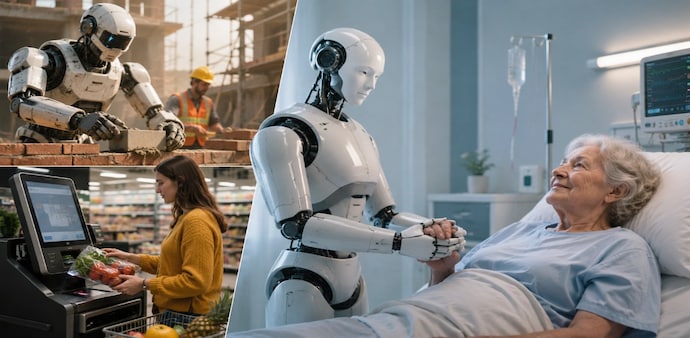
According to a June 2026 Planera study cited by Mint, employers would have to spend several times more to automate jobs such as nursing, home care and construction than they currently pay human workers.
The research analysed some of the most common occupations in the US, using government wage data and real-world pricing from automation vendors to estimate the annual cost of replacing one worker with AI and robotics.
Nursing assistants top the list
Nursing assistants emerged as the most expensive workers to replace with machines.
Replacing one nursing assistant with robotics would cost around $375,100 a year, compared with the profession's median annual wage of $42,200.
Don't Miss: India doubles down on mobile manufacturing; Cabinet approves Rs 62,500 crore mobile PLI 2.0
That makes automation nearly nine times more expensive than employing a person.
"Hands-on patient care requires humanoid robotics that don't yet exist as commercial products," the study noted.
Home health and personal care aides ranked second. Replacing one worker would cost employers around $282,200 a year, nearly eight times the median annual wage of $35,800.
Construction labourers came third. Automating one role would cost around $285,300 a year, compared with a median annual wage of $47,100.
General maintenance and repair workers ranked fourth. Replacing one worker with automation would cost around $286,900 annually, while the median annual wage is $49,500.
Teaching assistants completed the top five. Automating the role would cost around $194,300 a year, more than five times the median annual wage of $36,700.
Other jobs where automation remains costly
The findings also identified several other occupations where replacing workers with machines would cost at least twice as much as paying human wages.
These include:
- Registered nurses
- Elementary school teachers
- Security guards
- Assemblers and fabricators
- Restaurant cooks
Cashiers are the exception
Cashiers were the only major occupation where automation proved cheaper than employing people.
According to the findings, self-checkout systems cost around $24,220 a year, less than the median annual wage of $32,880 earned by cashiers.
"For years, the assumption was that low-paid, low-skill jobs would be the first to go. But the data shows the opposite. The workers earning the least tend to be the ones doing the most physically demanding, human-facing work. And that turns out to be exactly what machines struggle with most," a Planera spokesperson said.
The study also suggested that white-collar professions could face greater disruption from AI.
"It is white-collar roles that are now more exposed. Software developers, once considered untouchable, are already feeling it. Major tech companies have been cutting engineering headcount precisely because AI coding tools are getting good enough," the spokesperson added.
For Unparalleled coverage of India's Businesses and Economy – Subscribe to Business Today Magazine
Artificial intelligence may be changing workplaces, but replacing many frontline workers with robots is still far too expensive.
According to a June 2026 Planera study cited by Mint, employers would have to spend several times more to automate jobs such as nursing, home care and construction than they currently pay human workers.
The research analysed some of the most common occupations in the US, using government wage data and real-world pricing from automation vendors to estimate the annual cost of replacing one worker with AI and robotics.
Nursing assistants top the list
Nursing assistants emerged as the most expensive workers to replace with machines.
Replacing one nursing assistant with robotics would cost around $375,100 a year, compared with the profession's median annual wage of $42,200.
Don't Miss: India doubles down on mobile manufacturing; Cabinet approves Rs 62,500 crore mobile PLI 2.0
That makes automation nearly nine times more expensive than employing a person.
"Hands-on patient care requires humanoid robotics that don't yet exist as commercial products," the study noted.
Home health and personal care aides ranked second. Replacing one worker would cost employers around $282,200 a year, nearly eight times the median annual wage of $35,800.
Construction labourers came third. Automating one role would cost around $285,300 a year, compared with a median annual wage of $47,100.
General maintenance and repair workers ranked fourth. Replacing one worker with automation would cost around $286,900 annually, while the median annual wage is $49,500.
Teaching assistants completed the top five. Automating the role would cost around $194,300 a year, more than five times the median annual wage of $36,700.
Other jobs where automation remains costly
The findings also identified several other occupations where replacing workers with machines would cost at least twice as much as paying human wages.
These include:
- Registered nurses
- Elementary school teachers
- Security guards
- Assemblers and fabricators
- Restaurant cooks
Cashiers are the exception
Cashiers were the only major occupation where automation proved cheaper than employing people.
According to the findings, self-checkout systems cost around $24,220 a year, less than the median annual wage of $32,880 earned by cashiers.
"For years, the assumption was that low-paid, low-skill jobs would be the first to go. But the data shows the opposite. The workers earning the least tend to be the ones doing the most physically demanding, human-facing work. And that turns out to be exactly what machines struggle with most," a Planera spokesperson said.
The study also suggested that white-collar professions could face greater disruption from AI.
"It is white-collar roles that are now more exposed. Software developers, once considered untouchable, are already feeling it. Major tech companies have been cutting engineering headcount precisely because AI coding tools are getting good enough," the spokesperson added.
For Unparalleled coverage of India's Businesses and Economy – Subscribe to Business Today Magazine