
What did he see? Vishal Sikka explains why he backed OpenAI with $3 million in 2015
We had to have an AI platform that we could use. So here was Sam (Altman), who was looking to build an OpenAI platform. To me, it was obvious; it seemed straightforward that we should do this, says Vishal Sikka
- Feb 18, 2026,
- Updated Feb 18, 2026 4:21 PM IST
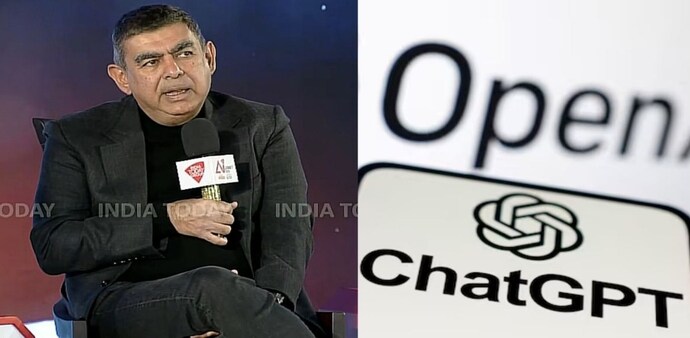
More than a decade before generative AI became mainstream, former Infosys CEO Vishal Sikka backed OpenAI with a donation of about $3 million. Looking back, he says the direction of artificial intelligence was already evident.
Sikka, now Founder and Chief Executive Officer of Vianai Systems, on Wednesday explained what led him to support OpenAI in 2015, when it was still a nonprofit.
OpenAI, which owns ChatGPT, was founded by Sam Altman in December 2015.
"It was a donation because OpenAI was a pure nonprofit at the time. We gave them $3 million or something like that. It was 11 years ago. I had just started at Infosys," Sikka said while speaking at India Today AI Summit 2026.
Also read: Is AI a bubble? Vishal Sikka does the math and there is a clear gap of $200 billion
At the time, he said, a breakthrough in artificial intelligence had already reshaped the field. "The Alex Net was already 2 years old. AlexNet was the computer vision system that had beaten human performance on a benchmark called ImageNet, which was built by Fei-Fei Li. So, all of a sudden, there was a neural network system that was able to do vision tasks even better than humans."
That shift, he suggested, made the future direction of AI evident. The tech titan said the trajectory was kind of clear about where this was headed. "We had to have an AI platform that we could use. So here was Sam (Altman), who was looking to build an OpenAI platform. To me, it was obvious; it seemed straightforward that we should do this."
Asked why Infosys, under his leadership, could not fully make the leap to become what he once described as India's AI-first company, Sikka said the company had built extensively for its time. "We did a lot. We built our own platform back then. We had a large collection of efforts that we were doing, which I thought was remarkable for the time. But as I said, I tend to look forward and look at what is possible now with AI. At the time, with what we had, we did what we could, and it's a different time now."
Sikka joined Infosys in June 2014 as an executive vice president before assuming the CEO role on August 1, 2014. He was the first non-founder CEO. He quit Infosys in August 2017.
Sikka on AI hallucinations and regulations
When asked about hallucinations in generative AI and whether countries such as India should lead on regulation, Sikka suggested that oversight is not optional but necessary. "The idea of regulation - we are sitting here in this room, and we are comfortable that this roof is not going to fall on our heads because of regulation," he said, suggesting that safeguards are embedded in everyday life. "Even barbers who cut our hair are regulated. So, what is the problem with regulating AI? it is an unbelievably powerful technology. You better believe it should be regulated."
Sikka said the Indian government was taking "a very leading and uncompromising stand on regulation, on safety, on ethics." "It is very important to do that," he said.
On hallucinations, one of the most persistent concerns surrounding generative AI, Sikka described the phenomenon as intrinsic to how the technology works. "Generative AI is inherently hallucinatory," he said. "It is not a deterministic system. It is a system based on probabilities. You pick the most likely next token when you give it a prompt."
That probabilistic nature, he argued, makes regulation and safety frameworks essential. "That hallucination creates the need for regulation for safety and things like that," he said, describing it as a "burden of regulation, the burden of safety and duty of care."
For Unparalleled coverage of India's Businesses and Economy – Subscribe to Business Today Magazine
More than a decade before generative AI became mainstream, former Infosys CEO Vishal Sikka backed OpenAI with a donation of about $3 million. Looking back, he says the direction of artificial intelligence was already evident.
Sikka, now Founder and Chief Executive Officer of Vianai Systems, on Wednesday explained what led him to support OpenAI in 2015, when it was still a nonprofit.
OpenAI, which owns ChatGPT, was founded by Sam Altman in December 2015.
"It was a donation because OpenAI was a pure nonprofit at the time. We gave them $3 million or something like that. It was 11 years ago. I had just started at Infosys," Sikka said while speaking at India Today AI Summit 2026.
Also read: Is AI a bubble? Vishal Sikka does the math and there is a clear gap of $200 billion
At the time, he said, a breakthrough in artificial intelligence had already reshaped the field. "The Alex Net was already 2 years old. AlexNet was the computer vision system that had beaten human performance on a benchmark called ImageNet, which was built by Fei-Fei Li. So, all of a sudden, there was a neural network system that was able to do vision tasks even better than humans."
That shift, he suggested, made the future direction of AI evident. The tech titan said the trajectory was kind of clear about where this was headed. "We had to have an AI platform that we could use. So here was Sam (Altman), who was looking to build an OpenAI platform. To me, it was obvious; it seemed straightforward that we should do this."
Asked why Infosys, under his leadership, could not fully make the leap to become what he once described as India's AI-first company, Sikka said the company had built extensively for its time. "We did a lot. We built our own platform back then. We had a large collection of efforts that we were doing, which I thought was remarkable for the time. But as I said, I tend to look forward and look at what is possible now with AI. At the time, with what we had, we did what we could, and it's a different time now."
Sikka joined Infosys in June 2014 as an executive vice president before assuming the CEO role on August 1, 2014. He was the first non-founder CEO. He quit Infosys in August 2017.
Sikka on AI hallucinations and regulations
When asked about hallucinations in generative AI and whether countries such as India should lead on regulation, Sikka suggested that oversight is not optional but necessary. "The idea of regulation - we are sitting here in this room, and we are comfortable that this roof is not going to fall on our heads because of regulation," he said, suggesting that safeguards are embedded in everyday life. "Even barbers who cut our hair are regulated. So, what is the problem with regulating AI? it is an unbelievably powerful technology. You better believe it should be regulated."
Sikka said the Indian government was taking "a very leading and uncompromising stand on regulation, on safety, on ethics." "It is very important to do that," he said.
On hallucinations, one of the most persistent concerns surrounding generative AI, Sikka described the phenomenon as intrinsic to how the technology works. "Generative AI is inherently hallucinatory," he said. "It is not a deterministic system. It is a system based on probabilities. You pick the most likely next token when you give it a prompt."
That probabilistic nature, he argued, makes regulation and safety frameworks essential. "That hallucination creates the need for regulation for safety and things like that," he said, describing it as a "burden of regulation, the burden of safety and duty of care."
For Unparalleled coverage of India's Businesses and Economy – Subscribe to Business Today Magazine