
UK bans smartphones in schools: Is it time for India to do the same?
While countries worldwide are exploring strict rules for smartphone use in school, India lacks a unified policy or law that addresses the use of smartphones in schools.
- Apr 23, 2026,
- Updated Apr 23, 2026 9:28 AM IST
Keir Starmer, Prime Minister of the United Kingdom, has backed a new England‑wide requirement that schools must ban smartphone use in school after pressure from the conservative party, teachers, and parents.
While the nation already had restrictions in place, the rule is now enforced as a “legal requirement for schools” to ban smartphone use. The goal is to create a "mobile-free environment" across all schools in England, while reducing the time children spend online and on social media.
Must read: Anthropic’s Mythos breached! Unauthorised access raises security concerns
England is not alone, a global wave of ban follows
Well, England is not alone; in 2024, New Zealand introduced a nationwide rule that bans students from using smartphones at school. The Netherlands also introduced national rules in 2024 banning phones in classrooms, and Finland's new law allows phones only with teacher permission.
Lastly, Sweden is also preparing to introduce a similar rule, where schools will collect phones at the start of the day for students between the ages of 7 and 16. While countries worldwide are exploring strict rules for smartphone use in schools, India lacks a unified policy or law addressing smartphone use in schools. But should India implement similar laws?
Where does India stand on smartphone ban at school?
Unlike the UK’s nationwide push, India is currently witnessing a state-led strategy. As of 2026, there is no nationwide law yet, but many states in the country are gradually moving to build strict rules for students.
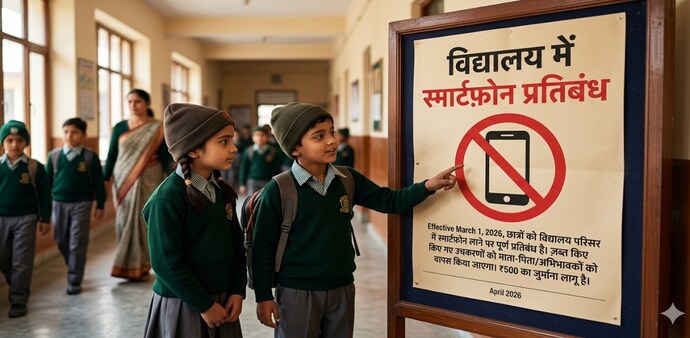
On March 1, 2026, Himachal Pradesh implemented a ban on smartphones in all private and government schools. The school can also charge a Rs 500 fine and device seizure if any student is found using school. Whereas, the Karnataka government proposed “digital wellness,” with screen-time limits and a social media ban for children under 16. But is such a measure necessary in India?
Tarun Pathak, the research director at Counterpoint Research, told Business Today that, “bringing in a strict law like England may not be the right approach” for India. “The situation in India is very different, with big gaps in access, infrastructure and how schools operate,” he said.
Must read: AI in warfare: India is betting big on 'aatmanirbhar' military AI
India’s balanced approach to smartphone use
In 2025, the Delhi High Court also refused a nationwide ban, calling it "impractical," and urged for digital ethics and monitoring. Pathak said, “Instead of strict law, the focus should be on making policies that are more consistent across schools. Smartphones are an important learning tool for many students, as smartphones are also an access device for digital learning.”
“So, a full ban could end up creating more inequality. Government platforms such as PM eVIDYA & DIKSHA were built to expand multi-mode access to education, including through smartphones,” he added.
Pathak further stated that India is following a more balanced approach, which makes it beneficial for students in terms of bridging the digital divide and expanding learning. He said, “It makes more sense to regulate their use, allowing them when needed, but restricting misuse so that both learning and discipline are maintained.”
For Unparalleled coverage of India's Businesses and Economy – Subscribe to Business Today Magazine
Keir Starmer, Prime Minister of the United Kingdom, has backed a new England‑wide requirement that schools must ban smartphone use in school after pressure from the conservative party, teachers, and parents.
While the nation already had restrictions in place, the rule is now enforced as a “legal requirement for schools” to ban smartphone use. The goal is to create a "mobile-free environment" across all schools in England, while reducing the time children spend online and on social media.
Must read: Anthropic’s Mythos breached! Unauthorised access raises security concerns
England is not alone, a global wave of ban follows
Well, England is not alone; in 2024, New Zealand introduced a nationwide rule that bans students from using smartphones at school. The Netherlands also introduced national rules in 2024 banning phones in classrooms, and Finland's new law allows phones only with teacher permission.
Lastly, Sweden is also preparing to introduce a similar rule, where schools will collect phones at the start of the day for students between the ages of 7 and 16. While countries worldwide are exploring strict rules for smartphone use in schools, India lacks a unified policy or law addressing smartphone use in schools. But should India implement similar laws?
Where does India stand on smartphone ban at school?
Unlike the UK’s nationwide push, India is currently witnessing a state-led strategy. As of 2026, there is no nationwide law yet, but many states in the country are gradually moving to build strict rules for students.
On March 1, 2026, Himachal Pradesh implemented a ban on smartphones in all private and government schools. The school can also charge a Rs 500 fine and device seizure if any student is found using school. Whereas, the Karnataka government proposed “digital wellness,” with screen-time limits and a social media ban for children under 16. But is such a measure necessary in India?
Tarun Pathak, the research director at Counterpoint Research, told Business Today that, “bringing in a strict law like England may not be the right approach” for India. “The situation in India is very different, with big gaps in access, infrastructure and how schools operate,” he said.
Must read: AI in warfare: India is betting big on 'aatmanirbhar' military AI
India’s balanced approach to smartphone use
In 2025, the Delhi High Court also refused a nationwide ban, calling it "impractical," and urged for digital ethics and monitoring. Pathak said, “Instead of strict law, the focus should be on making policies that are more consistent across schools. Smartphones are an important learning tool for many students, as smartphones are also an access device for digital learning.”
“So, a full ban could end up creating more inequality. Government platforms such as PM eVIDYA & DIKSHA were built to expand multi-mode access to education, including through smartphones,” he added.
Pathak further stated that India is following a more balanced approach, which makes it beneficial for students in terms of bridging the digital divide and expanding learning. He said, “It makes more sense to regulate their use, allowing them when needed, but restricting misuse so that both learning and discipline are maintained.”
For Unparalleled coverage of India's Businesses and Economy – Subscribe to Business Today Magazine