
“Visakhapatnam will be born as AI-Patnam”: Ashwini Vaishnaw as Google lays data centre foundation
Union IT minister Ashwini Vaishnaw noted that under the leadership of Andhra Pradesh Chief Minister N. Chandrababu Naidu, who played a key role in building Hyderabad’s Cyber Towers, the focus is now shifting towards AI in Vizag.
- Apr 28, 2026,
- Updated Apr 28, 2026 11:57 AM IST
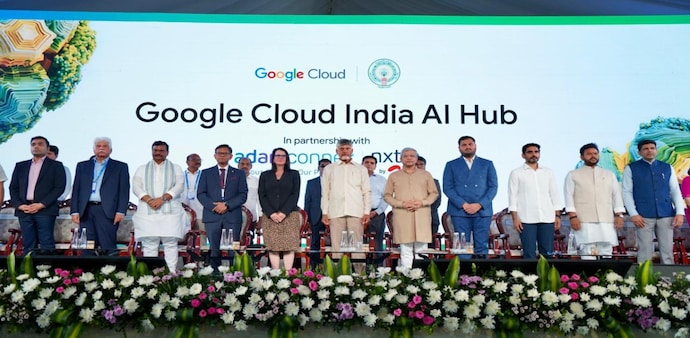
In a historic move, the foundation stone for Google’s $15 billion AI data centre in Visakhapatnam was laid today by the Andhra Pradesh government and Union IT Minister Ashwini Vaishnaw. The event was attended by top Union and state leaders, along with project partners Adani Group and Bharti Airtel. During his keynote address, Vaishnaw emphasised the state’s ambition to become “AI-Patnam,” a successor to Hyderabad’s “Cyberabad.”
Vaishnaw also highlighted that while India had missed previous technological cycles in past decades, the country is now making a definitive entry into the global AI leadership race. He said India is now positioned to lead in AI, semiconductors, and space technology.
“When the entire power is moving towards a totally new cycle of technology, [the Prime Minister] said we should take the lead in this technology. Because in the past, we missed out on many cycles... but now we should not miss out on any cycle of technology,” Vaishnaw stated.
He noted that under the leadership of Andhra Pradesh Chief Minister N. Chandrababu Naidu, who played a key role in building Hyderabad’s Cyber Towers, the focus is now shifting towards AI in Vizag.
“I think Visakhapatnam will be reborn as AI-Patnam. Like Cyberabad, it will become AI-Patnam,” the minister said.
Global supply chain & subsea connectivity
With the AI hub in Vizag, Google also plans to deploy a massive subsea cable network. Vaishnaw highlighted that Google will land three major subsea cables in the city, creating a critical digital bridge:
Route 1: Connecting India to Australia and the U.S. West Coast
Route 2: Connecting India to the Middle East, Europe, and the US
Route 3: Connecting via the African coast to the US
India is being positioned as a safe and dependable hub for handling data and AI systems, despite global tensions disrupting other regions. He noted that India can be relied upon to keep systems running securely.
Google’s three-point challenge
While the project marks a historic moment, Vaishnaw outlined a three-point challenge for Google and its partners to ensure long-term sustainability and alignment with India’s manufacturing goals: local server manufacturing, power efficiency, and water sustainability.
For Unparalleled coverage of India's Businesses and Economy – Subscribe to Business Today Magazine
In a historic move, the foundation stone for Google’s $15 billion AI data centre in Visakhapatnam was laid today by the Andhra Pradesh government and Union IT Minister Ashwini Vaishnaw. The event was attended by top Union and state leaders, along with project partners Adani Group and Bharti Airtel. During his keynote address, Vaishnaw emphasised the state’s ambition to become “AI-Patnam,” a successor to Hyderabad’s “Cyberabad.”
Vaishnaw also highlighted that while India had missed previous technological cycles in past decades, the country is now making a definitive entry into the global AI leadership race. He said India is now positioned to lead in AI, semiconductors, and space technology.
“When the entire power is moving towards a totally new cycle of technology, [the Prime Minister] said we should take the lead in this technology. Because in the past, we missed out on many cycles... but now we should not miss out on any cycle of technology,” Vaishnaw stated.
He noted that under the leadership of Andhra Pradesh Chief Minister N. Chandrababu Naidu, who played a key role in building Hyderabad’s Cyber Towers, the focus is now shifting towards AI in Vizag.
“I think Visakhapatnam will be reborn as AI-Patnam. Like Cyberabad, it will become AI-Patnam,” the minister said.
Global supply chain & subsea connectivity
With the AI hub in Vizag, Google also plans to deploy a massive subsea cable network. Vaishnaw highlighted that Google will land three major subsea cables in the city, creating a critical digital bridge:
Route 1: Connecting India to Australia and the U.S. West Coast
Route 2: Connecting India to the Middle East, Europe, and the US
Route 3: Connecting via the African coast to the US
India is being positioned as a safe and dependable hub for handling data and AI systems, despite global tensions disrupting other regions. He noted that India can be relied upon to keep systems running securely.
Google’s three-point challenge
While the project marks a historic moment, Vaishnaw outlined a three-point challenge for Google and its partners to ensure long-term sustainability and alignment with India’s manufacturing goals: local server manufacturing, power efficiency, and water sustainability.
For Unparalleled coverage of India's Businesses and Economy – Subscribe to Business Today Magazine