
'Writing code will not be the goal': Nandan Nilekani on how AI will transform talent and enterprises
This time the AI transition has been much faster than earlier transitions, says Nandan Nilekani
- Feb 17, 2026,
- Updated Feb 17, 2026 6:14 PM IST
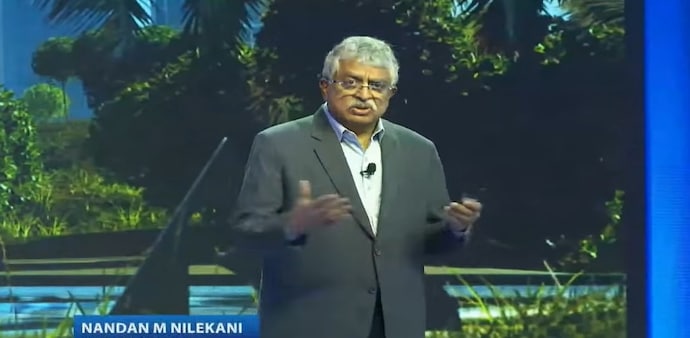
Artificial intelligence (AI) is not just another layer of technology. It is a structural break, a shift that will force companies to rethink how they operate, deploy talent, and even define work itself. That was the message from Infosys non-executive chairman Nandan Nilekani at Infosys AI Day 2026.
"We have seen technology shifts for centuries, whether the printing press or the telegraph. But over the last 60-70 years, we have seen a much faster change and PCs, Cloud, Gen AI, Agentic AI, and so on. So, change of technology and the speed of change have been a constant for many decades now. And each time there's a change, the way we address that change has been different," he said during his nearly 20-minute address.
From mainframes to mini computers, from PCs to client-server, LAN, web computing, mobile enterprise apps, and big data, each shift forced companies like Infosys to adapt. "Each time there was a tech transition, it had certain implications for us and firms like Infosys had to deal with what was new. So we are used to the fact that each time there's something different," he added.
But, he said, this time is different in both speed and scope. "This time the AI transition has been much faster than earlier transitions." He pointed to user adoption curves: "If you look at the number of years it took to reach 1 billion users, the internet took more than 10 years, smartphones took 5 years, AI is taking a couple of years."
That acceleration, Nilekani argued, became possible because of prior infrastructure like the internet and smartphones. "You have to realise that the AI speed is because of the first two things. The internet was already ubiquitous. Smartphones were already ubiquitous. It therefore allowed people to distribute a chat GPT or, Gemini, or Claude very easily. So in some sense, the speed of AI is also because of the infrastructure of the previous era."
Unlike smartphones or cloud, which could often be layered onto existing systems, AI demands structural change. "Now, what has happened this time is that this is a much more fundamental change to the way businesses will operate. So this is not a layer of technology," the tech veteran said.
The Infosys co-founder said that after the arrival of AI, the business cannot be run the old way; they will have to change. He said it is also a huge challenge for talent. "Talent will have to deal with a world where writing code will not be the goal. It'll actually be making AI work, orchestration, and those kinds of things. So the jobs will change."
Artificial intelligence, he noted, disrupts that certainty. Outputs can vary even when prompts remain similar, creating a fundamentally different operating challenge for businesses. "In this AI world, every time you give a prompt, you'll probably get a different answer. And therefore, how do you deal with this non-deterministic world? But how do you make sure what you build has the robustness, reliability, and resilience of the deterministic world? That's what the challenge is for everybody."
He summed up the shift: "This is a fundamental root and branch surgery of the way business is done, which is why this technology transition is so dramatically different from anything else that we have seen."
At the same time, Nilekani said the technology is far ahead of its deployment. "Because of this race and spending billions and some AGI and all that, the technology is moving faster than the ability of enterprises to deploy it," he noted, adding that model performance continues to rise, but implementation lags because "implementing this is hard stuff." "Fundamentally, it's about organizational change, business change, retraining your people, thinking about non-deterministic approaches, changing your data so it's no longer in silos."
The tech entrepreneur said that the tech will keep getting better and better because billions are going to be poured into it. "There's massive competition, but enterprise deployment is not going to go u,p and this deployment gap is what we can help to address," he flagged.
There has been fear that AI will hollow out white-collar jobs, particularly in coding, testing, documentation, and back-office roles that form the backbone of India’s IT services industry.
Nilekani did not dismiss the disruption. But he argued the real shift will be in the nature of work. "I think talent transformation is huge. It's not that you will not need it, you will need talent. But it'll go from QA testing or development, we have all kinds of new roles, AI engineers, forward deployment engineers, AI leads, forensic analysts."
What lies ahead, he suggested, is workforce reinvention rather than workforce reduction. "The challenge will be how do you take your workforce and make sure that they are reskilled and ready for the new business. And that's really the challenge that all the firms will face, and so there will be roles. The way you hire will change, the way you train will change, the way you deploy will change - all that is going to happen. There will be a need for people, but they'll be doing different things."
For Unparalleled coverage of India's Businesses and Economy – Subscribe to Business Today Magazine
Artificial intelligence (AI) is not just another layer of technology. It is a structural break, a shift that will force companies to rethink how they operate, deploy talent, and even define work itself. That was the message from Infosys non-executive chairman Nandan Nilekani at Infosys AI Day 2026.
"We have seen technology shifts for centuries, whether the printing press or the telegraph. But over the last 60-70 years, we have seen a much faster change and PCs, Cloud, Gen AI, Agentic AI, and so on. So, change of technology and the speed of change have been a constant for many decades now. And each time there's a change, the way we address that change has been different," he said during his nearly 20-minute address.
From mainframes to mini computers, from PCs to client-server, LAN, web computing, mobile enterprise apps, and big data, each shift forced companies like Infosys to adapt. "Each time there was a tech transition, it had certain implications for us and firms like Infosys had to deal with what was new. So we are used to the fact that each time there's something different," he added.
But, he said, this time is different in both speed and scope. "This time the AI transition has been much faster than earlier transitions." He pointed to user adoption curves: "If you look at the number of years it took to reach 1 billion users, the internet took more than 10 years, smartphones took 5 years, AI is taking a couple of years."
That acceleration, Nilekani argued, became possible because of prior infrastructure like the internet and smartphones. "You have to realise that the AI speed is because of the first two things. The internet was already ubiquitous. Smartphones were already ubiquitous. It therefore allowed people to distribute a chat GPT or, Gemini, or Claude very easily. So in some sense, the speed of AI is also because of the infrastructure of the previous era."
Unlike smartphones or cloud, which could often be layered onto existing systems, AI demands structural change. "Now, what has happened this time is that this is a much more fundamental change to the way businesses will operate. So this is not a layer of technology," the tech veteran said.
The Infosys co-founder said that after the arrival of AI, the business cannot be run the old way; they will have to change. He said it is also a huge challenge for talent. "Talent will have to deal with a world where writing code will not be the goal. It'll actually be making AI work, orchestration, and those kinds of things. So the jobs will change."
Artificial intelligence, he noted, disrupts that certainty. Outputs can vary even when prompts remain similar, creating a fundamentally different operating challenge for businesses. "In this AI world, every time you give a prompt, you'll probably get a different answer. And therefore, how do you deal with this non-deterministic world? But how do you make sure what you build has the robustness, reliability, and resilience of the deterministic world? That's what the challenge is for everybody."
He summed up the shift: "This is a fundamental root and branch surgery of the way business is done, which is why this technology transition is so dramatically different from anything else that we have seen."
At the same time, Nilekani said the technology is far ahead of its deployment. "Because of this race and spending billions and some AGI and all that, the technology is moving faster than the ability of enterprises to deploy it," he noted, adding that model performance continues to rise, but implementation lags because "implementing this is hard stuff." "Fundamentally, it's about organizational change, business change, retraining your people, thinking about non-deterministic approaches, changing your data so it's no longer in silos."
The tech entrepreneur said that the tech will keep getting better and better because billions are going to be poured into it. "There's massive competition, but enterprise deployment is not going to go u,p and this deployment gap is what we can help to address," he flagged.
There has been fear that AI will hollow out white-collar jobs, particularly in coding, testing, documentation, and back-office roles that form the backbone of India’s IT services industry.
Nilekani did not dismiss the disruption. But he argued the real shift will be in the nature of work. "I think talent transformation is huge. It's not that you will not need it, you will need talent. But it'll go from QA testing or development, we have all kinds of new roles, AI engineers, forward deployment engineers, AI leads, forensic analysts."
What lies ahead, he suggested, is workforce reinvention rather than workforce reduction. "The challenge will be how do you take your workforce and make sure that they are reskilled and ready for the new business. And that's really the challenge that all the firms will face, and so there will be roles. The way you hire will change, the way you train will change, the way you deploy will change - all that is going to happen. There will be a need for people, but they'll be doing different things."
For Unparalleled coverage of India's Businesses and Economy – Subscribe to Business Today Magazine