
Ravana’s ₹1 crore throne, Surpanakha’s ₹1.5 crore chariot: The stunning craft behind ‘Ramayana: Rise of a Legend’
From Ravana's grand throne to Surpanakha's chariot and a giant model of Jatayu, the art department spent months creating different parts of the Ramayana.
- Nov 8, 2026,
- Updated Nov 8, 2026 11:42 AM IST
Behind the sweeping visuals of Ramayana: Rise of a Legend lies a world built with extraordinary patience, precision and ambition. Art director Ramesh Andhale has revealed that some of the most elaborate props in Nitesh Tiwari’s Ramayana: Rise of a Legend were built through months of detailed craftsmanship.
In an interview with Prabhat Khabhar, which was conducted by international production designer Ramsey Avery, he shared insights into the making of two of the film’s standout creations—a grand throne for Ravana and a specially designed chariot for Surpanakha—offering a rare glimpse into the scale of the production design.
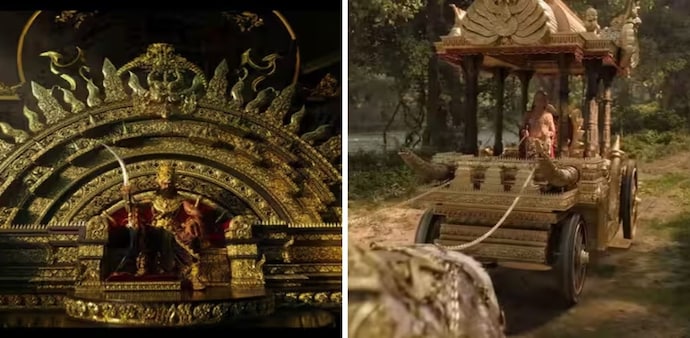
Art director Ramesh Andhale has revealed the extraordinary craftsmanship behind Nitesh Tiwari’s Ramayana: Rise of a Legend, disclosing that Ravana’s golden throne took four months to build and cost around ₹1 crore, while Surpanakha’s functional chariot cost approximately ₹1.5 crore.
A throne fit for Lanka
Speaking to Prabhat Khabar, Andhale explained that Ravana’s imposing throne was not a simple set piece. The team began with a clay model based on the approved design, created a mould, and then shaped the structure in fibre before applying the final finish.
To give the throne the regal appearance required for the ruler of Lanka, the art department used real 24-karat gold leafing. The elaborate process took nearly four months and reportedly cost about ₹1 crore.
“No set is ever finalised in its first place. It takes 10-15 different versions and variations to achieve what’s seen on screen,” Andhale said, underlining the scale of iteration involved in the production design.
Surpanakha’s costly chariot
While Ravana’s throne may be the more visually iconic prop, Surpanakha’s chariot reportedly carried a higher price tag. Built for the sequence in which the character arrives at Lord Ram’s hut, the vehicle took about three months to complete.
Andhale said the chariot had to be made in working condition rather than as a static background prop. Its detailed, gold-plated finish and functional design pushed the estimated cost to around ₹1.5 crore.
The prop appears in only one scene, but its construction reflects the film’s broader approach: building tangible, detailed environments rather than relying entirely on visual effects.
Craft behind the epic
The revelations offer a glimpse into the ambitious production design of Ramayana: Rise of a Legend, which reportedly features more than 150 elaborate sets and handcrafted props.
Producer Namit Malhotra had earlier said that the combined budget of the two Ramayana films exceeds ₹4,000 crore. Against that backdrop, the ₹1 crore throne and ₹1.5 crore chariot illustrate how even individual props have been treated as major creative investments.