
Budget 2026 may roll out PM-KUSUM 2.0 with nearly 45% funding hike to deepen farm solarisation
Union Budget 2026: Higher incentives and the introduction of new technologies are expected, with battery storage also likely to be incorporated to enhance reliability and enable better integration with the grid.
- Jan 29, 2026,
- Updated Jan 29, 2026 1:37 PM IST
The Union Budget 2026 is expected to announce the next phase of the government’s flagship farm solarisation programme, PM-KUSUM, with officials indicating a funding increase of nearly 45%, taking the overall allocation to around ₹50,000 crore from the current ₹34,422 crore.
Sources said the Ministry of New and Renewable Energy (MNRE) had submitted a proposal for PM-KUSUM 2.0 to the Finance Ministry, as the existing scheme is scheduled to conclude in March 2026. The revamped programme is likely to place stronger emphasis on decentralised solar deployment in rural India, higher incentives for farmers, and wider participation from the private sector.
Follow our detailed coverage on Union Budget 2026 here
Launched in 2019, the Pradhan Mantri Kisan Urja Suraksha evam Utthan Mahabhiyan aims to reduce the agriculture sector’s dependence on diesel, cut irrigation costs and supplement farmers’ incomes by promoting solar-powered pumps and grid-connected solar projects.
Under the scheme, farmers receive central subsidies of up to 30-50% for installing standalone solar pumps or solarising existing grid-connected pumps. The programme also allows farmers to set up grid-connected solar plants of up to 2 MW on barren or fallow land and sell surplus power to local distribution companies.
The current PM-KUSUM framework targets the addition of nearly 34,800 MW of solar capacity by March 2026, spread across three components.
- Component A focuses on setting up 10,000 MW of decentralised renewable power plants on agricultural land.
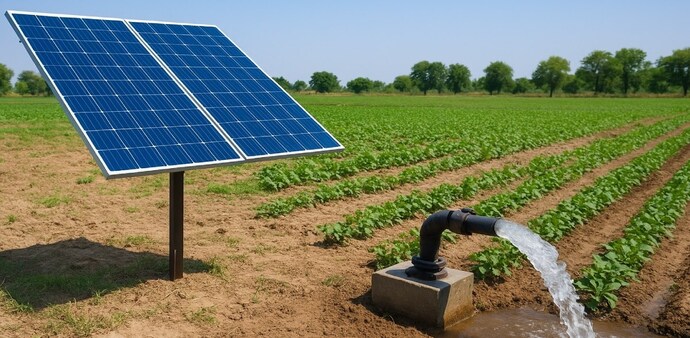
- Component B supports the installation of 14 lakh standalone solar pumps.
- Component C covers the solarisation of 35 lakh grid-connected pumps, including feeder-level projects. States are permitted to transfer capacities between Components B and C to improve implementation flexibility.
Officials said PM-KUSUM 2.0 will sharpen the focus on decentralised grid-connected solar plants, agricultural solar pumps and feeder-level solarisation. Higher incentives and the introduction of new technologies are expected, with battery storage also likely to be incorporated to enhance reliability and enable better integration with the grid.
The government is also looking to reduce compliance requirements to attract private investment and accelerate project execution.
The Union Budget 2026 is expected to announce the next phase of the government’s flagship farm solarisation programme, PM-KUSUM, with officials indicating a funding increase of nearly 45%, taking the overall allocation to around ₹50,000 crore from the current ₹34,422 crore.
Sources said the Ministry of New and Renewable Energy (MNRE) had submitted a proposal for PM-KUSUM 2.0 to the Finance Ministry, as the existing scheme is scheduled to conclude in March 2026. The revamped programme is likely to place stronger emphasis on decentralised solar deployment in rural India, higher incentives for farmers, and wider participation from the private sector.
Follow our detailed coverage on Union Budget 2026 here
Launched in 2019, the Pradhan Mantri Kisan Urja Suraksha evam Utthan Mahabhiyan aims to reduce the agriculture sector’s dependence on diesel, cut irrigation costs and supplement farmers’ incomes by promoting solar-powered pumps and grid-connected solar projects.
Under the scheme, farmers receive central subsidies of up to 30-50% for installing standalone solar pumps or solarising existing grid-connected pumps. The programme also allows farmers to set up grid-connected solar plants of up to 2 MW on barren or fallow land and sell surplus power to local distribution companies.
The current PM-KUSUM framework targets the addition of nearly 34,800 MW of solar capacity by March 2026, spread across three components.
- Component A focuses on setting up 10,000 MW of decentralised renewable power plants on agricultural land.
- Component B supports the installation of 14 lakh standalone solar pumps.
- Component C covers the solarisation of 35 lakh grid-connected pumps, including feeder-level projects. States are permitted to transfer capacities between Components B and C to improve implementation flexibility.
Officials said PM-KUSUM 2.0 will sharpen the focus on decentralised grid-connected solar plants, agricultural solar pumps and feeder-level solarisation. Higher incentives and the introduction of new technologies are expected, with battery storage also likely to be incorporated to enhance reliability and enable better integration with the grid.
The government is also looking to reduce compliance requirements to attract private investment and accelerate project execution.