
Davos 2026: EVs will hit inflection point in next 2 years, says Mahindra Group MD & CEO Anish Shah
WEF Summit Davos 2026: Says AI has helped the automaker in enhancing quality as well as increasing factory uptime
- Jan 20, 2026,
- Updated Jan 20, 2026 2:01 PM IST
Electric vehicles in India will hit an inflection point in the next two years as charging infrastructure on highways expands, according to Mahindra Group managing director and CEO Anish Shah.
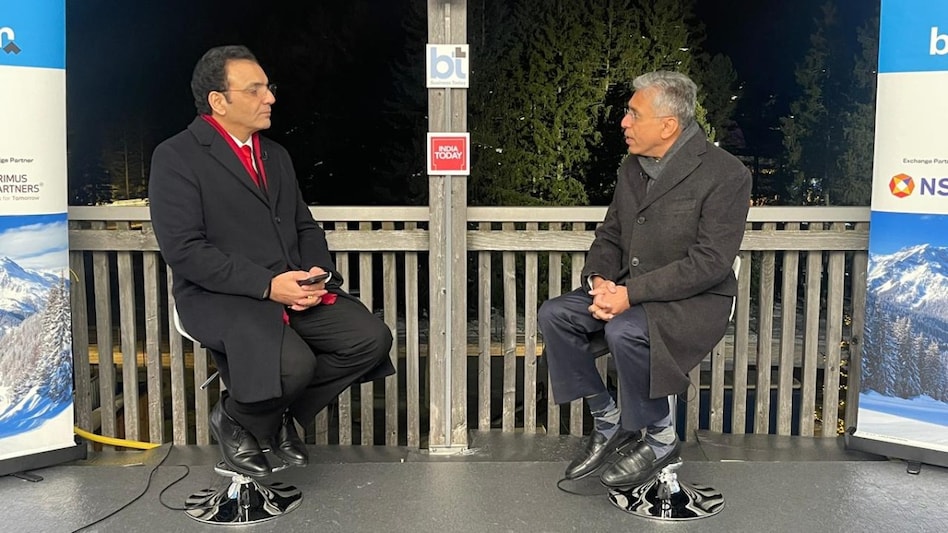
“EV charging infrastructure is required on the highways and this is where a lot of effort is going on as the government and the industry set up that infrastructure. And this will take two to three years to set up. We feel that the pickup for EVs will be good but the inflection point will come after charging infrastructure is set up in the next two years,” Shah told Business Today Group Editor Siddharth Zarabi in an interview on the sideline of World Economic Forum in Davos.
Shah said that EV charging infrastructure is not fully addressed currently. “In a city, you don’t really need it because if you are charging in a home or an office, you typically need to charge once a week,” he added.
Mahindra & Mahindra (M&M) expects EVs to account for 30% of all new car sales in the next three to four years.
“EV penetration in our SUV sales is currently at 8%. Europe is at 17%. We are eyeing 30% in the next 3-4 years,” said Shah.
The Mahindra Group CEO lauded the government for keeping incentives only for EVs and not hybrid vehicles. “The government has done the right thing. The incentivisation and focus has been on EVs and not on hybrids. Hybrid is a short-term technology. And that will frankly take away from EVs as charging infra will not come up as much,” he explained.
From a manufacturer’s standpoint, Shah said M&M can make hybrids as well, but the company’s focus has been on what it feels is a better product to address the two policy imperatives of reducing the country’s fuel import bill and cleaner air.
“I would give a lot of credit to the government for incentives they have put in for EVs, for essentially transitioning this industry. The incentives may not be required after the industry has taken off. But that was essential to give the consumer the price that was relatively on par with ICE,” said Shah.
Shah further added that Mahindra’s new EVs offer 500 kms of real-world range, taking away a lot of anxiety from customers. “We give a lifetime warranty within certain bounds. We see batteries lasting longer with the new configuration that we have,” he added.
On the benefits of artificial intelligence (AI) in manufacturing, Shah said AI has helped the automaker in enhancing quality as well as increasing factory uptime.
“We managed to increase uptime by 10-15%, especially at a time when our plants are running full and we have waitlist,” said Shah. “Productivity gains are a small part of AI. What we have seen more is in terms of quality. If we look at welding for example. With AI, there is 100% testing for the right weld and that creates a much better car. It creates a car that has less noise, offering a much better ride overall,” he explained.
The Mahindra Group chief executive does not agree with the notion that AI will cause jobs to go away. “We have seen various technologies that have caused many jobs to go away but other jobs have been created. The phone that you are holding in your hand has replaced so many gadgets and devices. There is a list of 50-70 devices that a phone has replaced. Technologies have always done that. We have to focus on reskilling. We have to make commitments that as we save in AI, we have to reskill our associates and be able to offer them role in other areas and that helps drive the growth.”
On the impact of 50 percent tariffs imposed by US president Donald Trump on Indian exports last year, Shah acknowledged that tariffs on India have impacted the automaker’s tractor business.
“From a Mahindra Group perspective, we have a tractor business in the US and that has clearly been impacted. We do have some assembly that is done in the US. I am fairly optimistic that we will get to a resolution on it. That likely would be the best answer for everyone. That would also strengthen the ties we have with the US. The India-EU FTA is around the corner. As that happens, it creates more positivity for us to close that with the US as well,” Shah said.
On his expectations from the Union Budget 2026, Shah said Budgets over the past few years have been remarkably good because they focused on the longer term. “They focused on investments and continued fiscal discipline. There is a narrative that private capex hasn’t kept pace with government capex. From our standpoint, we have quadrupled capacity in the Auto business. We have added 60% capacity for tractors. I feel that will happen. As industries get to 80-85% capacity utilization which is starting to happen now. You will see more capacity coming in.”
“From a government perspective, if we can stay the course, consistent with what we have done in the last few years, focus on capex, infrastructure creating, maintaining the fiscal discipline. We would look at that as a powerful Budget,” he added.
Electric vehicles in India will hit an inflection point in the next two years as charging infrastructure on highways expands, according to Mahindra Group managing director and CEO Anish Shah.
“EV charging infrastructure is required on the highways and this is where a lot of effort is going on as the government and the industry set up that infrastructure. And this will take two to three years to set up. We feel that the pickup for EVs will be good but the inflection point will come after charging infrastructure is set up in the next two years,” Shah told Business Today Group Editor Siddharth Zarabi in an interview on the sideline of World Economic Forum in Davos.
Shah said that EV charging infrastructure is not fully addressed currently. “In a city, you don’t really need it because if you are charging in a home or an office, you typically need to charge once a week,” he added.
Mahindra & Mahindra (M&M) expects EVs to account for 30% of all new car sales in the next three to four years.
“EV penetration in our SUV sales is currently at 8%. Europe is at 17%. We are eyeing 30% in the next 3-4 years,” said Shah.
The Mahindra Group CEO lauded the government for keeping incentives only for EVs and not hybrid vehicles. “The government has done the right thing. The incentivisation and focus has been on EVs and not on hybrids. Hybrid is a short-term technology. And that will frankly take away from EVs as charging infra will not come up as much,” he explained.
From a manufacturer’s standpoint, Shah said M&M can make hybrids as well, but the company’s focus has been on what it feels is a better product to address the two policy imperatives of reducing the country’s fuel import bill and cleaner air.
“I would give a lot of credit to the government for incentives they have put in for EVs, for essentially transitioning this industry. The incentives may not be required after the industry has taken off. But that was essential to give the consumer the price that was relatively on par with ICE,” said Shah.
Shah further added that Mahindra’s new EVs offer 500 kms of real-world range, taking away a lot of anxiety from customers. “We give a lifetime warranty within certain bounds. We see batteries lasting longer with the new configuration that we have,” he added.
On the benefits of artificial intelligence (AI) in manufacturing, Shah said AI has helped the automaker in enhancing quality as well as increasing factory uptime.
“We managed to increase uptime by 10-15%, especially at a time when our plants are running full and we have waitlist,” said Shah. “Productivity gains are a small part of AI. What we have seen more is in terms of quality. If we look at welding for example. With AI, there is 100% testing for the right weld and that creates a much better car. It creates a car that has less noise, offering a much better ride overall,” he explained.
The Mahindra Group chief executive does not agree with the notion that AI will cause jobs to go away. “We have seen various technologies that have caused many jobs to go away but other jobs have been created. The phone that you are holding in your hand has replaced so many gadgets and devices. There is a list of 50-70 devices that a phone has replaced. Technologies have always done that. We have to focus on reskilling. We have to make commitments that as we save in AI, we have to reskill our associates and be able to offer them role in other areas and that helps drive the growth.”
On the impact of 50 percent tariffs imposed by US president Donald Trump on Indian exports last year, Shah acknowledged that tariffs on India have impacted the automaker’s tractor business.
“From a Mahindra Group perspective, we have a tractor business in the US and that has clearly been impacted. We do have some assembly that is done in the US. I am fairly optimistic that we will get to a resolution on it. That likely would be the best answer for everyone. That would also strengthen the ties we have with the US. The India-EU FTA is around the corner. As that happens, it creates more positivity for us to close that with the US as well,” Shah said.
On his expectations from the Union Budget 2026, Shah said Budgets over the past few years have been remarkably good because they focused on the longer term. “They focused on investments and continued fiscal discipline. There is a narrative that private capex hasn’t kept pace with government capex. From our standpoint, we have quadrupled capacity in the Auto business. We have added 60% capacity for tractors. I feel that will happen. As industries get to 80-85% capacity utilization which is starting to happen now. You will see more capacity coming in.”
“From a government perspective, if we can stay the course, consistent with what we have done in the last few years, focus on capex, infrastructure creating, maintaining the fiscal discipline. We would look at that as a powerful Budget,” he added.