
AC politics: Europe debates using air conditioner as temperatures shoot up
Heatwave in Europe: With temperatures soaring, there has been a rush to buy portable units so children can spend a few hours in class and apartment residents can get through the night.
- Jul 1, 2026,
- Updated Jul 1, 2026 4:07 PM IST
Heatwave in Europe: Several parts of Europe saw temperatures touch 40 degree Celsius on Sunday during a heatwave that began on June 20 and has affected more than 150 million people, disrupting power generation, damaging infrastructure and putting healthcare systems under pressure. France alone reported 1,000 excess deaths during the heatwave, while the WHO said at least 1,300 excess people died across Europe.
Amid this a particular debate is taking shape: la clim aka air conditioning.
In France, where only about 25 per cent of households have an air-conditioning unit, the question of ‘la clim’ has opened a political divide. Hospitals and schools are only rarely equipped, thousands of schools have had to shut this week, and medical and nursing staff have said conditions are becoming intolerable.
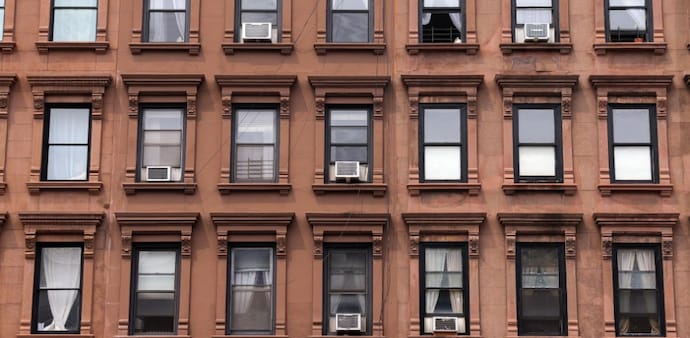
With temperatures soaring, there has been a rush to buy portable units so children can spend a few hours in class and apartment residents can get through the night.
MUST READ | Roads melt in Europe’s heatwave: Why Indian roads withstand temperatures above 50°C
WHY THE AC DEBATE?
The far-right National Rally party in France, led by Marine Le Pen, has called for a nationwide ‘plan clim’ to equip all schools and hospitals with air-conditioning. According to RN spokesman Jean-Philippe Tanguy, the plan would also include government-backed interest-free loans worth €20 billion ($22.7 billion) to allow 30 to 40 million householders to install cooling units.
Critics have described the plan as opportunistic and uncosted, and said the populist right was late to recognise the reality of climate change. In Britain, the opposition Conservatives have similarly argued for expanding domestic energy production, including fossil fuels, to meet rising electricity demand driven by cooling.
The debate in France has also shifted on the left. Marine Tondelier, head of the Ecologists party, said air-conditioning would be needed in schools and hospitals, adding: “There are places where we just can’t do without it now.” She said this meant breaking with what she called ‘anti-clim dogma’. Her position matters because the French Green movement has long seen air-conditioning as the worst possible response to climate change, arguing that it only softens the effects of global warming instead of addressing its causes.
WILL ACs ACTUALLY HELP?
Critics of widespread air-conditioning say it increases electricity demand, often leading to more fossil fuels being burned where grids are not clean, and that refrigerant gases can leak even though they are greenhouse gases. They also point to the urban heating effect caused by hot air being expelled onto the street.
Some studies cited in the debate suggest this can raise city temperatures by two or three degrees.
Across Europe, resistance to air-conditioning has been shaped by culture as well as policy. In France, air-conditioning has often been seen as garish and American, and there is a longstanding belief that too much exposure to cold air can make people ill. Many Europeans have regarded it as a luxury product. Homes with thick stone walls, wooden shutters and open windows were long seen as good architecture, making mechanical cooling appear unnecessary rather than desirable.
About a fifth of European households have air-conditioning, compared with 90 per cent or more in the United States, Japan and South Korea, said a report.
Ownership also varies sharply within Europe, with Italy, Spain and Greece far ahead of northern Europe. Italy alone accounts for more than one-third of all electricity used for air-conditioning across the 27 EU member states.
MUST READ | Heatwave in Europe: More than 1,300 excess deaths recorded since June 21
PRACTICAL REASONS
There are also practical reasons for the lower take-up. Cities in southern Europe were built to handle heat, with thick walls, shaded windows, well-ventilated streets, light-coloured facades and reflective surfaces that reduce heat absorption. Northern Europe, by contrast, built for long winters and milder summers, so many buildings were designed to trap heat.
Cost is another barrier. Electricity prices in Europe are much higher than in the United States, and the gap widened after the 2022 energy crisis triggered by Russia’s war with Ukraine. While units themselves have become more accessible, the cost of running them remains too high for many households.
The environmental argument has also shaped the continent’s wider climate policy. Policymakers and climate experts have long argued that widespread air-conditioning creates a vicious cycle by increasing electricity demand, adding waste heat outdoors and, where power still comes from fossil fuels, worsening the emissions that drive rising temperatures.
At the EU level, the European Commission has refused to take sides in the argument, saying it is not for the executive to dictate private choices. ‘We know most residential buildings and apartments in the European Union do not have air conditioning. It’s not something that is traditionally in-built, especially given that much of our housing stock is actually quite old and aged,’ said climate spokesperson Anna-Kaisa Itkonen.
DON'T MISS | Europe in record heatwave grip but EU is rewriting the future of ACs. Here's why
Heatwave in Europe: Several parts of Europe saw temperatures touch 40 degree Celsius on Sunday during a heatwave that began on June 20 and has affected more than 150 million people, disrupting power generation, damaging infrastructure and putting healthcare systems under pressure. France alone reported 1,000 excess deaths during the heatwave, while the WHO said at least 1,300 excess people died across Europe.
Amid this a particular debate is taking shape: la clim aka air conditioning.
In France, where only about 25 per cent of households have an air-conditioning unit, the question of ‘la clim’ has opened a political divide. Hospitals and schools are only rarely equipped, thousands of schools have had to shut this week, and medical and nursing staff have said conditions are becoming intolerable.
With temperatures soaring, there has been a rush to buy portable units so children can spend a few hours in class and apartment residents can get through the night.
MUST READ | Roads melt in Europe’s heatwave: Why Indian roads withstand temperatures above 50°C
WHY THE AC DEBATE?
The far-right National Rally party in France, led by Marine Le Pen, has called for a nationwide ‘plan clim’ to equip all schools and hospitals with air-conditioning. According to RN spokesman Jean-Philippe Tanguy, the plan would also include government-backed interest-free loans worth €20 billion ($22.7 billion) to allow 30 to 40 million householders to install cooling units.
Critics have described the plan as opportunistic and uncosted, and said the populist right was late to recognise the reality of climate change. In Britain, the opposition Conservatives have similarly argued for expanding domestic energy production, including fossil fuels, to meet rising electricity demand driven by cooling.
The debate in France has also shifted on the left. Marine Tondelier, head of the Ecologists party, said air-conditioning would be needed in schools and hospitals, adding: “There are places where we just can’t do without it now.” She said this meant breaking with what she called ‘anti-clim dogma’. Her position matters because the French Green movement has long seen air-conditioning as the worst possible response to climate change, arguing that it only softens the effects of global warming instead of addressing its causes.
WILL ACs ACTUALLY HELP?
Critics of widespread air-conditioning say it increases electricity demand, often leading to more fossil fuels being burned where grids are not clean, and that refrigerant gases can leak even though they are greenhouse gases. They also point to the urban heating effect caused by hot air being expelled onto the street.
Some studies cited in the debate suggest this can raise city temperatures by two or three degrees.
Across Europe, resistance to air-conditioning has been shaped by culture as well as policy. In France, air-conditioning has often been seen as garish and American, and there is a longstanding belief that too much exposure to cold air can make people ill. Many Europeans have regarded it as a luxury product. Homes with thick stone walls, wooden shutters and open windows were long seen as good architecture, making mechanical cooling appear unnecessary rather than desirable.
About a fifth of European households have air-conditioning, compared with 90 per cent or more in the United States, Japan and South Korea, said a report.
Ownership also varies sharply within Europe, with Italy, Spain and Greece far ahead of northern Europe. Italy alone accounts for more than one-third of all electricity used for air-conditioning across the 27 EU member states.
MUST READ | Heatwave in Europe: More than 1,300 excess deaths recorded since June 21
PRACTICAL REASONS
There are also practical reasons for the lower take-up. Cities in southern Europe were built to handle heat, with thick walls, shaded windows, well-ventilated streets, light-coloured facades and reflective surfaces that reduce heat absorption. Northern Europe, by contrast, built for long winters and milder summers, so many buildings were designed to trap heat.
Cost is another barrier. Electricity prices in Europe are much higher than in the United States, and the gap widened after the 2022 energy crisis triggered by Russia’s war with Ukraine. While units themselves have become more accessible, the cost of running them remains too high for many households.
The environmental argument has also shaped the continent’s wider climate policy. Policymakers and climate experts have long argued that widespread air-conditioning creates a vicious cycle by increasing electricity demand, adding waste heat outdoors and, where power still comes from fossil fuels, worsening the emissions that drive rising temperatures.
At the EU level, the European Commission has refused to take sides in the argument, saying it is not for the executive to dictate private choices. ‘We know most residential buildings and apartments in the European Union do not have air conditioning. It’s not something that is traditionally in-built, especially given that much of our housing stock is actually quite old and aged,’ said climate spokesperson Anna-Kaisa Itkonen.
DON'T MISS | Europe in record heatwave grip but EU is rewriting the future of ACs. Here's why