
BRICS challenges Western climate model: Why ‘Net Zero’ is missing from the New Delhi Declaration
The BRICS New Delhi Declaration takes a markedly different approach to climate action, placing sustainable development, equity and economic resilience ahead of a standalone Net Zero framework.
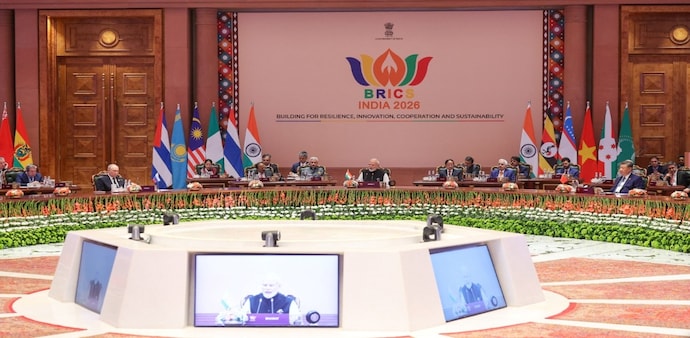
- Sep 12, 2026,
- Updated Sep 12, 2026 8:16 PM IST
The New Delhi Declaration adopted at the 18th BRICS Summit signals a distinct approach to climate policy, with the expanded grouping seeking to align decarbonisation with development priorities, energy security and economic resilience.
A notable feature of the declaration is the absence of the term “Net Zero”, a framing that has become central to climate policy discussions in Europe and other developed economies. Instead, BRICS places climate change within the broader challenge of sustainable development, linking environmental pressures with inequality, economic development and the political economy of growth.
Rathin Roy, Distinguished Professor, Kautilya School of Public Policy and Economic Advisor and Dean, GITAM School of Humanities and Social Sciences, said the distinction was significant.
“What is interesting about the declaration apart from its inordinate length is that it is profoundly multilateral. In an age when multilateralism has been actively rubbished by all the major powers,” Roy said, adding that the document argues emerging economies should have power commensurate with their economic salience in the multilateral system.
‘Sustainable development, including climate’
“On sustainable development, the line is fairly clear. All of them collectively are prioritising sustainable development. In most places, where climate change is mentioned – the word ‘including’ precedes climate change. So this is sustainable development, including climate. They are weaving in a broader lens,” Roy said.
MUST READ: BRICS New Delhi Declaration calls for dialogue and multilateralism: All that it says
Roy also pointed to the political significance of the missing Net Zero terminology.
“The favourite Euro-American phrase — Net Zero — is absent. So the framing is profoundly different from the way the Europeans framed the climate change problem,” he said.
Climate action tied to economic resilience
The declaration connects climate resilience with industrial policy, critical minerals, energy systems, supply chains, infrastructure, finance, insurance and food security. It also stresses differentiated responsibilities, national circumstances and development pathways, while calling for greater climate finance, technology transfer and capacity-building from developed economies.
This approach reflects the priorities of developing economies, where climate action is closely linked to access to energy, infrastructure investment, industrialisation and economic growth.
BRICS seeks its own energy-transition pathway
Li Shuo, Director, China Climate Hub, Asia Society Policy Institute, said BRICS was seeking to define its own energy-transition pathway.
“BRICS is determined to chart its own course on climate and energy, one that emphasizes the alignment of development and decarbonization rather than treating them as competing priorities,” he said.
ALSO READ: Xi Jinping warns against war in Middle East, Gulf, urges BRICS to stand on ‘right side of history’
The bloc’s position also retains a significant role for fossil fuels, particularly in developing economies, while supporting cooperation on smart grids, energy storage, hydrogen and solar manufacturing.
Pushback against carbon-border measures
The declaration’s opposition to carbon-border measures further underlines this approach. BRICS has opposed carbon border adjustment mechanisms that it considers unilateral, punitive, discriminatory and protectionist, arguing that such measures can undermine developing countries’ ability to adapt and develop.
The declaration therefore represents less a rejection of climate action than an attempt to redefine its terms—placing development, resilience and greater Global South policy space alongside decarbonisation.
DO READ: Xi Jinping tells Modi India, China have ‘significant responsibilities’ as Global South powers
The New Delhi Declaration adopted at the 18th BRICS Summit signals a distinct approach to climate policy, with the expanded grouping seeking to align decarbonisation with development priorities, energy security and economic resilience.
A notable feature of the declaration is the absence of the term “Net Zero”, a framing that has become central to climate policy discussions in Europe and other developed economies. Instead, BRICS places climate change within the broader challenge of sustainable development, linking environmental pressures with inequality, economic development and the political economy of growth.
Rathin Roy, Distinguished Professor, Kautilya School of Public Policy and Economic Advisor and Dean, GITAM School of Humanities and Social Sciences, said the distinction was significant.
“What is interesting about the declaration apart from its inordinate length is that it is profoundly multilateral. In an age when multilateralism has been actively rubbished by all the major powers,” Roy said, adding that the document argues emerging economies should have power commensurate with their economic salience in the multilateral system.
‘Sustainable development, including climate’
“On sustainable development, the line is fairly clear. All of them collectively are prioritising sustainable development. In most places, where climate change is mentioned – the word ‘including’ precedes climate change. So this is sustainable development, including climate. They are weaving in a broader lens,” Roy said.
MUST READ: BRICS New Delhi Declaration calls for dialogue and multilateralism: All that it says
Roy also pointed to the political significance of the missing Net Zero terminology.
“The favourite Euro-American phrase — Net Zero — is absent. So the framing is profoundly different from the way the Europeans framed the climate change problem,” he said.
Climate action tied to economic resilience
The declaration connects climate resilience with industrial policy, critical minerals, energy systems, supply chains, infrastructure, finance, insurance and food security. It also stresses differentiated responsibilities, national circumstances and development pathways, while calling for greater climate finance, technology transfer and capacity-building from developed economies.
This approach reflects the priorities of developing economies, where climate action is closely linked to access to energy, infrastructure investment, industrialisation and economic growth.
BRICS seeks its own energy-transition pathway
Li Shuo, Director, China Climate Hub, Asia Society Policy Institute, said BRICS was seeking to define its own energy-transition pathway.
“BRICS is determined to chart its own course on climate and energy, one that emphasizes the alignment of development and decarbonization rather than treating them as competing priorities,” he said.
ALSO READ: Xi Jinping warns against war in Middle East, Gulf, urges BRICS to stand on ‘right side of history’
The bloc’s position also retains a significant role for fossil fuels, particularly in developing economies, while supporting cooperation on smart grids, energy storage, hydrogen and solar manufacturing.
Pushback against carbon-border measures
The declaration’s opposition to carbon-border measures further underlines this approach. BRICS has opposed carbon border adjustment mechanisms that it considers unilateral, punitive, discriminatory and protectionist, arguing that such measures can undermine developing countries’ ability to adapt and develop.
The declaration therefore represents less a rejection of climate action than an attempt to redefine its terms—placing development, resilience and greater Global South policy space alongside decarbonisation.
DO READ: Xi Jinping tells Modi India, China have ‘significant responsibilities’ as Global South powers