
'Moment we feel...': Pak defence minister issues war threat to India over Indus waters
Speaking during an ARY News interview, Asif said the government was closely monitoring alleged violations and would consider the option of war if it found material evidence that India was moving at an “alarming speed” towards disrupting water supplies.
- Jun 20, 2026,
- Updated Jun 21, 2026 9:39 PM IST
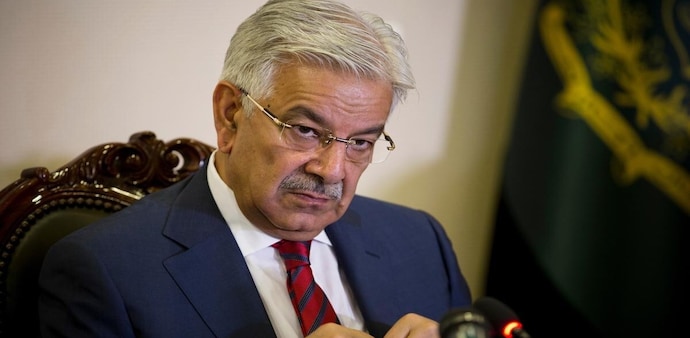
Pakistan defence minister Khawaja Asif has warned that Pakistan could consider military action against India if it concluded that its water security was under serious threat, amid growing concerns over the future flow of rivers governed by the Indus Waters Treaty.
Speaking during an ARY News interview, Asif said the government was closely monitoring alleged violations and any attempts to alter the situation on the ground.
“The moment we feel that our national security — and water is part of our national security — is being threatened, we will go to war against India. Definitely,” he said.
Asif added that Pakistan would consider the option of war if it found material evidence that India was moving at an “alarming speed” towards disrupting water supplies.
MUST READ | 'An Indian and a Pakistani': JD Vance jokes about his inner circle at US-Iran peace summit
His comments came after the programme played a clip of C R Patil, India’s water minister, claiming that the flow of Indus water to Pakistan could be stopped completely by June 2028.
The host also cited an alleged tender for a tunnel project linked to the diversion of Chenab water towards the Beas basin, as well as sediment-removal work at the Salal power station. These claims were not independently verified during the programme.
Asif said Pakistan had historically monitored Indian projects under the Indus Waters Treaty, including through physical inspections. He claimed Pakistani teams had conducted around 115 inspections to examine the height, storage capacity and other technical aspects of water infrastructure.
He, however, acknowledged that he did not have the latest information on developments over the past year.
Asif also expressed doubt over India’s ability to fully contain the Chenab, citing previous floods during which water, debris, animals and people were swept across the border. The host countered that India did not need to stop the water completely to cause damage, arguing that delayed releases could disrupt crop cycles and hurt Pakistan’s agriculture.
India’s response to the allegations and Asif’s remarks was not included in the broadcast.
In June 2025, Asif had declared the 1972 Simla Agreement “a dead document,” signaling a seismic shift in Islamabad’s posture on Kashmir during Operation Sindoor. In a blunt televised statement, Asif said Pakistan has reverted to the 1948 UN-backed stance, calling the Line of Control a ceasefire line rather than a recognised boundary.
1/3 of Pakistan faces water shortage
A crippling water shortage has gripped nearly one-third of Pakistan's population across the agricultural heartlands of Sindh and Balochistan. With downstream flows plummeting, local leaders are warning of an impending "economic massacre" as internal disputes over remaining water shares intensify across provincial borders.
The ground reality is highly visible around the Sukkur Barrage, a critical lifeline supporting millions of acres of farmland. According to data from Sindh's irrigation department, the North West Canal faces a 64.1% deficit, while the Rice Canal and Dadu Canal report shortfalls of 38% and 82%, respectively.
The crisis is heavily compounded by an escalating internal conflict between Pakistan's provinces. Sindh officials allege that upstream Punjab is illegally drawing 53,394 cusecs of water against its sanctioned allocation of 44,000 cusecs — an excess of over 21%. Similarly, the Taunsa Barrage is reportedly withdrawing 25,694 cusecs against its 24,000 cusecs limit.
Pakistan defence minister Khawaja Asif has warned that Pakistan could consider military action against India if it concluded that its water security was under serious threat, amid growing concerns over the future flow of rivers governed by the Indus Waters Treaty.
Speaking during an ARY News interview, Asif said the government was closely monitoring alleged violations and any attempts to alter the situation on the ground.
“The moment we feel that our national security — and water is part of our national security — is being threatened, we will go to war against India. Definitely,” he said.
Asif added that Pakistan would consider the option of war if it found material evidence that India was moving at an “alarming speed” towards disrupting water supplies.
MUST READ | 'An Indian and a Pakistani': JD Vance jokes about his inner circle at US-Iran peace summit
His comments came after the programme played a clip of C R Patil, India’s water minister, claiming that the flow of Indus water to Pakistan could be stopped completely by June 2028.
The host also cited an alleged tender for a tunnel project linked to the diversion of Chenab water towards the Beas basin, as well as sediment-removal work at the Salal power station. These claims were not independently verified during the programme.
Asif said Pakistan had historically monitored Indian projects under the Indus Waters Treaty, including through physical inspections. He claimed Pakistani teams had conducted around 115 inspections to examine the height, storage capacity and other technical aspects of water infrastructure.
He, however, acknowledged that he did not have the latest information on developments over the past year.
Asif also expressed doubt over India’s ability to fully contain the Chenab, citing previous floods during which water, debris, animals and people were swept across the border. The host countered that India did not need to stop the water completely to cause damage, arguing that delayed releases could disrupt crop cycles and hurt Pakistan’s agriculture.
India’s response to the allegations and Asif’s remarks was not included in the broadcast.
In June 2025, Asif had declared the 1972 Simla Agreement “a dead document,” signaling a seismic shift in Islamabad’s posture on Kashmir during Operation Sindoor. In a blunt televised statement, Asif said Pakistan has reverted to the 1948 UN-backed stance, calling the Line of Control a ceasefire line rather than a recognised boundary.
1/3 of Pakistan faces water shortage
A crippling water shortage has gripped nearly one-third of Pakistan's population across the agricultural heartlands of Sindh and Balochistan. With downstream flows plummeting, local leaders are warning of an impending "economic massacre" as internal disputes over remaining water shares intensify across provincial borders.
The ground reality is highly visible around the Sukkur Barrage, a critical lifeline supporting millions of acres of farmland. According to data from Sindh's irrigation department, the North West Canal faces a 64.1% deficit, while the Rice Canal and Dadu Canal report shortfalls of 38% and 82%, respectively.
The crisis is heavily compounded by an escalating internal conflict between Pakistan's provinces. Sindh officials allege that upstream Punjab is illegally drawing 53,394 cusecs of water against its sanctioned allocation of 44,000 cusecs — an excess of over 21%. Similarly, the Taunsa Barrage is reportedly withdrawing 25,694 cusecs against its 24,000 cusecs limit.