
Only 54 km at its narrowest, 20 million barrels per day: The Strait of Hormuz’s incomputable significance
Strait of Hormuz disruption: A closure of the strait could create havoc for global energy as this would strand LNG exports from Qatar and UAE – together representing almost 20 per cent of the global LNG exports.
- Mar 13, 2026,
- Updated Mar 13, 2026 1:08 PM IST
US-Israel-Iran war: The disruption at the Strait of Hormuz in the wake of the Iran war has sent the global energy ecosystem into a tailspin. It has pushed up fuel prices while squeezing supply. Perhaps, the narrow passageway is the most coveted corner of the Earth now with the US, Israel, and Iran – all seeking to seize control.
But why is the Strait of Hormuz so important? The Iran war has dramatically underscored its significance, making details of its traffic and routes readily available. Still the small stretch – it is a strait afterall – is incomputably crucial.
First, its proportions.
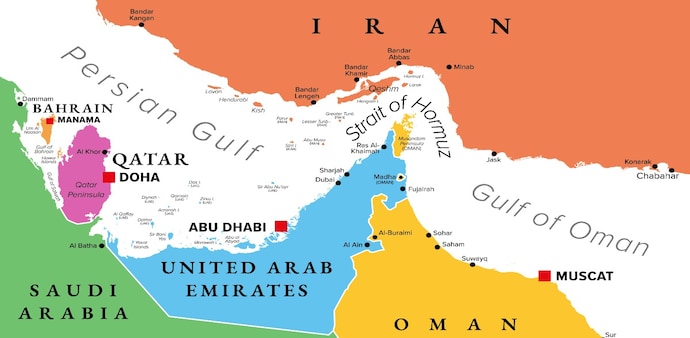
The narrow passage separates the Arabian Peninsula and Iran, and connects the Persian Gulf with the Gulf of Oman and the Arabian Sea. According to the International Energy Agency (IEA), the Strait of Hormuz only measures 54 km in width at its narrowest point. It consists of 3.7-km navigable channels for inbound and outbound shipping, apart from a 3.7-km wide buffer zone.
An average of 20 million barrels per day (mb/d) of crude oil and oil products were shipped in 2025 – making it one of the most critical transit chokepoints. Around 25 per cent of the world’s seaborne oil trade transits through the strait.
The lack of alternatives makes it all the more important.
This indicates that a closure of the strait could create havoc for global energy as this would strand LNG exports from Qatar and UAE – together representing almost 20 per cent of the global LNG exports.
So, what passes through the Strait of Hormuz? Primarily oil and natural gas.
The strait is the primary export route for oil produced in Saudi Arabia, the UAE, Kuwait, Qatar, Iraq, Bahrain and Iran, said IEA. The bulk of the oil leaving the strait heads to China, India, and Japan, as well as other Asian countries.
To put it in perspective, in 2025, nearly 15 million barrels per day of crude oil, accounting for about 34 per cent of global trade, passed through the Strait of Hormuz. Most of these exports were destined for Asia, with China and India together receiving 44 per cent of the oil.
Countries in the IEA imported around 29 per cent of the oil passing through the Strait, with Japan and Korea particularly dependent on these supplies. Only 4 per cent of the region's crude oil exports, approximately 600,000 barrels per day, went to Europe, said IEA.
Total oil exports via the strait reached close to 20 million barrels per day in 2025. Additionally, about 5 million barrels per day of oil products were exported through this route, mostly heading to Asia.
And then there is Qatar and the UAE that rely on the Strait of Hormuz for their liquefied natural gas exports. In 2025, Qatar was the world's second largest LNG exporter, with over 112 billion cubic metres exported, while the UAE exported 7 billion cubic metres. Together, they supplied almost 7 billion cubic metres of LNG to Kuwait. Nearly all LNG exports from these countries, except those destined for Kuwait, passed through the Strait, representing about 20 per cent of global LNG trade, said IEA.
Asian markets were the main destination for Qatari and Emirati LNG. In 2025, almost 90 per cent of LNG volumes exported via the Strait went to Asia, with just over 10 per cent supplied to Europe. LNG transported through the Strait accounted for about 27 per cent of Asia's total LNG imports and around 7 per cent of Europe's LNG inflows.
Are there any alternatives?
Alternative export routes for crude oil are limited, while there are no alternative routes for natural gas exports from Qatar or the UAE to the global LNG market beyond existing LNG liquefaction facilities.
Saudi Arabia and the UAE are the only countries with operational pipelines that bypass the Strait of Hormuz, offering an estimated capacity of 3.5 to 5.5 million barrels per day. Although some additional capacity exists in major pipelines, the logistics and supply chains required to reroute significant oil flows remain largely untested.
Qatar supplies piped gas to the UAE and Oman through the Dolphin pipeline, which carried almost 20.5 billion cubic metres in 2025, but this pipeline has limited spare capacity, said IEA. Oman's LNG export terminals operated near full capacity.
US-Israel-Iran war: The disruption at the Strait of Hormuz in the wake of the Iran war has sent the global energy ecosystem into a tailspin. It has pushed up fuel prices while squeezing supply. Perhaps, the narrow passageway is the most coveted corner of the Earth now with the US, Israel, and Iran – all seeking to seize control.
But why is the Strait of Hormuz so important? The Iran war has dramatically underscored its significance, making details of its traffic and routes readily available. Still the small stretch – it is a strait afterall – is incomputably crucial.
First, its proportions.
The narrow passage separates the Arabian Peninsula and Iran, and connects the Persian Gulf with the Gulf of Oman and the Arabian Sea. According to the International Energy Agency (IEA), the Strait of Hormuz only measures 54 km in width at its narrowest point. It consists of 3.7-km navigable channels for inbound and outbound shipping, apart from a 3.7-km wide buffer zone.
An average of 20 million barrels per day (mb/d) of crude oil and oil products were shipped in 2025 – making it one of the most critical transit chokepoints. Around 25 per cent of the world’s seaborne oil trade transits through the strait.
The lack of alternatives makes it all the more important.
This indicates that a closure of the strait could create havoc for global energy as this would strand LNG exports from Qatar and UAE – together representing almost 20 per cent of the global LNG exports.
So, what passes through the Strait of Hormuz? Primarily oil and natural gas.
The strait is the primary export route for oil produced in Saudi Arabia, the UAE, Kuwait, Qatar, Iraq, Bahrain and Iran, said IEA. The bulk of the oil leaving the strait heads to China, India, and Japan, as well as other Asian countries.
To put it in perspective, in 2025, nearly 15 million barrels per day of crude oil, accounting for about 34 per cent of global trade, passed through the Strait of Hormuz. Most of these exports were destined for Asia, with China and India together receiving 44 per cent of the oil.
Countries in the IEA imported around 29 per cent of the oil passing through the Strait, with Japan and Korea particularly dependent on these supplies. Only 4 per cent of the region's crude oil exports, approximately 600,000 barrels per day, went to Europe, said IEA.
Total oil exports via the strait reached close to 20 million barrels per day in 2025. Additionally, about 5 million barrels per day of oil products were exported through this route, mostly heading to Asia.
And then there is Qatar and the UAE that rely on the Strait of Hormuz for their liquefied natural gas exports. In 2025, Qatar was the world's second largest LNG exporter, with over 112 billion cubic metres exported, while the UAE exported 7 billion cubic metres. Together, they supplied almost 7 billion cubic metres of LNG to Kuwait. Nearly all LNG exports from these countries, except those destined for Kuwait, passed through the Strait, representing about 20 per cent of global LNG trade, said IEA.
Asian markets were the main destination for Qatari and Emirati LNG. In 2025, almost 90 per cent of LNG volumes exported via the Strait went to Asia, with just over 10 per cent supplied to Europe. LNG transported through the Strait accounted for about 27 per cent of Asia's total LNG imports and around 7 per cent of Europe's LNG inflows.
Are there any alternatives?
Alternative export routes for crude oil are limited, while there are no alternative routes for natural gas exports from Qatar or the UAE to the global LNG market beyond existing LNG liquefaction facilities.
Saudi Arabia and the UAE are the only countries with operational pipelines that bypass the Strait of Hormuz, offering an estimated capacity of 3.5 to 5.5 million barrels per day. Although some additional capacity exists in major pipelines, the logistics and supply chains required to reroute significant oil flows remain largely untested.
Qatar supplies piped gas to the UAE and Oman through the Dolphin pipeline, which carried almost 20.5 billion cubic metres in 2025, but this pipeline has limited spare capacity, said IEA. Oman's LNG export terminals operated near full capacity.