
Pakistan’s crypto push: Decoding the USD1 stablecoin deal linked to Donald Trump’s family
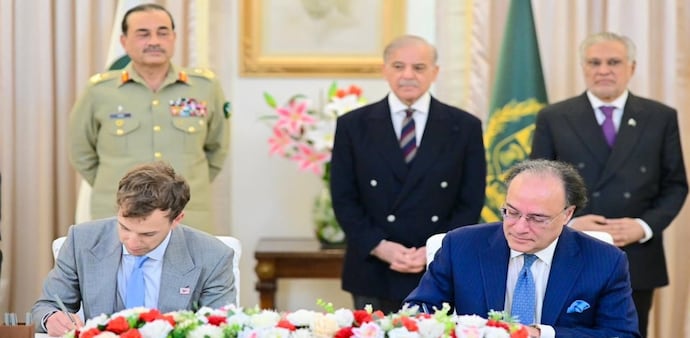
On January 14, Pakistan’s Virtual Asset Regulatory Authority (PVARA) announced that it had signed a memorandum of understanding (MoU) with SC Financial Technologies, described as an affiliated entity of World Liberty Financial.
- Jan 15, 2026,
- Updated Jan 16, 2026 11:20 AM IST
Pakistan has signed a preliminary agreement with a firm affiliated to World Liberty Financial, a cryptocurrency venture linked to US President Donald Trump’s family, to explore the use of its USD1 stablecoin for cross-border payments. The move highlights Islamabad’s growing interest in digital finance as it seeks faster, cheaper alternatives to traditional remittance systems — but it also raises questions around regulation, governance and political optics.
On January 14, Pakistan’s Virtual Asset Regulatory Authority (PVARA) announced that it had signed a memorandum of understanding (MoU) with SC Financial Technologies, described as an affiliated entity of World Liberty Financial. The agreement is aimed at enabling technical discussions and experimentation around emerging digital payment systems, particularly the use of stablecoins for cross-border transactions.
Under the MoU, SC Financial Technologies will work with Pakistan’s central bank to explore integrating World Liberty’s USD1 stablecoin into a regulated digital payments framework. According to a source familiar with the deal, the idea is for the token to operate alongside Pakistan’s own digital currency infrastructure rather than replacing it.
The announcement coincided with a visit to Pakistan by World Liberty co-founder and CEO Zach Witkoff, whose father, Steve Witkoff, currently serves as a US special envoy. World Liberty’s founding team also includes Donald Trump Jr and Eric Trump.
Why is Pakistan interested in stablecoins?
Pakistan is one of the world’s largest recipients of remittances, with annual inflows exceeding $36 billion. Cross-border transfers, however, remain costly and slow, often routed through multiple intermediaries. Stablecoins — cryptocurrencies pegged to traditional assets such as the US dollar — promise near-instant settlement and lower transaction costs.
PVARA estimates that Pakistan already has around 40 million crypto users and annual crypto trading volumes of up to $300 billion. The government is also preparing legislation to regulate virtual assets and plans to launch a pilot for a central bank digital currency (CBDC).
Against this backdrop, officials see stablecoins as a potential bridge between the traditional financial system and emerging digital payment rails, particularly for remittances and trade settlements.
What exactly are stablecoins?
Stablecoins are cryptocurrencies whose value is pegged to an underlying asset, most commonly fiat currencies like the US dollar. This peg is designed to reduce the extreme price volatility seen in assets such as Bitcoin and Ethereum.
They are widely used by crypto investors to move funds quickly, park profits without converting back into fiat currency, and execute cross-border transfers without relying on banks or clearing houses. Ownership and transactions are recorded on digital ledgers, cutting processing times and costs.
Global usage of stablecoins surged in 2025. According to Artemis Analytics, stablecoin transaction volumes rose 72% to $33 trillion last year, while Bloomberg Intelligence projects total payment flows could reach $56 trillion by 2030 — despite repeated warnings from the International Monetary Fund about financial stability risks.
Who is behind World Liberty Financial?
World Liberty Financial was founded in September 2024 by Donald Trump and Steve Witkoff, along with their sons and other partners, during Trump’s presidential campaign. Since Trump assumed office, both he and Witkoff have stepped back from day-to-day operations and are now listed as “Cofounders Emeritus”.
Operational control rests with Donald Trump Jr., Eric Trump and Zach Witkoff. However, a Trump-owned business entity reportedly holds a 60% stake in the firm and receives 75% of revenues from coin sales.
World Liberty and related Trump family crypto ventures have earned an estimated $1 billion in pre-tax profits over the past year, according to the Financial Times.
What products has World Liberty launched?
So far, World Liberty has rolled out three major crypto products:
- $WLFI, a cryptocurrency launched in October 2024
- $TRUMP and $MELANIA memecoins, launched in December 2024, which generated $427 million in sales and trading fees
- USD1, a dollar-pegged stablecoin launched in March 2025 and backed by US Treasury notes and similar securities
As of January 14, USD1 had a market capitalisation of $3.42 billion, still far smaller than market leader Tether’s USDT, which has $187 billion in circulation.
Trump himself disclosed earnings of $57.3 million from World Liberty in 2024, with filings expected to show a further increase reflecting profits from USD1.
Why is the deal controversial?
The Pakistan agreement comes amid heightened scrutiny of Trump’s dual role as president and crypto promoter. Since returning to office, Trump has reversed Biden-era restrictions on digital assets, actively promoted crypto investment from the White House, and signed legislation such as the GENIUS Act to regulate stablecoins in the US.
Critics argue that World Liberty’s global expansion blurs the line between public policy and private profit, especially as the firm remains majority-owned by Trump-linked entities. Stablecoins themselves have also been flagged by regulators for potential links to illicit finance and insufficient transparency, even as governments explore regulated use cases.
The MoU does not commit Pakistan to adopting USD1 but opens the door for technical pilots and regulatory discussions. Any large-scale deployment would require approval from Pakistan’s central bank and alignment with forthcoming virtual asset legislation.
Pakistan has signed a preliminary agreement with a firm affiliated to World Liberty Financial, a cryptocurrency venture linked to US President Donald Trump’s family, to explore the use of its USD1 stablecoin for cross-border payments. The move highlights Islamabad’s growing interest in digital finance as it seeks faster, cheaper alternatives to traditional remittance systems — but it also raises questions around regulation, governance and political optics.
On January 14, Pakistan’s Virtual Asset Regulatory Authority (PVARA) announced that it had signed a memorandum of understanding (MoU) with SC Financial Technologies, described as an affiliated entity of World Liberty Financial. The agreement is aimed at enabling technical discussions and experimentation around emerging digital payment systems, particularly the use of stablecoins for cross-border transactions.
Under the MoU, SC Financial Technologies will work with Pakistan’s central bank to explore integrating World Liberty’s USD1 stablecoin into a regulated digital payments framework. According to a source familiar with the deal, the idea is for the token to operate alongside Pakistan’s own digital currency infrastructure rather than replacing it.
The announcement coincided with a visit to Pakistan by World Liberty co-founder and CEO Zach Witkoff, whose father, Steve Witkoff, currently serves as a US special envoy. World Liberty’s founding team also includes Donald Trump Jr and Eric Trump.
Why is Pakistan interested in stablecoins?
Pakistan is one of the world’s largest recipients of remittances, with annual inflows exceeding $36 billion. Cross-border transfers, however, remain costly and slow, often routed through multiple intermediaries. Stablecoins — cryptocurrencies pegged to traditional assets such as the US dollar — promise near-instant settlement and lower transaction costs.
PVARA estimates that Pakistan already has around 40 million crypto users and annual crypto trading volumes of up to $300 billion. The government is also preparing legislation to regulate virtual assets and plans to launch a pilot for a central bank digital currency (CBDC).
Against this backdrop, officials see stablecoins as a potential bridge between the traditional financial system and emerging digital payment rails, particularly for remittances and trade settlements.
What exactly are stablecoins?
Stablecoins are cryptocurrencies whose value is pegged to an underlying asset, most commonly fiat currencies like the US dollar. This peg is designed to reduce the extreme price volatility seen in assets such as Bitcoin and Ethereum.
They are widely used by crypto investors to move funds quickly, park profits without converting back into fiat currency, and execute cross-border transfers without relying on banks or clearing houses. Ownership and transactions are recorded on digital ledgers, cutting processing times and costs.
Global usage of stablecoins surged in 2025. According to Artemis Analytics, stablecoin transaction volumes rose 72% to $33 trillion last year, while Bloomberg Intelligence projects total payment flows could reach $56 trillion by 2030 — despite repeated warnings from the International Monetary Fund about financial stability risks.
Who is behind World Liberty Financial?
World Liberty Financial was founded in September 2024 by Donald Trump and Steve Witkoff, along with their sons and other partners, during Trump’s presidential campaign. Since Trump assumed office, both he and Witkoff have stepped back from day-to-day operations and are now listed as “Cofounders Emeritus”.
Operational control rests with Donald Trump Jr., Eric Trump and Zach Witkoff. However, a Trump-owned business entity reportedly holds a 60% stake in the firm and receives 75% of revenues from coin sales.
World Liberty and related Trump family crypto ventures have earned an estimated $1 billion in pre-tax profits over the past year, according to the Financial Times.
What products has World Liberty launched?
So far, World Liberty has rolled out three major crypto products:
- $WLFI, a cryptocurrency launched in October 2024
- $TRUMP and $MELANIA memecoins, launched in December 2024, which generated $427 million in sales and trading fees
- USD1, a dollar-pegged stablecoin launched in March 2025 and backed by US Treasury notes and similar securities
As of January 14, USD1 had a market capitalisation of $3.42 billion, still far smaller than market leader Tether’s USDT, which has $187 billion in circulation.
Trump himself disclosed earnings of $57.3 million from World Liberty in 2024, with filings expected to show a further increase reflecting profits from USD1.
Why is the deal controversial?
The Pakistan agreement comes amid heightened scrutiny of Trump’s dual role as president and crypto promoter. Since returning to office, Trump has reversed Biden-era restrictions on digital assets, actively promoted crypto investment from the White House, and signed legislation such as the GENIUS Act to regulate stablecoins in the US.
Critics argue that World Liberty’s global expansion blurs the line between public policy and private profit, especially as the firm remains majority-owned by Trump-linked entities. Stablecoins themselves have also been flagged by regulators for potential links to illicit finance and insufficient transparency, even as governments explore regulated use cases.
The MoU does not commit Pakistan to adopting USD1 but opens the door for technical pilots and regulatory discussions. Any large-scale deployment would require approval from Pakistan’s central bank and alignment with forthcoming virtual asset legislation.