
Saudi Arabia's huge mineral discovery: 110 million tonnes of rare earth, uranium-rich ore found in Madinah
Saudi Arabia has long been one of the world's leading oil economies. For the kingdom, crude exports have played a central role in government revenues, exports, and economic activity
- Sep 14, 2026,
- Updated Sep 14, 2026 9:53 PM IST
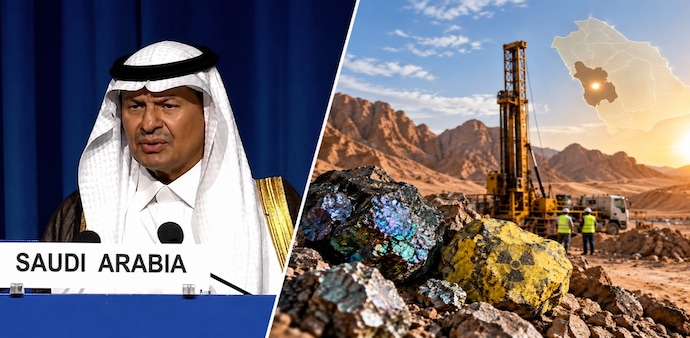
Saudi Arabia has discovered an estimated 110 million tonnes of ore containing high concentrations of rare earth minerals and promising concentrations of uranium in the Madinah region, Arab News reported on Monday.
The discovery was announced by Energy Minister Prince Abdulaziz bin Salman at the 70th Regular Session of the International Atomic Energy Agency General Conference.
The resources were identified through exploration and geological studies at the Jabal Sayid project in Madinah, according to the report.
"Exploration and geological studies at the Jabal Sayid project in Madinah have revealed estimated resources of around 110 million tonnes of ore with high concentrations of rare earth minerals, especially the heavy elements, alongside promising concentrations of uranium," Prince Abdulaziz said.
Don't Miss: BRICS Summit 2026: PM Modi warns against turning critical supply chains into geopolitical tools
Saudi Arabia has long been one of the world's leading oil economies. For the kingdom, crude exports have played a central role in government revenues, exports, and economic activity. The kingdom is the largest oil producer in OPEC and holds some of the world's biggest proven crude oil reserves.
In recent years, however, Riyadh has been pushing to reduce its dependence on hydrocarbons under Vision 2030. Riyadh has expanded investment in mining, tourism, manufacturing, technology, and renewable energy.
China Leads Rare Earth Reserves
The discovery could add to Saudi Arabia's mineral resource base at a time when rare earth elements have become strategically important.
According to the US Geological Survey's Mineral Commodity Summaries 2026, China has the world's largest identified rare earth reserves. Its reserves are estimated at about 44 million metric tonnes of rare earth oxide equivalent, or roughly 40% of the global total.
In Case You Missed It: India expected to become self-sufficient in metals: Vedanta Group Founder Anil Agarwal
Australia Leads Uranium Resources
Australia has the world's largest identified recoverable uranium resources, accounting for about 28% of the global total, according to the OECD Nuclear Energy Agency and the IAEA's Uranium 2024 report.
Australia has about 1.67 million tonnes of uranium resources, followed by Kazakhstan with about 814,000 tonnes and Canada with 582,000 tonnes.
Other countries with substantial uranium resources include Namibia, Russia, Niger, South Africa, and China. Namibia has about 498,000 tonnes, Russia 477,000 tonnes, Niger 336,000 tonnes, South Africa 321,000 tonnes, and China about 271,000 tonnes.
Saudi Arabia has discovered an estimated 110 million tonnes of ore containing high concentrations of rare earth minerals and promising concentrations of uranium in the Madinah region, Arab News reported on Monday.
The discovery was announced by Energy Minister Prince Abdulaziz bin Salman at the 70th Regular Session of the International Atomic Energy Agency General Conference.
The resources were identified through exploration and geological studies at the Jabal Sayid project in Madinah, according to the report.
"Exploration and geological studies at the Jabal Sayid project in Madinah have revealed estimated resources of around 110 million tonnes of ore with high concentrations of rare earth minerals, especially the heavy elements, alongside promising concentrations of uranium," Prince Abdulaziz said.
Don't Miss: BRICS Summit 2026: PM Modi warns against turning critical supply chains into geopolitical tools
Saudi Arabia has long been one of the world's leading oil economies. For the kingdom, crude exports have played a central role in government revenues, exports, and economic activity. The kingdom is the largest oil producer in OPEC and holds some of the world's biggest proven crude oil reserves.
In recent years, however, Riyadh has been pushing to reduce its dependence on hydrocarbons under Vision 2030. Riyadh has expanded investment in mining, tourism, manufacturing, technology, and renewable energy.
China Leads Rare Earth Reserves
The discovery could add to Saudi Arabia's mineral resource base at a time when rare earth elements have become strategically important.
According to the US Geological Survey's Mineral Commodity Summaries 2026, China has the world's largest identified rare earth reserves. Its reserves are estimated at about 44 million metric tonnes of rare earth oxide equivalent, or roughly 40% of the global total.
In Case You Missed It: India expected to become self-sufficient in metals: Vedanta Group Founder Anil Agarwal
Australia Leads Uranium Resources
Australia has the world's largest identified recoverable uranium resources, accounting for about 28% of the global total, according to the OECD Nuclear Energy Agency and the IAEA's Uranium 2024 report.
Australia has about 1.67 million tonnes of uranium resources, followed by Kazakhstan with about 814,000 tonnes and Canada with 582,000 tonnes.
Other countries with substantial uranium resources include Namibia, Russia, Niger, South Africa, and China. Namibia has about 498,000 tonnes, Russia 477,000 tonnes, Niger 336,000 tonnes, South Africa 321,000 tonnes, and China about 271,000 tonnes.