
Unprecedented scenes: Thousands of migrants break through border to enter Spain’s Ceuta
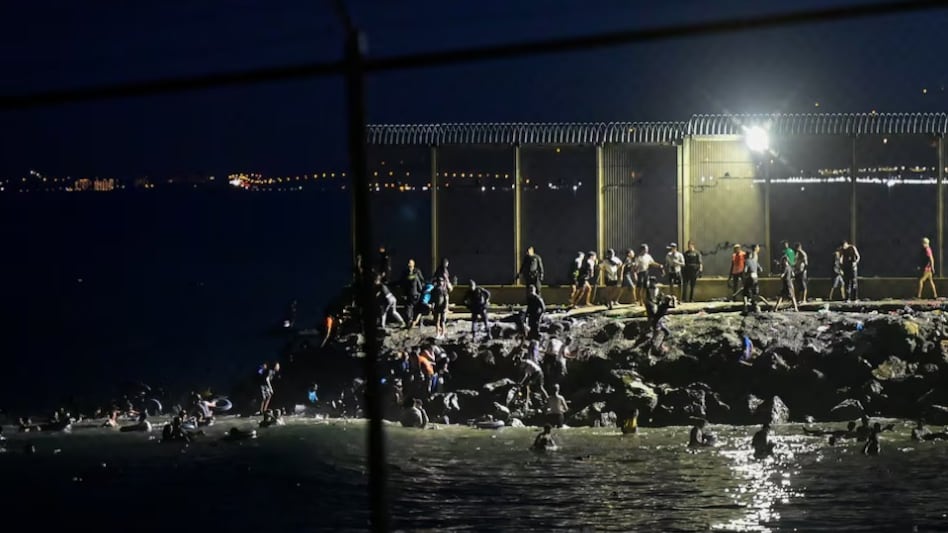
Video footage showed hundreds of migrants swimming or using inner tubes to cross from the Moroccan side, while others broke through a land border gate and ran into the city.
- Jul 31, 2026,
- Updated Jul 31, 2026 10:52 AM IST
Chaotic scenes unfolded in Spain’s North African enclave of Ceuta after 2,000-3,000 migrants crossed from Morocco by land and sea on Thursday in what state broadcaster TVE said has overwhelmed local authorities and prompted concerns over border security.
The Spanish government said the Armed Forces would assist the Civil Guard in maintaining security in Ceuta, while Prime Minister Pedro Sanchez and Interior Minister Fernando Grande-Marlaska were scheduled to visit the enclave on Friday. Local authorities said nine bodies were found during the chaos.
Video footage showed hundreds of migrants swimming or using inner tubes to cross from the Moroccan side, while others broke through a land border gate and ran into the city. The surge also spread towards Melilla, Spain's second autonomous city in North Africa, where local media and human rights groups reported clashes at the Beni Ansar border crossing as authorities attempted to stop further entries.
In the Moroccan border town of Fnideq, witnesses told Reuters that Moroccan authorities used water cannons to deter people from crossing. Migrant Jadid Zacaria, who had just reached Ceuta, said the crossing was difficult but that determination had carried them through. Some migrants shouted "Long live Spain" and "Viva Espana!" after entering the enclave.
Rachid Sbihi, head of the association representing Civil Guard officers policing the Ceuta border, described the situation as "absolute chaos" and said the border had "totally collapsed". Achraf Maimouni of the Moroccan Association for Human Rights called the situation "exceptional" and said the Tarajal border had been opened under unusual circumstances.
Most of those crossing appeared to be young men, although families with women and children were also among the arrivals. Authorities said reception centres had been overwhelmed, with hundreds of migrants sleeping on the streets after more than 1,500 people entered Ceuta during the past week.
Spain's Interior Ministry said 200 specialised police officers and 60 troops had arrived from mainland Spain to reinforce local security forces. However, it rejected calls from Ceuta's regional government to declare a national emergency, saying migration flows are not legally classified as a national security risk.
DON'T MISS | Major blow to Trump: US court strikes down asylum ban. What it means for migrants
The ministry said it was working closely with Morocco, whose police were stopping numerous attempted crossings, and that both countries had agreed to cooperate on the return of those who entered Ceuta illegally as soon as possible.
Spanish authorities linked the increase in arrivals to a recent Supreme Court ruling that barred the immediate return, without due process, of migrants intercepted at sea while attempting to reach Ceuta or Melilla. The government argued the surge had been fuelled by criminal networks exploiting the ruling rather than by Spain's programme to regularise around 500,000 undocumented migrants.
The latest crossings recalled the May 2021 border crisis, when thousands of migrants entered Ceuta over two days, highlighting renewed pressure on the European Union's only land borders with Africa.
Chaotic scenes unfolded in Spain’s North African enclave of Ceuta after 2,000-3,000 migrants crossed from Morocco by land and sea on Thursday in what state broadcaster TVE said has overwhelmed local authorities and prompted concerns over border security.
The Spanish government said the Armed Forces would assist the Civil Guard in maintaining security in Ceuta, while Prime Minister Pedro Sanchez and Interior Minister Fernando Grande-Marlaska were scheduled to visit the enclave on Friday. Local authorities said nine bodies were found during the chaos.
Video footage showed hundreds of migrants swimming or using inner tubes to cross from the Moroccan side, while others broke through a land border gate and ran into the city. The surge also spread towards Melilla, Spain's second autonomous city in North Africa, where local media and human rights groups reported clashes at the Beni Ansar border crossing as authorities attempted to stop further entries.
In the Moroccan border town of Fnideq, witnesses told Reuters that Moroccan authorities used water cannons to deter people from crossing. Migrant Jadid Zacaria, who had just reached Ceuta, said the crossing was difficult but that determination had carried them through. Some migrants shouted "Long live Spain" and "Viva Espana!" after entering the enclave.
Rachid Sbihi, head of the association representing Civil Guard officers policing the Ceuta border, described the situation as "absolute chaos" and said the border had "totally collapsed". Achraf Maimouni of the Moroccan Association for Human Rights called the situation "exceptional" and said the Tarajal border had been opened under unusual circumstances.
Most of those crossing appeared to be young men, although families with women and children were also among the arrivals. Authorities said reception centres had been overwhelmed, with hundreds of migrants sleeping on the streets after more than 1,500 people entered Ceuta during the past week.
Spain's Interior Ministry said 200 specialised police officers and 60 troops had arrived from mainland Spain to reinforce local security forces. However, it rejected calls from Ceuta's regional government to declare a national emergency, saying migration flows are not legally classified as a national security risk.
DON'T MISS | Major blow to Trump: US court strikes down asylum ban. What it means for migrants
The ministry said it was working closely with Morocco, whose police were stopping numerous attempted crossings, and that both countries had agreed to cooperate on the return of those who entered Ceuta illegally as soon as possible.
Spanish authorities linked the increase in arrivals to a recent Supreme Court ruling that barred the immediate return, without due process, of migrants intercepted at sea while attempting to reach Ceuta or Melilla. The government argued the surge had been fuelled by criminal networks exploiting the ruling rather than by Spain's programme to regularise around 500,000 undocumented migrants.
The latest crossings recalled the May 2021 border crisis, when thousands of migrants entered Ceuta over two days, highlighting renewed pressure on the European Union's only land borders with Africa.